
Displaying items by tag: Hans Christian Andersen
Finding Light in Winter: The Snow Queen at The Den Theatre
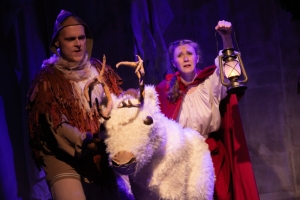
First published by Hans Christian Andersen in 1844, The Snow Queen has captivated readers for nearly two centuries. Now, The Impostors Theatre Company brings the cherished fairy tale to life at The Den Theatre, reimagining the story as a theatrical adventure that blends wonder, danger, and the enduring power of friendship.
At the heart of the story are Gerda and Kay, two close friends whose lives are upended when a shard of an enchanted mirror becomes lodged in Kay's eye and heart, distorting his perception of the world and leaving him vulnerable to the influence of the mysterious Snow Queen. Drawn away to her frozen realm, Kay vanishes into a kingdom of ice and solitude. Refusing to abandon him, Gerda embarks on a perilous quest to bring him home, navigating a series of magical encounters that test her courage, resilience, and unwavering devotion to her friend.
The shattered magic mirror in The Snow Queen scatters countless shards across the world, infecting humanity one fragment at a time. Even the smallest speck can transform the sunniest disposition into one clouded by despair, not merely pessimism. When a shard pierces the heart or eye, every good thing suddenly appears bad, close friends seem like enemies, and life becomes a perpetual half-empty glass. For Gerda, time is of the essence, as Kay's infection deepens with each passing day, threatening to permanently sever his connection to the people and world he once loved.
The mirror shards can also serve as a compelling metaphor for what has been recognized since the 1980s as Seasonal Affective Disorder (SAD), the very real form of depression often triggered by long winters and a lack of warmth and sunlight, something I personally identify with. As the Snow Queen's seemingly endless winter tightens its grip on the world, joy, hope, and bonds of friendship slowly fade. It's a theme that resonates deeply with me, capturing the emotional weight that darker, colder months can bring and reminding us how essential warmth, light, and companionship are to our well-being.
Another theme here is the avoidant male struggle with a depressed ego and the difficulty of expressing love for his best friend. In this story, it is the boy, not the girl, who is pierced by the negative energy of the Snow Queen and finds himself unable to escape the freezing grasp of numbness and despair. As the infection worsens, Kay becomes increasingly disconnected from the love and joy that once defined him. His journey becomes a battle not only against the Snow Queen's influence, but against his own fading ability to recognize and hold onto the emotional connections that matter most. Ultimately, The Snow Queen is a timeless tale about love, resilience, and the comfort of human connection triumphing over fear, isolation, and despair.
At the center of The Snow Queen are Shannon McEldowney as the determined Gerda and Cee Scallen as the conflicted Kay. Gerda's quest drives the narrative, making McEldowney the emotional anchor of the production, while Scallen's portrayal of Kay charts the character's transformation from devoted friend to a boy caught under a dangerous spell. McEldowney brings heart and determination to Gerda, while Scallen effectively captures Kay's gradual emotional withdrawal. Supporting them is a versatile ensemble of storytellers who bring Gerda's fantastical world to life, including Courtney Marie as the enigmatic Snow Queen, whose imposing and mysterious presence looms over the adventure even when she is not on stage, alongside Hilary Sanzel as the Raven, Bryson David Hoff as the Reindeer, Mara Currens as the Robber Girl, JA Loyd as the Old Woman, Mab De Guzman as the Sprite, Mary Ross as Grandma, and Eilish Morse-O'Rourke as Mother. Together, they embody the colorful characters, guides, and adversaries Gerda encounters along her quest through Andersen's enchanted landscape.

Cee Scallen as Kay (left) with Eilish Morse-O'Rourke as Mother. Photo by Kyle Smart.
Playwright Mallory Swisher, a founding member of The Impostors Theatre Company, adapts Hans Christian Andersen's classic tale under the skilled direction of ITC artistic director Stefan Roseen, a Jeff Award-winning director, with Anna Roemer, the company's resident choreographer and co-founder of Schoolhouse Shakespeare Company, serving as co-director and choreographer. Roseen also serves as Scenic and Sound Designer.
The production also benefits from the wonderfully inventive work of Kimzyn Campbell (Puppet Director), Jackie Bobbit (Props Designer/Puppet Assistant), and Jessica Dommer (Puppet Designer/Props Assistant). Their imaginative use of puppets and props brings Andersen's fantastical world to life in unexpected ways, encouraging audiences to fill in the gaps with their own imagination and proving that creativity can be every bit as magical as special effects.
One especially memorable touch was keeping the theater slightly chilled throughout the performance. It was never uncomfortable but just cool enough to make audiences feel as though they had stepped into the Snow Queen's frozen realm. Equally delightful was the decision to offer blankets to guests as they entered, allowing theatregoers to stay warm and cozy while soaking in the atmosphere. It's a small detail, but one that beautifully enhanced the sense of immersion and demonstrated the production's commitment to creating a complete theatrical experience.
Beneath its fairy tale trappings, The Impostors Theatre Company's production reminds audiences that perseverance, loyalty, compassion, and the transformative power of love remain powerful forces in an increasingly disconnected world. Gerda's journey is not merely an adventure through an enchanted landscape, but a testament to the courage required to hold onto hope when confronted by fear, loss, and isolation. In an age when genuine human connection can often feel fragile, the story's enduring message about empathy and resilience remains as relevant as ever, reminding audiences that even the coldest hearts can be reached through kindness and determination.
I also want to commend both The Den Theatre and The Impostors Theatre Company for their thoughtful accommodation of patrons with disabilities. The Den's intimate upstairs performance space is accessible via an elevator upon request for those unable to navigate the stairs, and I was encouraged to see several guests using wheelchairs and canes able to access the theater comfortably. Equally appreciated was the kindness shown by The Impostors team when arranging seating. Not only did they place me on an aisle to make navigating the space easier, but they took the additional step of asking exactly how many stairs I could comfortably manage in order to provide the best possible view. That rare gesture was especially meaningful because every disability is different, and one never truly knows what another person experiences with their disability or what challenges they may be managing beyond what is visible. It was a simple act of consideration, but one that demonstrated a genuine understanding that accessibility is not a one-size-fits-all matter.
Recommended for audiences of all ages.
The Snow Queen runs November 5 through December 6 at The Den Theatre's Upstairs Mainstage, with performances Thursdays through Saturdays at 7:30 p.m. and Sundays at 3:00 p.m. Opening weekend performances take place Thursday, November 5, and Friday, November 6, at 7:30 p.m. General admission tickets are $20, with reserved seating available for $25. Tickets may be purchased through The Den Theatre box office.
Disney's The Little Mermaid at Drury Lane: An Inspiring and Delightful Production Celebrating Girls' Unique Voices

I thoroughly enjoyed Drury Lane's enchanting stage production of Disney’s The Little Mermaid from start to finish. While few are overly familiar with Hans Christian Andersen’s original, darker tale of ill-fated romance, the Disney animated film and this stage adaptation, with a book by Doug Wright and music by Alan Menken, lyrics by Howard Ashman and Glenn Slater, beautifully transform the fairytale into a heartwarming story of love and triumph for the heroine, Princess Ariel.
The mermaid Ariel, portrayed with sunny enthusiasm and skillful vocal stylings by Sarah Kay, is a Princess and the beloved daughter of King Triton, convincingly played by Anand Nagraj. Ariel is captivated by the world above the waves, yearning to experience the sunshine and the joy of walking through green fields. Her fascination with the human world deepens when she falls in love from afar with a human prince.
During a fierce storm, Ariel saves the Prince from drowning, and in that moment, she finds herself falling for him. The Prince, portrayed with sensitivity and earnestness by Patrick Johnson, is captivated by the voice of his rescuer, though he never sees her face as Ariel swiftly returns to the sea, hiding her mermaid identity.
The chemistry between Kay and Johnson enriches their characters, making their blossoming romance both believable and heartfelt. Kay's Ariel exudes innocence and curiosity, while Johnson's Prince captures sincerity and a deep longing to find the mysterious singer who saved his life.
King Triton, wary of humans and deeming them dangerous, has commanded his daughters to stay away from them. This forces Ariel to make a desperate deal with Ursula—her powerful, estranged, octopus-like aunt, who was once banished by King Triton, her brother.

Anand Nagraj as King Titan and Michael Earvin Martin as Sebastian.
Ursula, portrayed by Sawyer Smith, casts a spell on Ariel, compelling her to give up her extraordinarily beautiful voice in exchange for a chance at love. Ariel must win the heart of the Prince, who must love her so deeply that he is compelled to kiss her. Only True Love's kiss can break Ursula's twisted spell. If Ariel fails to find true love and receive the Prince's kiss, she will be banished to the underworld, and Ursula will claim her soul. Sawyer Smith, as Ursula, is a showstopper! Smith's costumes, makeup and movements are menacing, powerful, yet glamorous all at the same time. Smith’s talent is fully on display during a commanding rendition of “Poor Unfortunate Souls.”
The cast delivers uniformly strong performances throughout. Matt Edmonds also stands out with his impeccable comic timing as Chef Louis, eliciting plenty of hearty laughs with his hilarious solo number “Les Poissons.”
I valued the emphasis placed on the power of a single woman’s voice and the profound impact of a young woman losing her voice, especially in today’s context. It was heartwarming to see so many young girls in the audience, their faces glowing with delight. They were captivated by the show's humor and romance, yet also deeply moved to tears by the poignant theme of Ariel sacrificing her voice to win the love of a man.
This production, under the skillful direction of Scott Weinstein, with choreography by Kasey Alfonso and a vibrant set designed by Tijana Bjelajac, excels in providing delightful musical theater entertainment for both children and adults. It is truly a pleasure to watch.

Patrick Johnson as Prince Eric and Sarah Kay as Ariel.
The puppetry in this production was extraordinary, among the finest I've seen on a Chicago stage. For instance, the two eels, Ursula’s sinister accomplices, glide gracefully through the audience and across the stage with glittering lights encased in sheer black chiffon, creating an absolutely magical effect. The puppet characters were all exceptionally well played and designed. Notable performances include Sebastian (Michael Earvin Martin), Scuttle (Landree Fleming), Flounder (Maya Lou Hlava), Jetsam (Ryan Michael Hamman) and Flotsam (Leah Morrow). The impressive puppet design was crafted by Chicago Puppet Studio, Caitlin McLeod, and Zachary Sun.
The set design, featuring the imaginative light projections by Anthony Churchill and the atmospheric lighting by Ryan O’Gara, brilliantly conveyed the sensation of being under the ocean. Their work uniquely and creatively transported the audience to an enchanting underwater world, making the experience both magical and mesmerizing.
The Little Mermaid is a fantastic ensemble piece, and the entire cast brings the house down with their rousing, colorful, and energetic group number in “Under The Sea.” This performance beautifully captures the splendor of the mermaid's underwater home and castle, making it a mesmerizing highlight.
I highly recommend this colorful, ingenious, and lively production for audiences of all ages who wish to experience one of their favorite Disney fairytales come to life!
Disney’s The Little Mermaid is being performed at Drury Lane Theatre in Oakbrook through January 12th. For tickets and/or more show information, visit https://drurylanetheatre.com/the-little-mermaid/.
Joffrey Ballet's 'The Little Mermaid' is Magnificent from Beginning to End

The Little Mermaid at Lyric Opera House is an incredibly beautiful and massive production that holds the audience spellbound from the moment it begins until the final magnificent scene of love transcendent.
This ballet created by John Neumeier for the Royal Danish Ballet in 2005 was way ahead of its time in that it tackles a lot of somber adult themes including surviving assault, struggles with mental health and physical disability when the little Mermaid is confined to a wheelchair and sees all the healthy young people around her dancing through their lives, falling in love and marrying while she is pushed and carried through human life by the adoring Poet who feels everything she feels. This ballet is so wonderfully choreographed and danced, the music and lighting and set design so sumptuous, that the audience is allowed to fill in their own blanks of this timeless tale of unrequited love through the wordless yet completely emotive dancers of the Joffrey Ballet Company, the highest caliber of dancers in the world today.
The brilliant Neumeier also created fantastic sets that include giant arcs of white light that represent the moving seas, a starry night that descends into their bedroom and carries the lovers into heavenly bliss. Also impactful is a white box shaped room with a ceiling that frighteningly closes in on the Little Mermaid, as she the incredibly expressive Victoria Jaiani literally "climbs the walls" while struggling to maintain her sanity working out her deep grief and anxiety over human love and life in her final transformation to immortality.
According to the program notes, this production has reinterpreted Hans Christian Andersen's dark yet uplifting fairy tale to include the unrequited love of The Poet, played with wonderful intensity and longing by Stefan Goncalvez, for the Prince (Dylan Gutierrez) a gallant, athletic alpha male. However, the Prince, it appears, is actually more suited for the cheerful blonde debutante Princess (Anais Bueno) that he eventually marries than either the Poet or The Little Mermaid who, in this interpretation, both long to win his heart and marry him, but this amazing interpretation represents archetypes of human personalities not genders.
Again, it is important to mention this is NOT the Disney version of The Little Mermaid, and there is a scene described as violent in her transformation that has sexual assault undertones as she is stripped naked by the Sea Witch and left on the beach alone. In the 1838 original and the Disney film, the moral message or warning to girls and women was more about The Mermaid giving up her VOICE, when she agrees to be made mute by the Sea Witch who cuts off her tongue as payment for the spell to pursue her beloved Prince. Yet, I loved that Neumeier focuses on the disability that crushes her spirit by sacrificing her beautiful, graceful and strong swimmer's tail because even though she is still able to dance better for the Prince than any human, the Sea Witch has ensured that every step she takes for her Prince will hurt her terribly, "filling her shoes with blood".
From Hans Christian Andersen's The Little Mermaid;
"Every footstep felt as if she were walking on the blades and points of sharp knives, just as the witch had foretold, but she gladly endured it. She moved as lightly as a bubble as she walked beside the Prince. He and all who saw her marveled at the grace of her gliding walk. Graceful slaves now began to dance to the most wonderful music. Then the little mermaid lifted her shapely white arms, rose up on the tips of her toes, and skimmed over the floor. No one had ever danced so well. Each movement set off her beauty to better and better advantage, and her eyes spoke more directly to the heart than any of the singing slaves could do."
Although her name and the other leads, like The Poet and Prince and Princess are only listed in alphabetical order in the program as a member of the company, this ballet is not a true ensemble piece.
I want to acknowledge the superb dancer, the superstar who brought to life and danced the lead character of the Mermaid, Victoria Jaiani, throughout this two-and-a-half hour long, highly emotionally and physically demanding role. Jaiani is absolutely stunning and heartbreakingly expressive in this sublime role with every single move of her graceful expressive hands, legs and face.
"The most eager of them all was the youngest, She was an unusual child, quiet and wistful, and when her sisters decorated their gardens with all kinds of odd things they had found in sunken ships, she would allow nothing in hers except flowers as red as the sun, and a pretty marble statue. This figure of a handsome boy, carved in pure white marble, had sunk down to the bottom of the sea from some ship that was wrecked. Beside the statue she planted a rose-colored weeping willow tree, which thrived so well that its graceful branches shaded the statue and hung down to the blue sand, where their shadows took on a violet tint, and swayed as the branches swayed. It looked as if the roots and the tips of the branches were kissing each other in play."

Stefan Goncalvez as The Poet in 'The Little Mermaid'
The choreography was spectacular and modern, like watching a silent movie wherein the actors express everything they are feeling through their faces and bodies without words.
The costume design also by Neumeier was lush and rich in every scene, especially in its ingenious depiction of the underwater world in which Jaiani appears to swim, float and twist in the water like a real fish, suspended in the air by three black-clothed dancers who disappear in the wake of her beauty like puppeteers.
A final note from Hans Christian Andersen on the relationship between The Poet who watches The Little Mermaid and literally carries and comforts her emotionally throughout her ordeal on earth is that everyone can identify with the Poets' quest to find his own true self and love through the Little Mermaid, who represents his Everlasting Soul, which is not truly in his control nor is the Little Mermaid his "Creation".
“Who are you, toward whom I rise?" she asked, and her voice sounded like those above her, so spiritual that no music on earth could match it.
"We are the daughters of the air," they answered. "A mermaid has no immortal soul and can never get one unless she wins the love of a human being. Her eternal life must depend upon a power outside herself. The daughters of the air do not have an immortal soul either, but they can earn one by their good deeds. We fly to the south, where the hot poisonous air kills human beings unless we bring cool breezes. We carry the scent of flowers through the air, bringing freshness and healing balm wherever we go. When for three hundred years we have tried to do all the good that we can, we are given an immortal soul and a share in mankind's eternal bliss. You, poor little mermaid, have tried with your whole heart to do this too. Your suffering and your loyalty have raised you up into the realm of airy spirits, and now in the course of three hundred years you may earn by your good deeds a soul that will never die."
The little mermaid lifted her clear bright eyes toward God's sun, and for the first time her eyes were wet with tears.
"We may get there even sooner," one spirit whispered.
I was so moved by this piece I will see it again before the short run ends. I highly recommend this explosive, hypnotic and mind-bending extravaganza of superb dancers for everyone over the age of 16.
Through April 30th at Lyric Opera House. For tickets and/or more show information, click here.
Lookingglass Theatre’s 'The Steadfast Tin Soldier' A Hans Christian Andersen Holiday Tale for Children of All Ages

Let’s begin with a children’s story. A children’s story about children’s stories, really.
Long, long ago, there lived a boy who could not decide what he would be when he grew up. He might have grown up to sing songs or tally bills, to right wrongs or treat ills, but he just could not decide. Then one day, the boy met a wonderful enchantress — a creator and a raconteur who herself had vowed never to grow up, and who lived her life telling stories for children. She told the boy that he, too, needn’t ever grow up, for he had been placed in this world for the same purpose as her — to tell tales that enchant children, young and old. And so, the boy did just that for many years until one day, as boys sometimes do, he grew up and went on to smaller, lesser things. And while that ageless enchantress still tells stories to children while the tired, graying boy does not, somewhere deep inside him lurks a longing for that storybook world he left behind, a longing let out now and again when he reads or hears or sees a story told truly and lovingly, told for and to those who have yet to grow up.
I begin with that story because Hans Christian Andersen’s fairy tale “The Steadfast Tin Soldier” was always the gold standard when that boy considered what a true and lovely children’s story is. Lookingglass Theatre’s The Steadfast Tin Soldier, written and directed by Mary Zimmerman, is the rare adaptation of a true classic that’s not only worthy and respectful of its source material, but takes it to new and wondrous places.
Show, don’t tell. That’s perhaps the first rule of good storytelling, and Zimmerman’s production adheres to that maxim. From the curious pre-show goings-on that evoke an advent countdown to both Christmastime and the curtain’s rise, to the inspired puppets and streamers and set pieces that create worlds within worlds on the Lookingglass stage, to the powdered wigs (“That’s Mozart!” my six-year-old cried when she spotted music director and arranger Leandro Lopez Varady take his seat at the piano) and classical instruments that arm the four-piece orchestra tasked with playing Andre Pluess and Amanda Dehnert’s exceptional score, a time and a place and a mood have been created before the story even begins.
Show, don’t tell. For the length of the play, not a word is spoken. I imagine that Ms. Zimmerman drew inspiration from silent movies, as her cast tells the story with what they show the audience — with their actions, with their bodies, with their faces, with their eyes.
John Gregorio and Joe Dempsey are the play’s active, madcap jacks of all trades, filling pointed elven shoes as puppeteers, scene-makers and set-movers, and various roles throughout. Dempsey’s Nursemaid is positively Pythonian in her prissy, proper pomp and posture. And Gregorio’s Rat, one of many parts he plays, adds a sense of gnawing doom and gloom.
As the ballerina, tucked away inside a doll’s house into which the audience is soon invited, Kasey Foster enchants both said audience and the titular tin soldier with her grace and her beauty. But she’s equally charming later on as a rambunctious rapscallion wreaking havoc in the Danish streets.
Anthony Irons’ costumes and props — as a wine-buzzed master of the house, as a masked fairyland creature of questionable species, and as a jack-in-the-box goblin who sets the story’s plot in motion — often capture the eye, but it’s his facial gestures I noticed most. From grins to glares to grimaces, Irons harkens character actors like Don Knotts with his oversized expressions that translate from the stage every bit as clearly as his castmates’ bodily movements.
But it’s Alex Stein’s Steadfast Tin Soldier who’s, quite literally by the end of it, the play’s heart. While the others frolic about, Stein’s one-legged plaything is destined to remain static, so it’s his eyes that show us all we need to know. Above, I wondered if Mary Zimmerman was inspired by the silent movies of yesteryear, and I think it’s Stein’s Buster Keaton-esque ability to tell it all with just one look that got me thinking that way, every bit as much as the entire wordless production did. When Stein’s eyes gleamed, brimming with tears, so did mine.
Perhaps he’s as old fashioned as those silent films of yore, but that boy who’s all grown up now is not a crier. Then this holiday play for kids of any age went and brought him to tears, the same as Hans Christian Andersen’s original children’s story always did. And maybe, just maybe, this children’s story told truly and lovingly will also remind that boy that he hasn’t yet grown up all the way and that there are still children’s stories of his own to tell — stories that delight and inspire, that entertain and touch — just like Lookingglass Theatre’s The Steadfast Tin Soldier is doing from now through January 26.
The Toddle Whisperer: The Emperor's New Clothes delights children of all ages at Marriott Theater

I love the theater. Having no talent for acting myself, I venture to see skilled thespians bring stories to life on the stage. My love of theater was fostered from an early age and, as an adult, I want to pass that love onto the next generation and help grow my children’s creativity and imagination. No other playhouse helps to do this quite as well as The Marriott Theater in Lincolnshire, who once again brought a beloved Hans Christian Andersen tale to the stage. Not only was the show delightful, but it kept two toddlers and a four year old entertained for over an hour without disruption. This is no small feat.
The Emperor's New Clothes is the story of fourteen-year-old Emperor Marcus the Third, who is nervous to take the throne. Deciding that he can only gain confidence by dressing in the finest attire, Marcus commands his Royal Clothesmaker to fashion him in the most royal wardrobe. Taking advantage of Marcus' uncertainty and immaturity, a Swindler promises to make magic clothes that are "invisible to fools, liars, and anyone you should ignore," for a large and hefty price. Only Arno, the simple-hearted mop boy, can help Marcus out of this royal mess and teach him an important lesson about outward appearance.
The play was performed with the same campy, over-the-top styling that can only be found in children’s theater, but there was also a genuineness brought to the story through the characters. This was most noticeable in the relationship between Emperor Marcus played by Declan Desmond and Arno, played by Garrett Lutz. The characters dominated the small cast and were at their best in their scenes together. They were genuine without overdoing it, authentic without trying too hard. The young actors’ charisma drew in all audiences and their fun back and forth banter made children giggle and clap with excitement. The actors seemed to genuinely enjoy what they were doing and above all just wanted to make the audience laugh. With so much joy and enthusiasm to their acting it was easy to see why young audiences were completely focused on them.
With quality play selection, wonderful acting, and a cast whose hearts are as young as the audience members’, you have a winning combination for a weekend excursion. Children will hopefully start to love the theater and parents will love an uninterrupted hour where they are not the entertainers.
The Emperor’s New Clothes is a one-hour presentation for kids (and parents) of all ages. All performances are followed by a Q&A session with the cast. The play runs through May 12, 2018 and tickets can be purchased at http://www.marriotttheatre.com/show/the-emperors-new-clothes. Please note: all patrons, regardless of age, need a ticket.





Latest Articles
-
 CELESTIA: A Heavenly Event
Written by Mary Beth EukerIn 1871 our broad city burned in the Great Chicago Fire. In 1875 St. Vincent de Paul church rose in Lincoln Park. It was constructed of Indiana limestone and still stands proudly at the corner of Webster and Sheffield like…
-
 Paramount's A Christmas Carol Stands Among the Season's Finest Gifts
Written by Ken PayneFew holiday stories are as deeply woven into the fabric of the season as A Christmas Carol, yet Paramount Theatre's lavish production in Aurora finds fresh magic within Charles Dickens' familiar classic. Combining spectacular stagecraft, heartfelt performances, and an infectious…
-
 Jackalope’s ‘Engines and Instruments of Flight’ Gives Wings to the Legend of Tony Kushner
Written by John AccroccoEngines and Instruments of Flight: A Fantasia in Three Acts by local playwright Calamity West is everything you’ve ever wanted to know about Angels in America but have been too afraid to ask Tony Kushner. Jackalope Theatre gives this fascinating…
-
 Steppenwolf Theatre Presents JESSIE MUELLER WITH SETH RUDETSKY – December 18 & 19
Written by Buzz Center StageSteppenwolf Theatre Company and Mark Cortale welcome back Tony Award winner Jessie Mueller (Beautiful: The Carole King Musical, Waitress) for a special holiday engagement. Catch the Broadway star live in Chicago before she heads back to New York next spring in the…
Does your theatre company want to connect with Buzz Center Stage or would you like to reach out and say "hello"? Message us through facebook or shoot us an email at This email address is being protected from spambots. You need JavaScript enabled to view it..
*This disclaimer informs readers that the views, thoughts, and opinions expressed in the text belong solely to the author, and not necessarily to Buzz Center Stage. Buzz Center Stage is a non-profit, volunteer-based platform that enables, and encourages, staff members to post their own honest thoughts on a particular production.