
Displaying items by tag: Drury Lane Theatre
Genuine Heart Meets Classic Charm in Drury Lane’s Sunny Holiday Revival of Annie
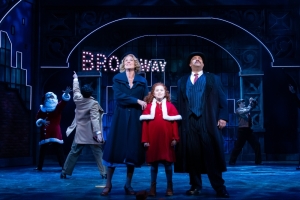
Almost fifty years after she first sang her way into Broadway history, the sun is still shining bright in Oakbrook Terrace as Drury Lane Theatre brings the beloved holiday classic Annie back to its stage for the first time in over a decade. Directed by Scott Weinstein and starring young powerhouse Emerson Mae Chan in the title role on opening night (with Catharina Araujo playing the part at select performances and Kate in others), this lavish seasonal revival captures all the Depression-era charm and infectious optimism of the original 1977 hit. From the opening notes of the overture, Drury Lane delivers a polished, crowd-pleasing take on a familiar favorite.
The story never gets old and remains a warm tale of resilience and hope. Set in New York City during December 1933, Annie follows an irrepressibly optimistic 11-year-old streetwise orphan determined to find the birth parents who left her on the steps of the New York City Municipal Orphanage a decade earlier. Armed with only half of a silver locket and a handwritten note promising they would return for her, Annie endures the daily misery of the orphanage’s bitter, scheming matron, Miss Hannigan. But her luck takes a dramatic turn when Grace Farrell, the warmhearted personal secretary to billionaire industrialist Oliver Warbucks, selects Annie to spend the Christmas holidays at Warbucks' Fifth Avenue mansion. Though initially awkward around children, the gruff tycoon is quickly charmed by Annie's pluck and determination, growing so fond of her that he asks to adopt her himself. When Annie gently declines - still holding out hope of finding her real parents - Warbucks vows to help her search, eventually offering a massive cash reward, and enlisting some help from none other than President Franklin D. Roosevelt. Predictably, the promise of a payout attracts the greed of Miss Hannigan, her swindler brother Rooster, and his accomplice Lily St. Regis, sparking a frantic race for Warbucks to expose their con and give Annie a true home just in time for Christmas.
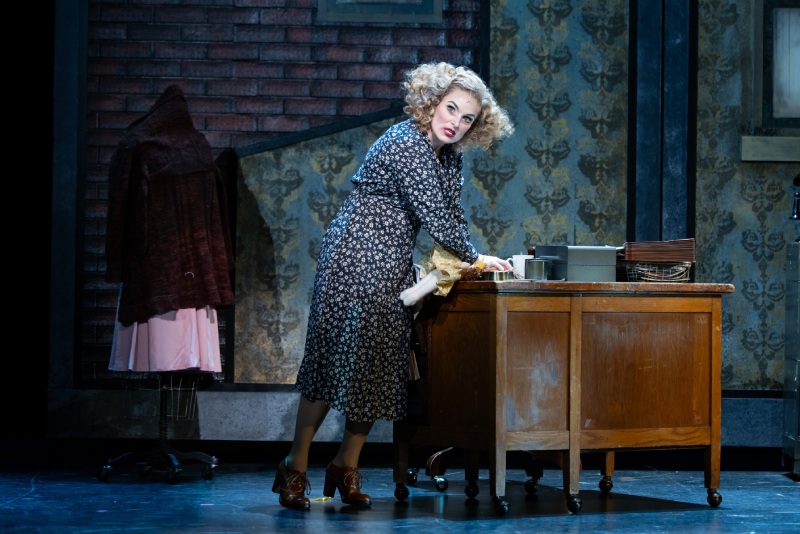
Kelly Felthous as Miss Hannigan in Annie at Drury Lane Theatre. Photos by Justin Barbin.
Weinstein’s direction keeps that familiar plot moving at a brisk, buoyant pace, anchored by standout performances across the board. After two years of touring full-time, Emerson Mae Chan returns home in her Drury Lane debut, capturing Annie’s spunky spirit with effortless charm, hitting her funniest lines with great timing and delivering a nice vocal highlight on “Tomorrow” - the signature number that defines Annie’s sunny outlook. Anand Nagraj delivers one of my favorite performances of the evening as Oliver “Daddy” Warbucks, impressing with both his strong baritone vocals and his nuanced acting. Rather than playing the billionaire as a one-note caricature, Nagraj brings genuine warmth and subtle humor to the role, making it a treat to watch his guarded exterior soften as his heart fills with love and he finds his childlike joy again. Meanwhile, nobody commands the stage quite like Kelly Felthous as Miss Hannigan, who delivers a gloriously unhinged, standout comedic performance from her very first entrance. She makes the iconic villainess unmistakably her own. Felthous is joined by Jackson Evans (Rooster) and Amanda Walker (Lily St. Regis), who each score solid laughs in their roles and help turn “Easy Street” into a high-energy highlight. Elsewhere, Allison Sill impresses vocally as Grace Farrell, lending a calming, assured presence whenever she steps onstage.
A large, energetic ensemble gives the entire production an undeniable lift. The young performers portraying the orphans often take center stage with sharp timing and genuine personality, holding their own alongside a hard-working adult ensemble that fills out the show's many worlds - stepping into everything from street vendors and radio performers to servants and politicians with ease.
Equally irresistible is Georgie, the real live dog playing Annie’s loyal companion, Sandy. Well-behaved and utterly endearing onstage, Georgie melts the theater on contact - every appearance triggers a chorus of affectionate "awwws" from the audience.
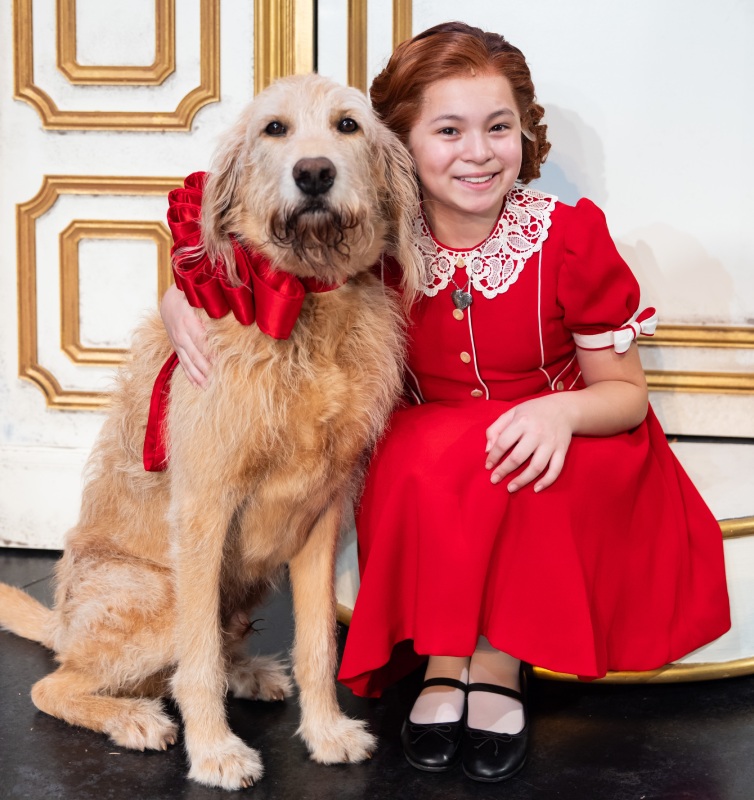
Georgie as Sandy and Emerson Mae Chan as Annie in Annie.
One of my favorite moments in the show arrives in Act II during a trip to the White House, where Annie interrupts a tense, pessimistic meeting between President Roosevelt (wonderfully played by Ron E. Rains) and his Cabinet as they struggle to pull the country out of the Great Depression. While his advisors bicker over grim economic forecasts, FDR turns to Annie for her perspective, sparking a playful back-and-forth that perfectly captures her ability to find a silver lining in everything. Sharing her simple philosophy that the sun will always come out tomorrow, Annie wins over the President - who nudges his gloomy Cabinet members to take her advice to heart before joining her in a spirited reprise of "Tomorrow" that turns a dreary policy session into a lively sing-along.
Another standout sequence was the live radio broadcast scene, which offers a fun glimpse back in time at how an old-school radio show operated - complete with a scene-stealing foley operator whose deadpan, almost-bored demeanor suggested every sound effect was pure second nature.
Visually, the production strikes a rich, theatrical balance. Under the crisp musical direction of Julia Schade, the live orchestra brings Charles Strouse’s definitive score vibrantly to life. Tijana Bjelajac’s scenic design effortlessly transitions between the bleak, shadowy grays of 1930s Hoovervilles and the warm, gilded grandeur of the Warbucks estate. Paired with Mara Blumenfeld’s period-authentic costumes and Jose Santiago’s atmospheric lighting, the staging highlights the stark economic contrasts of the era while keeping the holiday magic front and center. Mara Newberry Greer’s crisp, athletic choreography gives the young performers plenty of room to shine, particularly during high-energy numbers like "It’s the Hard-Knock Life" and "You’re Never Fully Dressed Without a Smile."
Ultimately, Drury Lane’s Annie succeeds because it treats its classic material with genuine affection rather than mere nostalgia. By pairing strong performances and polished stagecraft with an honest, heartfelt approach to the story, the production reminds audiences why this scrappy orphan has endured for nearly half a century without ever feeling dated or overly saccharine. Running at Drury Lane Theatre in Oakbrook Terrace through January 10, this joyous revival makes for the perfect holiday treat for the entire family.
Recommended.
For tickets and/or more show information, click here.
Buddy Holly’s Brilliance, Reawakened on the Drury Lane Stage
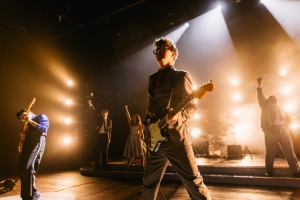
Drury Lane Theatre opens its latest musical with a warm jolt of rock ’n’ roll energy as Buddy – The Buddy Holly Story, by Alan James, returns to the stage, decades after its 1989 debut at the Plymouth Theatre Royal in England. What began as a modest jukebox biography has grown into a global crowd pleaser, and Drury Lane’s production celebrates everything that made Buddy Holly a seismic force - the sound, the swagger, and the fearless creativity of a young artist reshaping American music before the world even realized it was happening.
Buddy – The Buddy Holly Story had already shown how actor‑musician theatre could thrive, pairing a biographical narrative with dramatic scenes and a concert‑style climax that traced Holly’s artistic evolution before building to a full musical finale. Nearly two decades later, when Million Dollar Quartet premiered, the influence was unmistakable. Million Dollar Quartet distilled that approach, replacing the cradle-to-grave arc with a single-night reenactment inside Sun Studio. Instead of character development, it relied on direct address, minimal plot, and the raw electricity of live performance. The shared DNA is clear - legendary early rock played by the actors themselves - but Million Dollar Quartet takes a different approach. It’s a performance framed as a single moment in history, whereas Buddy – The Buddy Holly Story is a story‑driven musical that builds toward a showcase, ultimately shaping the theatrical vocabulary that Million Dollar Quartet would later draw from.
That lineage sets the stage for what Drury Lane achieves here. This staging traces Holly’s meteoric rise from Lubbock teenager to chart-topping innovator, capturing the joy, drive, and restless imagination that defined his short but revolutionary career. Drury Lane emphasizes so well the live-show pulse, packing the evening with hits, tight musicianship, and the infectious spirit of 1950s rock ’n’ roll. The production revisits the era beautifully and recreates the thrill of watching a new sound take flight in real time. With its high-energy ensemble and a lead performance that channels Holly’s mix of sweetness and swagger, Buddy delivers both nostalgia and immediacy, reminding audiences why his influence still reverberates through rock, pop, and musical theatre. It is a dynamic tribute to a musician who changed everything - and whose story still lands with irresistible rhythm. And as the story reaches its final stretch, the production kicks fully into showcase mode, delivering a roof-raising finish that feels less like musical theatre and more like being dropped into a live 1950s rock ’n’ roll set.
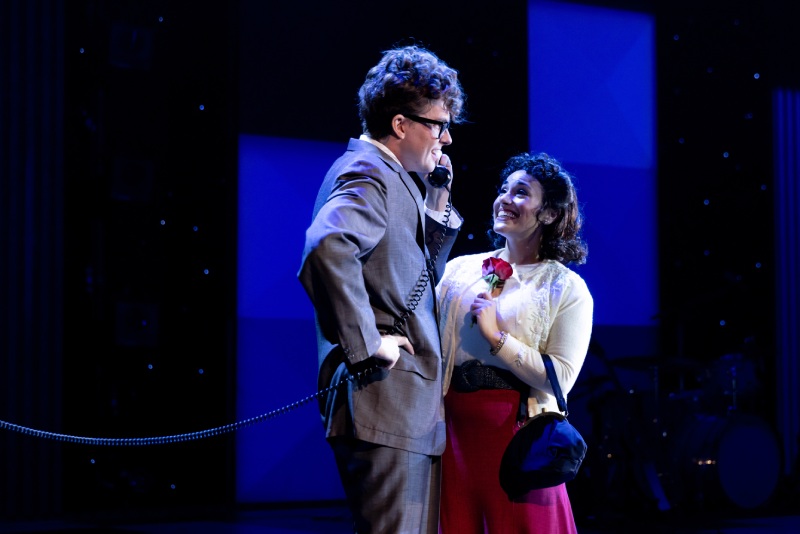
Joey Chelius as Buddy Holly and Samantha Sayah as Maria Elena Santiago Holly. All photos by Kyle Flubacker.
It is no surprise that the Drury Lane cast is top notch as always. Under the sharp direction of Matthew D. Carney and the vibrant choreography of Kenny Ingram, the ensemble delivers the kind of crisp musicianship and infectious charge this show demands. Joey Chelius makes a terrific Buddy Holly - charismatic, boyish, and fully in command of the rock ’n’ roll pioneer’s sound and spirit. He brings an easy, unaffected charm to the role, pairing Holly’s trademark vocal clarity with a grounded emotional throughline that keeps the performance from ever feeling like mere impersonation. Chelius captures the spark of a young artist discovering his own power. His playful, high-energy guitar work adds an extra lift of authenticity - the kind of spirited musicianship that makes the stage feel like a live 1950s jam session. When he locks in with the band, the stage lights up with the kind of voltage that makes you forget you are watching an actor at all. He is backed by an outstanding trio of Crickets: Alek Boggio as drummer Jerry Allison, Grant Alexander Brown as bassist Joe B. Mauldin, and Elliot Coe Esquivel as guitarist Niki Sullivan, who doubles as Richie Valens and plays the hell out of “La Bamba.” Together, they create a tight, exhilarating band that feels more like a live performance when they jam than a traditional musical number, filling the room with the kind of raw, unfiltered early rock drive that Buddy Holly himself once ignited.
As someone already familiar with Holly’s catalog, I walked away an even bigger fan - the show makes his artistry feel immediate, alive, and impossible not to resist. I was also struck by a detail I hadn’t known before seeing this production. Early in his career, Holly faced strong pressure from his record label to adopt a more conventional country‑western sound and image. The show makes clear that he flatly refused to be branded that way, holding fast to the rockabilly edge and melodic style that defined his emerging voice. Rather than reshape his music to fit a marketable country mold, he committed to the sound he believed in - a choice that ultimately set him apart and helped spark a new era in American rock ’n’ roll.
Samantha Sayah offers a gentle, grounding presence as Maria Elena Santiago Holly, anchoring the emotional stakes of Buddy’s personal life with warmth and quiet strength. She provides a steady, heartfelt counterbalance to the show’s high‑voltage musical energy, reminding us of the love and partnership that shaped Holly beyond the spotlight. She also adds a charming layer to the live music, stepping in with the band on keyboard while doubling in another role with easy versatility. Marta Bady is terrific across multiple roles, matched by Eric Andrew Lewis, who shines in a variety of roles and puts his vocal talent on full display. Together they deliver one of the night’s standout moments when they tear into “Shout” and absolutely bring the house down. Bady plays several roles throughout the show, including Marlena Madison, the smoldering and vibrant co‑host/performer at the Apollo Theater, and she’s compelling in every one of them. She brings a confident, magnetic stage presence that elevates each number she touches. Productions like this often skew male‑driven simply because of the era they depict, which places a particular weight on the women in the cast. Here, the two female performers supply all the necessary feminine energy, charisma, and sensuality that help charge the production with the same spark Buddy Holly inspired in his fans - a blend of modern edge and romantic warmth that defined his music.
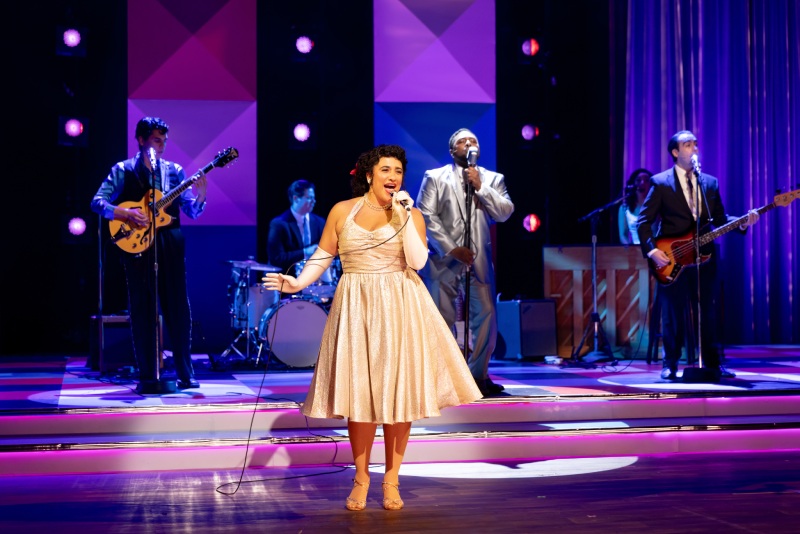
Marta Bady and cast.
Russell Mernaugh is another standout, slipping into several characters with ease, but it is his turn as The Big Bopper during Buddy’s final showcase that truly stops the show - an unforgettable moment that is off the charts good.
Beyond the performances, one of the unexpected pleasures of this production is watching Buddy Holly’s rock ’n’ roll evolution unfold as the show progresses. Drury Lane emphasizes the early chapters of his career, showing him as a shy, slightly unpolished teenager pushed toward the country genre his record label expected him to embrace. Holly’s early career also reflects a familiar music-industry pitfall: he accepted a restrictive record deal that undervalued his talent - a pattern that has continued to affect young artists from his era all the way to the present day. Those early scenes capture the tension between who he was told to be and who he was becoming - an artist quietly steering himself away from Nashville conventions and toward the raw, rhythmic spark of the new sound that felt truer, bolder, and entirely his own. As the productions unfolds, that tentative spark grows into full-fledged confidence. The shift is fascinating to watch: a young musician testing boundaries until he suddenly realizes he is creating something revolutionary.
The show’s greatest thrill comes from the music - a steady stream of Buddy Holly hits that still come alive with the invention and joy he poured into them in the late 1950s. Musical Director Chuck Mead’s fine choices amplify that spirit, shaping arrangements that feel larger than life at times without ever losing the raw simplicity that defined Holly’s sound. Drury Lane’s production treats these songs not as museum pieces but as living, breathing bursts of the raw spark of early rock, and Joey Chelius really delivers, driving each number with clarity, charm, and an effortless command of Holly’s style. Classics like “Peggy Sue,” “That’ll Be the Day,” “Everyday,” and “Oh Boy” land with fresh vitality, while the amped-up concert sequences bring the crowd to its feet. The band’s tight harmonies, crisp instrumentation, and sheer exuberance remind audiences just how groundbreaking Holly’s music was - and why these songs continue to resonate across generations.
Buddy Holly’s world comes alive so vividly thanks to the outstanding work of the design team - Lauren Nichols’ scenic design, Rachel Boylan’s period-perfect costumes, Lee Fiskness’ dynamic lighting, and Leland Plumridge’s crisp, full-bodied sound. The sets move fluidly from the intimacy of a recording studio to a series of performance stages, including a striking recreation of the famous Apollo in Harlem, NY. This core team does a fantastic job creating an atmosphere that feels authentic, immersive, and at times downright electric, giving the production its vibrant sense of place and time.
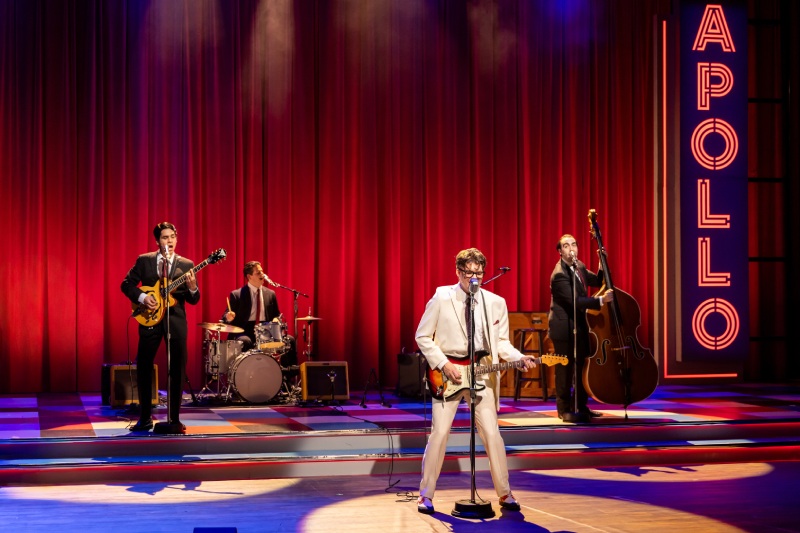
(left to right) Elliot Coe Esquivel, Alek Boggio, Joey Chelius, Grant Alexander Brown as Buddy Holly and the Crickets in Buddy – The Buddy Holly Story.
It is impossible to watch Buddy – The Buddy Holly Story without feeling the weight of how young he was when his life ended - just 22, still in the earliest stretch of a career that was already reshaping American music. The production doesn’t dwell on the tragedy, but knowing what comes after gives the final moments an undeniable ache. And because the show focuses, rightly, on celebration rather than sorrow, it’s worth briefly stepping beyond the edges of the stage to revisit the real history behind that night - not to overshadow the production, but to deepen the audience’s appreciation of what it’s honoring. Holly chartered the plane because the tour bus had broken down repeatedly, had no heat, and had already hospitalized his original drummer with frostbite - forcing a local substitute to step in. He simply wanted to get to Fargo early to rest, do laundry, and escape the miserable travel conditions.
The seats on the flight were traded for entirely practical reasons among Holly’s actual Winter Dance Party band and tour mates. J.P. Richardson (“The Big Bopper”), sick with the flu, asked current Crickets bass player Waylon Jennings for his seat, and Jennings agreed. Ritchie Valens and touring guitarist Tommy Allsup flipped a coin for the remaining spot, and Valens won. None of these decisions were driven by fear of the flight itself. The pilot, Roger Peterson, was young but licensed, and witnesses reported a normal takeoff. In reality, Holly was flying in dangerous winter weather - not a dramatic “storm warning” scenario, but conditions poor enough to make the trip risky, and they played a major role in the crash.
It’s also worth remembering that the show is, at heart, a feel-good celebration - not only of Holly, but of the three extraordinary artists who lost their lives that night. Still, for the sake of historical clarity, their deaths were the result of circumstances that never should have existed. The tour bus failures, the brutal cold, and the frostbite suffered by a band member were all consequences of a music industry unwilling to provide even basic support for the musicians it relied on. The concert they were traveling toward was not a high-stakes engagement; under safer, more humane conditions, the artists should have been given the option to delay the trip. Instead, a combination of grueling tour logistics and record-label cost-cutting placed them in harm’s way, costing the music world three bright stars.
Holly died in that crash on February 3, 1959, alongside fellow rock and roll trailblazers Ritchie Valens (just 17 years old), and J.P. “The Big Bopper” Richardson, as well as Peterson. The accident - later immortalized as “the day the music died” - cut short three rising careers in a single instant. Holly had recorded only a few years’ worth of material, yet his influence still reverberates through rock, pop, and country. And watching his world come alive so vividly onstage, you can’t help but wonder what other genius music he might have created had he been given even a little more time.
Buddy - The Buddy Holly Story is an easy show to wholeheartedly suggest - a colorful, high-energy celebration of a musical pioneer whose influence still echoes across generations. It is a fantastic homage to an incredible artist. Drury Lane Theatre’s production captures both the thrill of Holly’s sound and the poignancy of his too-short life, delivering an experience that feels as heartfelt as it is electrifying. This musical runs August 19 through October 18 at Drury Lane Theatre in Oakbrook, with a run time of 2 hours including a 20-minute intermission and comes highly recommended.
For tickets and/or more information, click here.
Nunsense, Not Quite Immaculate - But Blessed With a Strong Cast
Following its recent winter production of Sister Act, Drury Lane Theatre returns to the convent with Nunsense, a light-hearted musical comedy which, as the title implies, is a lot of nonsense.
The premise is funny, albeit morbid. After an unfortunate mishap, 52 members of the Little Sisters of Hoboken die from tainted soup prepared by Sister Julia, Child of God. With limited resources, the surviving nuns can only cover the funeral expenses of some of their sisters - leaving the remaining four bodies in their convent freezer, awaiting burial. How can they solve this problem? Well, stage a variety show, obviously! After all, while these women are nuns, they all wanted a moment in the spotlight.
E. Faye Butler, who also directed Sister Act, returns to stage Nunsense and injects the same optimism into this show. Unfortunately, it lacks the same substance, failing to elevate its premise beyond the initial idea.
The origin of Nunsense seems to explain its structural weakness. In the early 1980s, playwright Dan Goggin created a line of tongue-in-cheek greeting cards featuring a nun offering witty, irreverent quips. The cards were a hit, and Goggin used them as a jumping-off point for a cabaret show, which was later expanded into a full-length musical.
Unfortunately, the script doesn’t have much narrative depth or structural momentum. It seems to wander through quips and gags, trying to find a laugh rather than developing character or plot. At one point, we learn that a health inspector will fine them if they can’t raise the money by tomorrow, but it doesn’t land as a serious threat or even a driving force for the remainder of the show. The problem even has a quick resolution when Sister Mary Amnesia remembers her identity and discovers she’s suddenly rich thanks to a contest - talk about a deus ex machina (mary-ina, if you will).
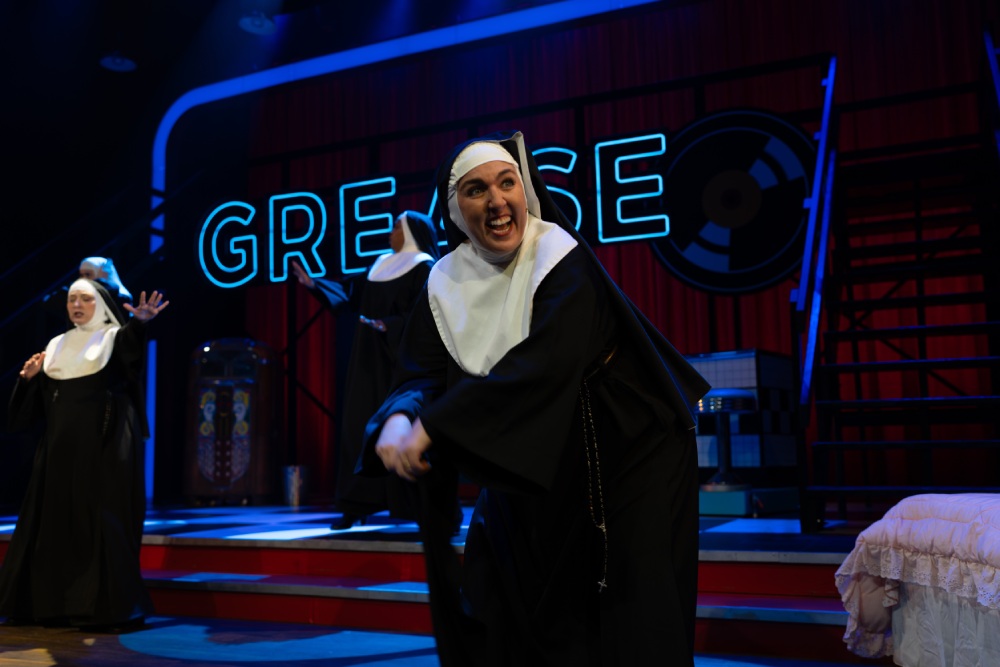
Rachel Carreras in Drury Lane THeatre's Nunsense. Photos by Caitlin Dennis.
The book’s weaknesses are unfortunate because the cast is genuinely strong. Every member brings spectacular vocals to the stage, effortlessly belting out musical numbers and sounding excellent throughout.
Sharriese Hamilton delivers a standout performance as Sister Hubert. Her sassy comebacks and vocal riffs are hilarious, especially her trill in their rap. Her big second-act number, "Holier Than Thou," takes the audience to church and gives the show a much-needed jolt of energy. Cory Goodrich, Rachel Carreras, Kelly Felthous, and Aurora Boe also do well in their solo moments, whether it’s physical comedy, playing with a puppet, or ballet. Felthous gets to shine with her audience work and banter, and it is fun to see the cast do callbacks to specific interactions, such as flirting with or chiding audience members.
The show succeeds best when it moves quickly. Without much plot, gags can get tired easily. For instance, the Reverend Mother accidentally inhales a drug found in the girls’ locker room and goes to pieces. The sequence goes on a few beats too long. Transitions also could be tightened so the show doesn’t lose steam between numbers.
Nunsense is a fun idea, but the script fails to execute it satisfyingly. It’s also unclear who the intended audience is; the PG‑13 tone might make it a slightly tougher fit for families, even though they’d otherwise be a natural demographic.
While each performer gets a well-deserved moment to shine, it is a shame that such a talented cast doesn't have better material to serve either their collective skills or a meaningful story. Drury Lane's Nunsense has its moments, but it never quite reaches divine heights.
This review is proudly shared with our friends at www.TheatreInChicago.com.
A Final Bow: Chicago Theatre Mourns Matt DeCaro

The Chicago theater community is grappling with the sudden loss of Matt DeCaro, whose death early Saturday came as a shock to colleagues and audiences alike. A cause of death has not been made public. Only hours before, he had taken the stage at the Goodman Theatre, performing the role of Sturdyvant in Ma Rainey’s Black Bottom during Friday night’s show. His unexpected passing led to the cancellation of Saturday’s matinee, while the evening performance moved forward as a tribute to his decades of work and the impact he left on the city’s artistic landscape.
DeCaro’s career stretched across more than four decades and reached nearly every major stage in Chicago. His long association with the Goodman Theatre included roles in Heartbreak House, The White Snake, The Cherry Orchard, Night of the Iguana, Boy Gets Girl, Camino Real, Romance, Richard II, Spinning into Butter, and The Play About the Baby. He moved fluidly between companies and styles, portraying Winston Churchill in Drury Lane’s The Audience, stepping into Doc’s role in Marriott Theatre’s West Side Story, and earning a Jeff Award for his performance in Cat on a Hot Tin Roof. His work extended across the region as well, with appearances at Chicago Shakespeare Theater, Victory Gardens, Licoln Center, the Guthrie, and Asolo Rep. Beyond his extensive Goodman history, DeCaro built a substantial body of work across the city, including a standout turn in Steppenwolf’s Men of Tortuga - recognized by the Chicago Tribune as one of 2005’s most memorable performances - and a role in Victory Gardens’ Symmetry, further underscoring his versatility and command as a character actor.
His screen résumé was equally wide-ranging, with roles in Prison Break, The Office, Curb Your Enthusiasm, Chicago P.D., ER, U.S. Marshals, and Richie Rich. Yet for many, it was his presence on Chicago stages that defined him - steady, generous, and deeply rooted in the craft. Among the roles that left a lasting mark on those who followed his work, DeCaro’s Big Daddy in Cat on a Hot Tin Roof at Drury Lane stands out as a personal favorite. The mix of authority and raw vulnerability he brought to the character made the performance unforgettable - the kind that lingers in your mind long after the production has ended.
As tributes continue to emerge, the sense of loss is felt not only by those who worked beside him, but by audiences who witnessed his final performance just one night before his passing - a testament to how fully he remained devoted to the work until the very end.
In losing Matt DeCaro, Chicago loses one of the quiet forces that helped shape its stages for decades. His work was never about spotlight or spectacle - it was about craft, commitment, and the kind of presence that made every production stronger simply because he was in it. Even as the community mourns, the stories he told and the characters he embodied continue to resonate, a lasting reminder of an artist who gave everything he had to the world he loved.
Drury Lane Theatre names Matthew D. Carney as Artistic Director

Drury Lane Theatre announces the appointment of Matthew D. Carney as its new Artistic Director. A longtime collaborator and key member of the artistic team at Drury Lane, Carney steps into the role following more than a decade of artistic contributions that have helped support the theatre's signature style and high standard of excellence.
Carney joined Drury Lane Theatre in June 2013 and, over the past 13 years, has served as Associate Artistic Director, Casting Director, and Company Manager. His extensive work with the organization includes directing the upcoming production of Buddy – The Buddy Holly Story, serving as Casting Director for more than 70 productions, and acting as resident director for the annual Theatre for Young Audiences production of A Christmas Carol. He has also worked as assistant director on productions including The 39 Steps, Steel Magnolias, Shrek, and Joseph and the Amazing Technicolor Dreamcoat, and as costume designer for The Gin Game. Carney holds a BFA in Theatrical Design and Technology focused in Costume Design from Wright State University.
Kyle DeSantis, President of Drury Lane Productions, welcomed Carney as the new Artistic Director, "When my grandfather first raised the curtain in 1949, he created something special: a place where families discovered the magic of live theatre, children experienced their first Broadway musical, and a passion for performance was handed down through generations. Matt is just the person to carry on the Drury Lane legacy. I have worked with him for over a decade – his artistry and leadership never ceases to amaze me. I am looking forward to his continued transcendent journey with Drury Lane. I am elated to collaborate with him as he guides us into the next era of world-class theatre in Chicagoland!
"I am deeply honored to lead the next chapter in Drury Lane's story," said Carney. "I am excited by the opportunity to build on Tony DeSantis' legacy while embracing a fresh perspective for a new generation of theatre goers. My goal is to cultivate a space where artists feel inspired to tell classic stories in new ways, audiences feel welcomed and moved by their experience, and every production reflects the excellence Drury Lane is known for."
In his new role, Carney will oversee artistic programming and production at Drury Lane Theatre, helping to shape future seasons while continuing the organization's long-standing commitment to delivering world-class entertainment. Carney's appointment marks an exciting continuation of Drury Lane's tradition of artistic excellence and collaboration.
About Drury Lane Theatre
Built from scratch. Built in Oakbrook. Built for you.
Founded by Anthony DeSantis over 70 years ago, Drury Lane remains a family-run organization under the leadership of President Kyle DeSantis. Drury Lane Theatre continues as a major force in the Chicagoland theatre scene, producing world-class theatre in collaboration with some of the nation's leading actors, directors, and creative minds. Drury Lane Theatre produces the highest quality theatrical experience that immerses and supports artists and audiences in the exploration of what it means to be human and to experience the transcending power of the performing and visual arts. Drury Lane strives to create an environment in which every individual or group is welcomed, respected, supported, valued and able to fully experience and participate in this transformative art form.
The theatre has staged more than 2,000 productions and has been nominated for over 360 Joseph Jefferson Awards. Drury Lane proudly employs thousands of professional actors, musicians, designers, and crew members to entertain upwards of nine million audience members and counting.
Drury Lane’s Father of the Bride Charms with Effortless Fun

The 1950s is easy to idealize. Men styled tailored suits, women dazzled in pleated dresses, and everything glimmered like it was in a commercial. Life’s troubles were solved with a talk from pop or a hug from mom – or that’s how it seemed. Drury Lane Theatre’s Father of the Bride transports audiences to that romanticized time, and it’s a welcome trip!
Published in 1949, Father of the Bride was adapted for the stage and screen, including two beloved movies starring Hollywood heavy-weights Elizabeth Taylor, Spencer Tracy, and, later, Steve Martin in 1991. While a wedding-gone-wrong may be a familiar story, director Michael Heitzman infused Drury Lane’s rendition with charm, laughter, and sincerity, making it feel fresh.
The play follows Stanley Banks, whose one-and-only daughter prepares for her big day, but she just wants a simple ceremony. Then again, she does want to invite all of her friends… and wants a beautiful dress… and well, by the time everything adds up, the small affair balloons into a whopping headache for dad.
Joe Dempsey’s portrayal of Banks, the set-in-his-ways father, is spot on, and his ad-libbed groans and physical comedy can’t help but make you laugh and empathize with poor, ol’ dad. He balances his old‑school bravado with the teddy-bear-interior so well, creating the heart of the story and avoiding the tired “dumb dad” troupes.

Aurora Penepacker and Jake DiMaggio Lopez in Father of the Bride. Photo by Justin Barbin.
Also making up the family is Rachel Sullivan, who plays the mother, Ellie Banks, with a gentle, confident air, and sons Ben and Tommy are portrayed by Kyle Ringley and Charlie Long, who bring charismatic Leave It to Beaver energy.
Aurora Penepacker plays Kay Banks, the soon-to-be bride with all of the charm of Elizabeth Taylor, and Jake DiMaggio Lopez is her moonstruck, in-over-his-head fiancée, Buckley Dunstan. Their chemistry is fun to watch as every emotion ping-pongs around as their nuptials draw near.
The ensemble also includes some fantastic performances. Michele Vazaquez portrays the tightly wound secretary, Miss Bellamy, who delivers a hilarious meltdown when every member of the family sabotages her efforts to finalize a guest list. Ed Kross brings quirky comedy as the caterer, Mr. Missoula, who steamrolls the Banks (and jumps like Super Mario), and Maya Hlava as Peggy Swift is an overzealous girl-next-door who plots to catch the bouquet.
The original compositions composed by Curtis Moore also deserve a shout-out. They serve as the perfect soundtrack during sequences which showed seasons changing or wedding gifts flooding in and add that extra something that makes you feel like you’re watching your favorite black-and-white sitcom.
Comedy can be tricky to tackle, but Father of the Bride makes ever beat work. It’s whimsical, playful, and a reminder that when things go awry, those you love will always be there. Father of the Bride is an invitation to a pure, wholesome evening, and it’s an invite you should not pass up.
Father of the Bride runs through May 31 at Drury Lane Theater. Click here for tickets and more information.
This review is proudly shared with our friends at www.TheatreInChicago.com.
Murder, Deception, and Mid-Century Glamour at Drury Lane Theatre

Something wicked is winding its way through the velvet curtains of Drury Lane Theatre—and it reeks of roses, red wine, and murder. Dial M for Murder, the classic thriller originally crafted by Frederick Knott in 1952 and immortalized on screen by Alfred Hitchcock in 1954, returns to the stage with a razor-sharp adaptation by Jeffrey Hatcher that’s as stylish as it is sinister.
Set against the moody backdrop of 1950s London, the production invites us into the polished yet precarious world of Margot (Amanada Drinkall) and Tony Wendice (Erik Hellman) - a couple whose marriage gleams with charm but conceals a darker undercurrent. Beneath the tailored suits and cocktail-hour smiles lies a web of betrayal, manipulation, and a meticulously plotted murder that threatens to unravel with every twist of the telephone cord.
Hatcher’s adaptation breathes fresh life into the suspense, tightening the dialogue and sharpening the stakes while preserving the noir elegance of the original. The result is a theatrical experience that feels both vintage and vital - a slow burn that simmers into a full-blown psychological inferno.
Tony Wendice, a former tennis star turned calculating husband, discovers his wife Margot’s affair with mystery writer Maxine Hadley (Alexandra Silber). Rather than confront her, he plots her murder with chilling precision, believing one perfect move will reclaim his unraveling life.
But perfection proves elusive.
When the plan collapses, the story spirals into a maze of blackmail, disloyalty, and psychological warfare. Margot becomes both pawn and player, navigating a world where loyalties shift, truths blur, and every silence speaks volumes.
This isn’t just a thriller—it’s a taut exploration of control, vulnerability, and the artful menace of manipulation.

Alexandra Silber, Amanda Drinkall, Erik Hellman in Drury Lane Theatre's Dial M for Murder.
The players are sensational in the dialogue heavy, quick witted, edge-of-your-seat mystery thriller. Erick Hellman delivers a diabolical and shrewd Tony, Amanda Drinkall is delightful as Margot and Alexandra Silber is a true force as Maxine. Johnathan Weir is also tremendous as sleuthing Inspector Hubbard while Ian Paul Custer is perfectly cast as the Tony’s patsy, Captain Lesgate.
Wonderfully directed by Adam Immerwahr in his Drury Lane debut, this production of Dial M for Murder masterfully marries vintage intrigue with a brisk, modern rhythm. It’s not just a revival - it’s a reinvention – and Drury Lane Theatre is the perfect venue to stage this mystery thriller. The bones of Frederick Knott’s original mystery remain intact, but the pacing has been sharpened, the humor dialed up, and the twists recalibrated for a contemporary audience.
Visually, the production luxuriates in noir-inspired elegance, its seductive precision shaped by a powerhouse design team: Paige Hathaway’s scenic work evokes shadow and intrigue, Joshua Schmidt’s sound design hums with tension, Emma Deane’s lighting casts drama in every corner, and Nicole Boylan’s costumes wrap the cast in mystery and allure. Shadow-drenched lighting carves out tension in every corner, while period costumes evoke mid-century elegance tinged with menace. The sound design - subtle yet insistent - acts as an invisible character, underscoring moments of dread, desire, and deception. It’s a production that doesn’t just tell a story; it envelops the audience in its atmosphere.
The result is a theatrical experience that feels both timeless and timely - a stylish homage to Hitchcockian suspense, reimagined with the velocity and wit of modern storytelling.
At its core, Dial M for Murder is a taut exploration of trust fractured by ambition, love corroded by suspicion, and appearances polished to mask peril. The play doesn’t simply flirt with deception - it dissects it. Every gesture, every line of dialogue, is laced with the question: how far will someone go to preserve their illusion of control, or to dismantle another’s?
Dial M for Murder is a psychological chess match where secrets are currency, gaslighting is taken to the extreme and duplicity is both weapon and wound. As the characters maneuver through layers of manipulation and moral ambiguity, the audience is left to ponder not just who’s guilty - but whether anyone is truly innocent.
Running through October 26th, this is a highly recommended thriller that you won’t want to miss. For tickets and/or more show information visit https://drurylanetheatre.com/dial-m-for-murder/.
*This review is also featured on https://www.theatreinchicago.com/!
Sweet Dreams and Steel Guitars: Drury Lane’s Tender Tribute to Patsy Cline

Always...Patsy Cline is a poignant and entertaining jukebox musical that honors the legacy of iconic country singer Patsy Cline through the heartfelt story of an unexpected friendship, which is currently beautifully staged at the Drury Lane Theatre in Oakbrook. Conceived and written by Ted Swindley, the production is inspired by the real-life bond between Cline and Louise Seger, a devoted fan from Houston who first heard Cline on the radio in the late 1950s. Their connection sparked in 1961 when Seger met Cline before a performance, marking the beginning of a sincere pen-pal friendship that continued until Cline’s untimely death in a plane crash on the way to Nashville on March 5th, 1963. Patsy Cline was just 30 when her life was cut short, right as she stood on the brink of what many believe could have been a long and illustrious career. Her star was still rising, leaving us to wonder just how far her extraordinary talent might have taken her.
Framed through Louise’s vivid recollections, the musical interweaves narrative and music, featuring over twenty of Cline’s signature songs such as “Crazy,” “Walkin’ After Midnight,” and “Sweet Dreams.” As Louise shares their story, Cline takes the spotlight to perform, offering a touching blend of live music and personal storytelling. The show captures not only the spirit of Cline’s music but also the deep emotional bond that fans can forge with their idols, making it a heartfelt homage to lasting friendship and musical legacy.
There’s a spark of something special from the moment Louise—punctual as ever—spots Patsy Cline sitting alone before the show. Summoning her trademark blend of boldness and charm, she approaches, introduces herself, and warmly invites Patsy to join her table with her family and boss. Cline’s easy reply, “Well, why don’t I just join you?” becomes the turning point that launches an unforgettable evening and the beginning of a heartfelt friendship.
From the moment Louise steps into the neon-soaked nightlife of Houston, Texas, Louise reveals she’s no mere admirer—she’s a woman with grit, savvy, and a spine of steel. That very night, she’s floored to find that country music icon Patsy Cline has arrived entirely on her own—no agent, no assistant, not even a friendly face in sight. It’s a glaring oversight, and Louise isn’t about to let it slide.
The real kicker? Cline is booked to sing for four uninterrupted hours. Outraged, Louise takes charge. She marches straight into the manager’s office, Cline trailing behind, clearly unaccustomed to someone going to bat for her. Louise doesn’t mince words. She calmly but firmly asks: at what time is Patsy expected to start each of her two sets? Her meaning is unmistakable—this isn’t one continuous gig; it’s two full shows, and the artist deserves to be treated—and paid—as such.
The bold move pays off. Cline walks away with double the fee and something just as valuable: a chance to rest her voice and spirit between sets.
But Louise’s backstage hustle doesn’t end there. By sunrise, she’s already secured Cline a slot on a local radio broadcast, giving the singer a quick burst of publicity in the regional market. And when it’s time for Cline to catch her flight, Louise is the one who sees her off, driving her to the airport like a trusted friend. In just 24 hours, Louise proves she’s more than a fan—she’s a fixer, a fierce protector, and someone who understands exactly what it means to lift up another woman.
Aja Alcazar takes center stage as the legendary Patsy Cline, and she doesn’t just step into the role — she owns it. With the grace of a seasoned storyteller and the vocal firepower to match, Alcazar channels the spirit of the Virginia-born country icon in a performance that’s nothing short of electric. Her portrayal is steeped in authentic country warmth, infused with a lively sense of sass and vulnerability that makes Cline feel both larger than life and achingly real.
From the moment she launches into the opening notes of “Walkin’ After Midnight,” Alcazar captivates the room, weaving through a powerhouse setlist that also includes timeless classics like “Your Cheatin’ Heart,” “I Fall to Pieces,” “She’s Got You,” and many more. Each song becomes a showcase not only of her vocal skill but of her ability to emotionally inhabit Cline’s journey — turning beloved hits into deeply personal moments. It’s a performance that doesn't just honor Cline’s legacy; it breathes new life into it.
Bria Sudia is equally impressive as boisterous uber fan Louise Sefer. Sudia is adorable, adding a ton of charisma and energy to the role is - and she is damn funny. Louise serves as the heart and storyteller of the production, guiding the audience through her memories with warmth and wit. Though she doesn't perform full songs, she livens the stage with colorful narration, sharp comedic instincts, and the occasional burst of humming or playful singing - especially in moments when Patsy's music stirs something deep within her.
Collette Pollard’s set design at Drury Lane conjures a warm, inviting honky tonk atmosphere, where a live band dressed in classic western attire strums away in the background. This rustic charm seamlessly blends with the intimate setting of Louise’s small-town kitchen, creating a space that feels both nostalgic and personal. Even before the first note plays, the allure sets in—with strands of vintage string lights draped above the stage, casting a nostalgic glow that instantly invites the audience into the world of the show.
Always… Patsy Cline offers a warm, nostalgic window into the golden era of late 1950s country western music, capturing the charm, grit, and heart of the time. But beyond the rhinestones and twangy guitars, the musical is a heartfelt tribute to one of the most iconic voices in American music history—a woman whose star burned brightly and far too briefly.
At its core, the show is also a celebration of human connection. It tells the improbable, yet true story of a friendship that bloomed between a legendary performer and an ordinary fan, offering audiences a touching reminder of how music has the power to bridge worlds. For anyone who has ever dreamed of meeting their idol, sharing a laugh, or swapping stories over coffee, Always… Patsy Cline is a beautiful, funny, and emotionally rich journey that brings that dream to life.
Always…Patsy Cline is being performed at Drury Lane Theatre through August 3rd. For tickets and/or more show information, click here.
This delightful musical is highly recommended for all ages.
*This review is also featured on https://www.theatreinchicago.com/!
Disney's The Little Mermaid at Drury Lane: An Inspiring and Delightful Production Celebrating Girls' Unique Voices

I thoroughly enjoyed Drury Lane's enchanting stage production of Disney’s The Little Mermaid from start to finish. While few are overly familiar with Hans Christian Andersen’s original, darker tale of ill-fated romance, the Disney animated film and this stage adaptation, with a book by Doug Wright and music by Alan Menken, lyrics by Howard Ashman and Glenn Slater, beautifully transform the fairytale into a heartwarming story of love and triumph for the heroine, Princess Ariel.
The mermaid Ariel, portrayed with sunny enthusiasm and skillful vocal stylings by Sarah Kay, is a Princess and the beloved daughter of King Triton, convincingly played by Anand Nagraj. Ariel is captivated by the world above the waves, yearning to experience the sunshine and the joy of walking through green fields. Her fascination with the human world deepens when she falls in love from afar with a human prince.
During a fierce storm, Ariel saves the Prince from drowning, and in that moment, she finds herself falling for him. The Prince, portrayed with sensitivity and earnestness by Patrick Johnson, is captivated by the voice of his rescuer, though he never sees her face as Ariel swiftly returns to the sea, hiding her mermaid identity.
The chemistry between Kay and Johnson enriches their characters, making their blossoming romance both believable and heartfelt. Kay's Ariel exudes innocence and curiosity, while Johnson's Prince captures sincerity and a deep longing to find the mysterious singer who saved his life.
King Triton, wary of humans and deeming them dangerous, has commanded his daughters to stay away from them. This forces Ariel to make a desperate deal with Ursula—her powerful, estranged, octopus-like aunt, who was once banished by King Triton, her brother.

Anand Nagraj as King Titan and Michael Earvin Martin as Sebastian.
Ursula, portrayed by Sawyer Smith, casts a spell on Ariel, compelling her to give up her extraordinarily beautiful voice in exchange for a chance at love. Ariel must win the heart of the Prince, who must love her so deeply that he is compelled to kiss her. Only True Love's kiss can break Ursula's twisted spell. If Ariel fails to find true love and receive the Prince's kiss, she will be banished to the underworld, and Ursula will claim her soul. Sawyer Smith, as Ursula, is a showstopper! Smith's costumes, makeup and movements are menacing, powerful, yet glamorous all at the same time. Smith’s talent is fully on display during a commanding rendition of “Poor Unfortunate Souls.”
The cast delivers uniformly strong performances throughout. Matt Edmonds also stands out with his impeccable comic timing as Chef Louis, eliciting plenty of hearty laughs with his hilarious solo number “Les Poissons.”
I valued the emphasis placed on the power of a single woman’s voice and the profound impact of a young woman losing her voice, especially in today’s context. It was heartwarming to see so many young girls in the audience, their faces glowing with delight. They were captivated by the show's humor and romance, yet also deeply moved to tears by the poignant theme of Ariel sacrificing her voice to win the love of a man.
This production, under the skillful direction of Scott Weinstein, with choreography by Kasey Alfonso and a vibrant set designed by Tijana Bjelajac, excels in providing delightful musical theater entertainment for both children and adults. It is truly a pleasure to watch.

Patrick Johnson as Prince Eric and Sarah Kay as Ariel.
The puppetry in this production was extraordinary, among the finest I've seen on a Chicago stage. For instance, the two eels, Ursula’s sinister accomplices, glide gracefully through the audience and across the stage with glittering lights encased in sheer black chiffon, creating an absolutely magical effect. The puppet characters were all exceptionally well played and designed. Notable performances include Sebastian (Michael Earvin Martin), Scuttle (Landree Fleming), Flounder (Maya Lou Hlava), Jetsam (Ryan Michael Hamman) and Flotsam (Leah Morrow). The impressive puppet design was crafted by Chicago Puppet Studio, Caitlin McLeod, and Zachary Sun.
The set design, featuring the imaginative light projections by Anthony Churchill and the atmospheric lighting by Ryan O’Gara, brilliantly conveyed the sensation of being under the ocean. Their work uniquely and creatively transported the audience to an enchanting underwater world, making the experience both magical and mesmerizing.
The Little Mermaid is a fantastic ensemble piece, and the entire cast brings the house down with their rousing, colorful, and energetic group number in “Under The Sea.” This performance beautifully captures the splendor of the mermaid's underwater home and castle, making it a mesmerizing highlight.
I highly recommend this colorful, ingenious, and lively production for audiences of all ages who wish to experience one of their favorite Disney fairytales come to life!
Disney’s The Little Mermaid is being performed at Drury Lane Theatre in Oakbrook through January 12th. For tickets and/or more show information, visit https://drurylanetheatre.com/the-little-mermaid/.
FIDDLER ON THE ROOF – tableaux that reach through time and space

It’s hard to believe that Fiddler on the Roof turns 60 this year. It’s even harder to believe that the show, which opened on Broadway in 1964, can still take an audience by surprise. In continuous production around the globe, and with brides continuously walking down the aisle to “Sunrise, Sunset,” Drury Lane Theatre’s new version proves Fiddler’s mettle once again.
Director Elizabeth Margolius and choreographer Rommy Sandhu dispense with some of the standard staging choices, mostly without disturbing the spirit that animates the musical. Evocative tableaux replace folky dances right from the opening number. After Tevye (Mark David Kaplan) ushers us into Anatevka, lights come up on the townspeople in rows that initially suggest a church choir or a Greek chorus.
“Tradition” proceeds in that linear formation, bringing the village to life in a cluster rather than filling the full stage. Then, as Tevye narrates the action, the cast begins to sway and bob, the movement not of Christians or Hellenes but of worshipping Jews. Each group – the papas, the mamas, the sons, the daughters – has its verse, standing upright and illuminated while the others crouch. Roles are specified, expectations declared. Whether expressing the closeness of the community, fear of what lays beyond the shtetl or just the cold Russian climate, these people function as a bickering, intertwined unit.
At least, it starts that way. Jack McGaw’s set puts the flat façade of a house center stage, a piece of scenery that disappears, panel by panel, as the story progresses. With every personal encounter, traditions break down and push everyone towards the empty space of the future. Tevye tells Golde, “it’s a new world.” How comfortable was the old world? Projections, designed by Mike Tutaj, appear on screens throughout the show, and an historic photograph of a shabby shack reminds us that a poor man like Tevye had little in the way of comfort.
There are no props – no dairy cart beside Tevye during “If I Were a Rich Man” or a book for his daughter Chava to exchange with her non-Jewish suitor Fyedka. Though odd at first, it works especially well during “Sabbath Prayer” when the family gathers to light the shabbas candles. Instead of candlesticks, the screens that frame the action fill with images of flames. In group scenes such as this, the use of projections is stirring. During more intimate moments, when the faces of the characters are projected onto the screens, they seem less of an enrichment and more of a distraction.
Several cast members bring new attention to smaller roles, such as Joel Gelman as Lazar Wolf, the widowed butcher who sets his sights on Tevye’s first born Tzeitel. Yes, Lazar Wolf is too old and unrefined for the girl. But Gelman exudes such heartfelt joy at the prospect of marrying her, he inspires sympathy when the deal falls through. In the hands of Janet Ulrich Brooks, Yente the Matchmaker lands the laugh lines that have turned “yente” into a synonym for meddlesome gossip. But Brooks also conveys the loneliness of a woman who has no one to call her own.
What do the inhabitants of Anatevka have to call their own by the end? Not much. Their bickering, intertwined unit scatters in all directions as the Russian authorities confiscate their property. We know these people after 60 years of imagining that fiddler trying to keep his balance on a shaky roof. At Drury Lane Theatre, we meet them once again as tableaux of memory that reach through time and space.
Fiddler on the Roof is playing now through March 24th at Drury Lane Theatre in Oakbrook. Tickets are available at www.drurylanetheatre.com




Latest Articles
-
 CELESTIA: A Heavenly Event
Written by Mary Beth EukerIn 1871 our broad city burned in the Great Chicago Fire. In 1875 St. Vincent de Paul church rose in Lincoln Park. It was constructed of Indiana limestone and still stands proudly at the corner of Webster and Sheffield like…
-
 Paramount's A Christmas Carol Stands Among the Season's Finest Gifts
Written by Ken PayneFew holiday stories are as deeply woven into the fabric of the season as A Christmas Carol, yet Paramount Theatre's lavish production in Aurora finds fresh magic within Charles Dickens' familiar classic. Combining spectacular stagecraft, heartfelt performances, and an infectious…
-
 Jackalope’s ‘Engines and Instruments of Flight’ Gives Wings to the Legend of Tony Kushner
Written by John AccroccoEngines and Instruments of Flight: A Fantasia in Three Acts by local playwright Calamity West is everything you’ve ever wanted to know about Angels in America but have been too afraid to ask Tony Kushner. Jackalope Theatre gives this fascinating…
-
 Steppenwolf Theatre Presents JESSIE MUELLER WITH SETH RUDETSKY – December 18 & 19
Written by Buzz Center StageSteppenwolf Theatre Company and Mark Cortale welcome back Tony Award winner Jessie Mueller (Beautiful: The Carole King Musical, Waitress) for a special holiday engagement. Catch the Broadway star live in Chicago before she heads back to New York next spring in the…
Does your theatre company want to connect with Buzz Center Stage or would you like to reach out and say "hello"? Message us through facebook or shoot us an email at This email address is being protected from spambots. You need JavaScript enabled to view it..
*This disclaimer informs readers that the views, thoughts, and opinions expressed in the text belong solely to the author, and not necessarily to Buzz Center Stage. Buzz Center Stage is a non-profit, volunteer-based platform that enables, and encourages, staff members to post their own honest thoughts on a particular production.