

Kendall Royzen
Beggin' For Something: Jersey Boys Falls Flat at CIBC
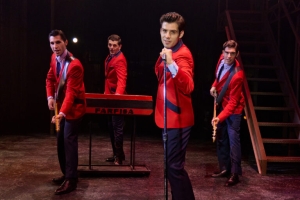
When I was growing up in Southern California, the radio dial of our family car was always tuned to one station, K-Earth 101. It was an oldies station, which in the late 90s and early 2000s meant it played music exclusively from the 50s and 60s. While other kids were listening to emotive grunge coming out of Seattle or poppy boy bands from Florida, my brother and I sang along with Jackie Wilson, The Beatles, The Beach Boys, Sam Cooke, and one of my personal favorites, The Four Seasons. For me, there is no greater decade for music than the 1960s. For every hit single, there are dozens of untold stories of how it got there. Stories of overcoming adversity, defying the odds, never giving up on a dream, persevering, and persistence paying off. One such story is that of Frankie Valli and The Four Seasons.
Jersey Boys is a jukebox musical that tells the story of The Four Seasons (Frankie Valli, Bob Gaudio, Tommy DeVito, and Nick Massi). Featuring a book by Marshall Brickman and Rick Elice, music by Bob Gaudio, lyrics by Bob Crewe, and direction by Des McAnuff, the show follows a more documentary-style telling of how four working-class Italian-American kids from New Jersey went from singing at bowling alleys and running into trouble with the law to finding their signature sound and becoming international stars. The show is structured into four "seasons" (Spring, Summer, Autumn, Winter), with each band member narrating a different part of the story from their own point of view while celebrating classic hits like "Sherry," "Big Girls Don't Cry," and "Beggin'."
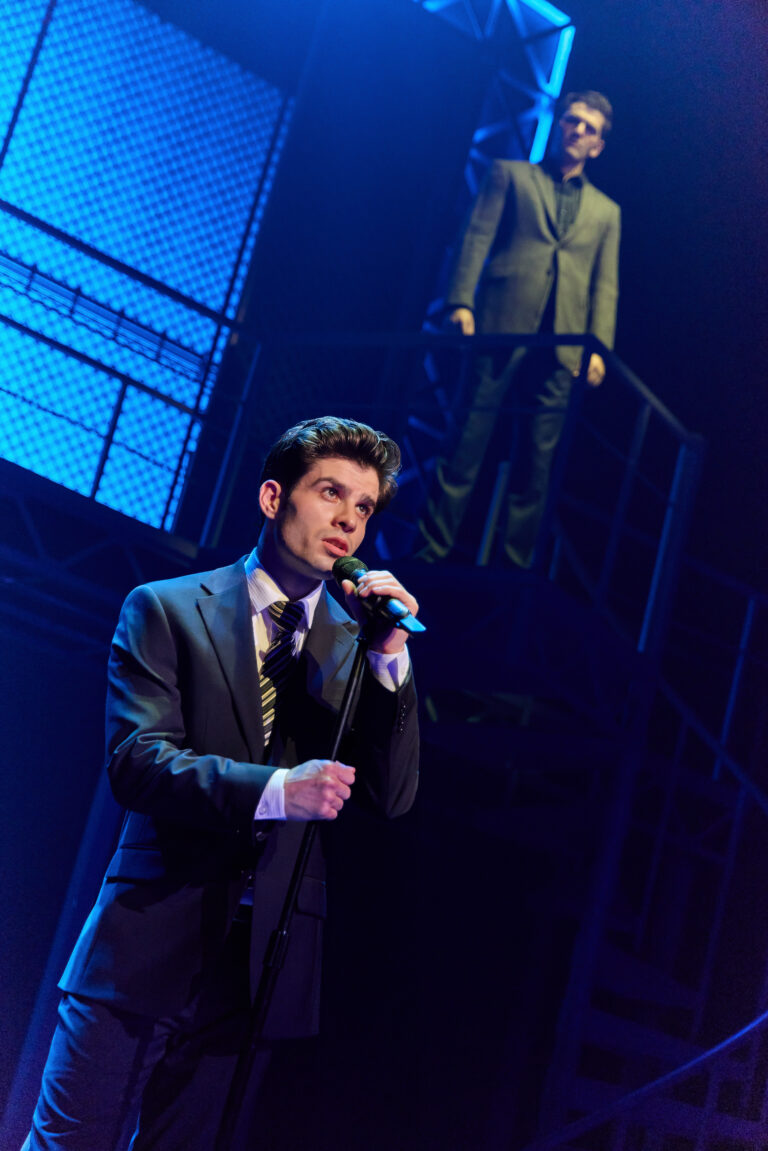
"Can’t Take My Eyes Off You” - Coby Oram as ‘Frankie Valli’ and Peyton Schoenhofer as ‘Bob Gaudio’ in the 20th Anniversary Tour of Jersey Boys.
Those classic hits featured in Jersey Boys played routinely on K-Earth 101. My grandmother would ask my brother to sing the high notes and for me to sing harmonies. When I found Frankie Valli on a certain man’s playlists in college (totally not pirated through LimeWire), I thought it was more impressive than keg stands. "Can’t Take My Eyes Off You" was on my wedding playlist. My husband (whose playlist impressed me so) took me on a rare date night to see Frankie Valli perform at the Genesee Theatre in Waukegan in 2025 as part of "The Last Encores" tour. To say the Four Seasons has a special place in my heart would be an understatement. So when the opportunity arose to see Jersey Boys, I was beggin' to see the show, not only to check off an item on my musical theatre bucket list but to experience a show that never seemed to have a negative review.
So why is it so hard for me to say that Jersey Boys fell flatter than a double flat note?
Every play, particularly musicals, can have issues. Audiences generally forgive quite a bit out of respect for the art, the actors, the crew, and magic-makers. But it wasn’t just a few issues with Jersey Boys at CIBC; in fact, I can’t pinpoint just one thing. Maybe it was the speakers that played too loud, the lights that practically blinded the audience, or the mics that cut in and out as frequently as the actors’ accents. Perhaps it was the lackluster stage energy, where the actors moved like they were simply blocking their marks and delivering their lines to show they memorized them versus actually embodying them. Maybe it was the fact that the narrators were telling us what happened to these band members rather than actually showing the audience what happened, one of the cardinal sins of storytelling. There was nothing particularly bad about the production, but there certainly wasn’t anything to write home about. Even the singing felt flat. While the four main actors - Coby Oram (Frankie Valli), Peyton Schoenhofer (Bob Gaudio), Harry Sperduto (Tommy DeVito), and Owen McCredie (Nick Massi) - looked and sounded the part, they delivered the classic songs with the same energy they delivered their lines, as if proving they memorized them versus actually singing them.
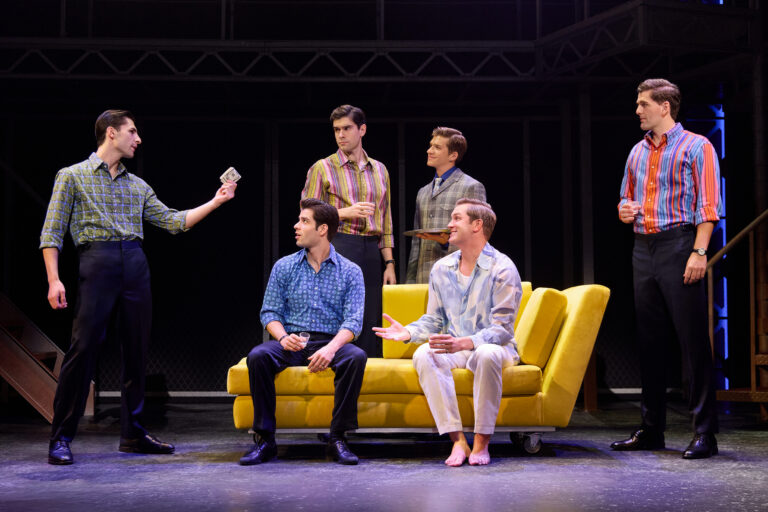
Bob Crewe’s Apartment
To say I was disappointed in this musical would be an understatement. Tickets for Jersey Boys run from $100-$400, with orchestra seats easily $200 apiece, and they’ll most likely sell out. For such a price tag, one would expect hallmark elements of a Broadway show to be on display, from the triple threat of actors who can sing, act, and dance, projecting to the very back rows of the dress circle, to the spectacle and stagecraft where music, script, and lights collide to create that theatre magic, or just having that wow-factor that you can’t place but that leaves you wanting more. Jersey Boys has none of that. Even the playbill for this run is minimalist and artistically vacant.
Jersey Boys relies almost entirely on the nostalgia of the 1960s and Frankie’s falsetto that can be replicated but never duplicated. Compared to musicals like Tina Turner: The Tina Turner Musical or Beautiful: The Carole King Musical, this jukebox musical has no story to fall back on when we strip away the familiar classic oldies. While the play doesn’t shy away from The Four Seasons’ real-life challenges with gambling, run-ins with the law, adjacency with the mob, and struggles to break into the industry, there’s nothing particularly captivating about the story. Not every story needs to be dramatic, but it should resonate with the audience in some way. The only time the audience for Jersey Boys had any resonating reaction at CIBC was when a d-level curse word was uttered a few times by the cast. Pearls were clutched, and tongues were tsked. And it is in that reaction that I argue that Jersey Boys has had its run as a musical. It can join the ranks of musical classics that have also run their course like The Music Man or Hello, Dolly.
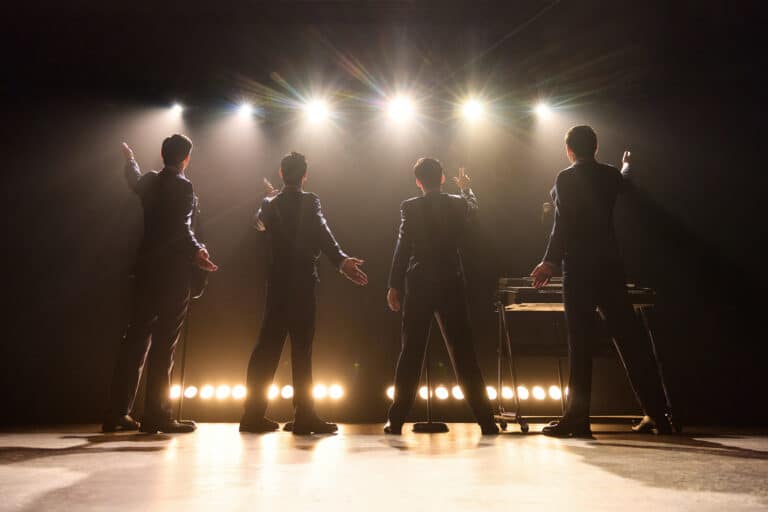
"Dawn"
If I set aside my personal nostalgia for The Four Seasons music and those days of oldie stations and pirated music, a fog lifts, and I’m objectively seeing a musical that feels dated, lacking, and not all that compelling a story. Jersey Boys requires your nostalgia in order to keep you in your seats. It's that same nostalgia that gasps and shakes its head when an actor emotes and uses the word bull*%$, outdated and old-fashioned. I might be alone in this box seat, and I might lose a millennial card when I note a musical only 20 years old needs to be retired with musicals from 70 years ago, but a curtain eventually closes on every show and decades of music are relegated to their own oldies station. As beautiful as nostalgia can be, it can also hold us back from asking or demanding different things. There is no shortage of stories to be told. There will always be songs to write and artists to honor through biographical jukebox musicals. It remains to be seen, but Jersey Boys might just be on its last encore tour, even if it doesn’t know it yet.
Jersey Boys is now playing at the CIBC Theatre (18 W Monroe St, Chicago) through November 22nd. Tickets are available for purchase at BroadwayinChicago.com [https://www.broadwayinchicago.com/shows/jersey-boys-3/].
Sardonic Love In The Time of Gen Z: World Premiere of The Break Up at Rivendell Theatre
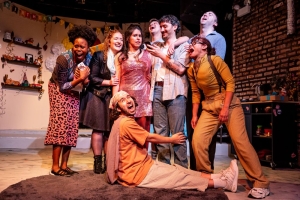
There are more important things in the world to worry about. At some point in our lives we’ve heard this phrase, often uttered when the other person, or persons, find the matter being discussed as unimportant. Take a break up of good friends, for example. A break up on its surface is small in comparison with the grander issues of the world. But to those individuals who broke up, and those closest to them, it’s more earth-shattering than the actual shattering of the world. Inevitably there will be someone who listens to your story about this cataclysmic break up only for them to find no importance of the matter and dismiss it as unimportant, reminding you that there are more important things in the world to worry about. But what if the break up was in fact more catastrophic than the literal end of the world? Avalanche Theatre’s They Broke Up, now playing at Rivendell Theatre Ensemble, explores just this.
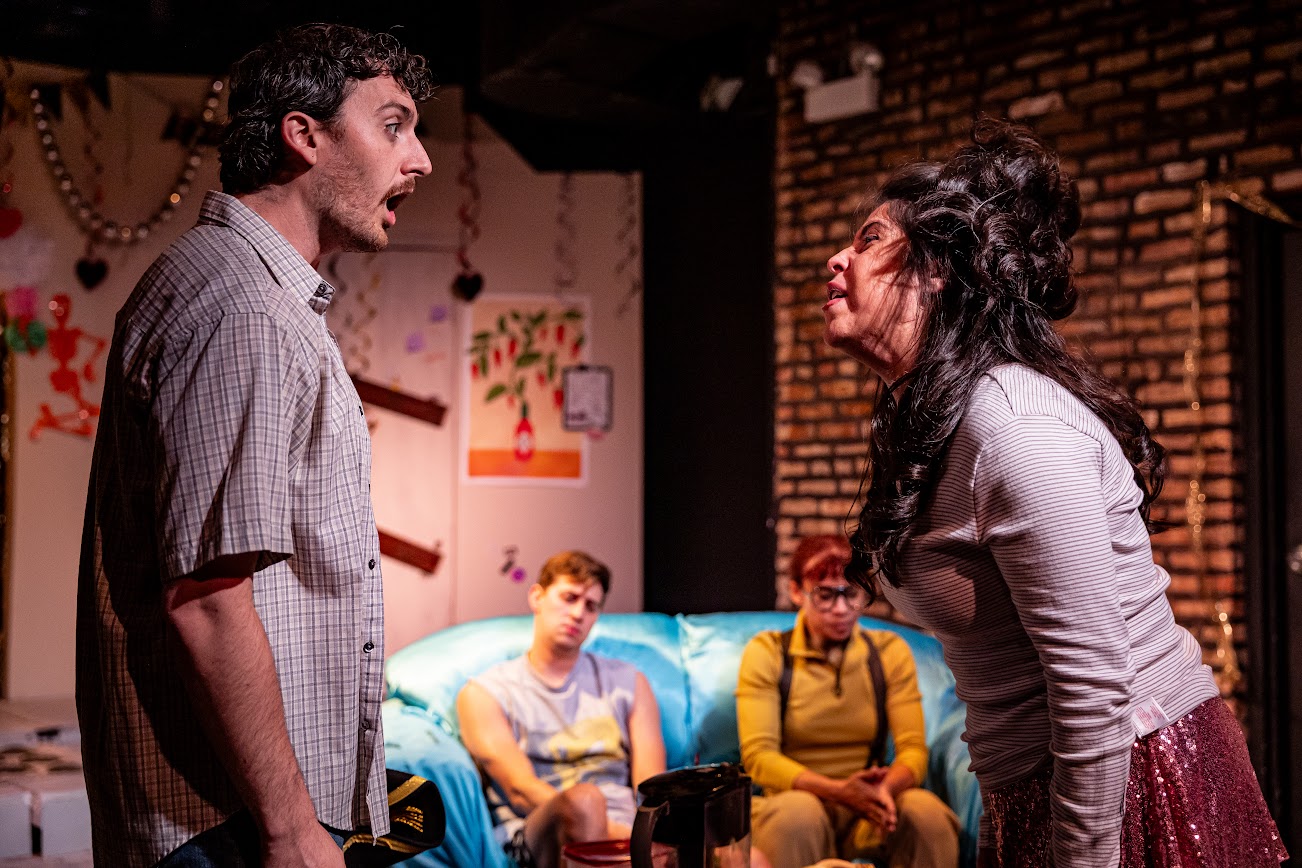
Photos by Alex Albrecht.
It's New Year's Eve, and it sure looks like the world is ending. But much more importantly, Brett and Amy have just broken up. As aliens pollute the water, zombies run for Congress, birds ravage the housing market, and apocalyptic cult plans for the end of days, Brett and Amy's friends scheme to reunite them while the ex-couple themselves try to navigate a world with an end-date and a world without each other. They Broke Up is an apocalyptic absurdist comedy centered around a friend group trying to weather both the end of the world and the much more devastating end of a relationship.
If the synopsis for They Broke Up reads a bit extra, a little too much, it’s because it is. Throughout the nearly three-hour production the cast of characters reveal themselves and the absurd world around them through fast-paced, self-deprecating, hyper-self-aware, farcical and troupe-tiptoeing dialogue that needed a level of attention of presence that not even an Italian Opera requires. The true plot of The Break Up is hidden somewhere between the flesh-eating party vying for political dominance and conspiracy theories around South Dakota. If you’re able to find decent rent from the bird landlords and avoid being sworn into a cult, you might be able to find the message or point to the production. There might be more important things to focus on, but They Broke Up spends entirely too much time on the subplots and quirky commentary about the world around them that the audience forgets the plot is not the end of the world but the break up of the two main characters. Perhaps that was the intention of the playwright. “I remember reading three grotesquely awful news stories in a row in a Trader Joe's parking lot and then dissociating heavily next to the oranges,” said playwright Skyler Tarnas. “I realized that's what this play was going to try to capture... the constant overload of tragedy and the deranged sense of detachment I felt like I needed to get through the day, letting numbness shut out helpfulness and growth.” The characters do wonderfully portray a true sense of apathy to the insane events around them through quick-witted delivery and commanding physical comedy. But the plot is entirely lost to the world the characters are in. The break up itself is mentioned with the same blasé narrative as one of the characters near-death experiences with the land-hoarding birds. Occasionally humorous but entirely too much, The Break Up as a play has potential to capture the apathetic, dissociative yet endearing heart of the Gen Z generation with some careful trimming and tightening of the play.
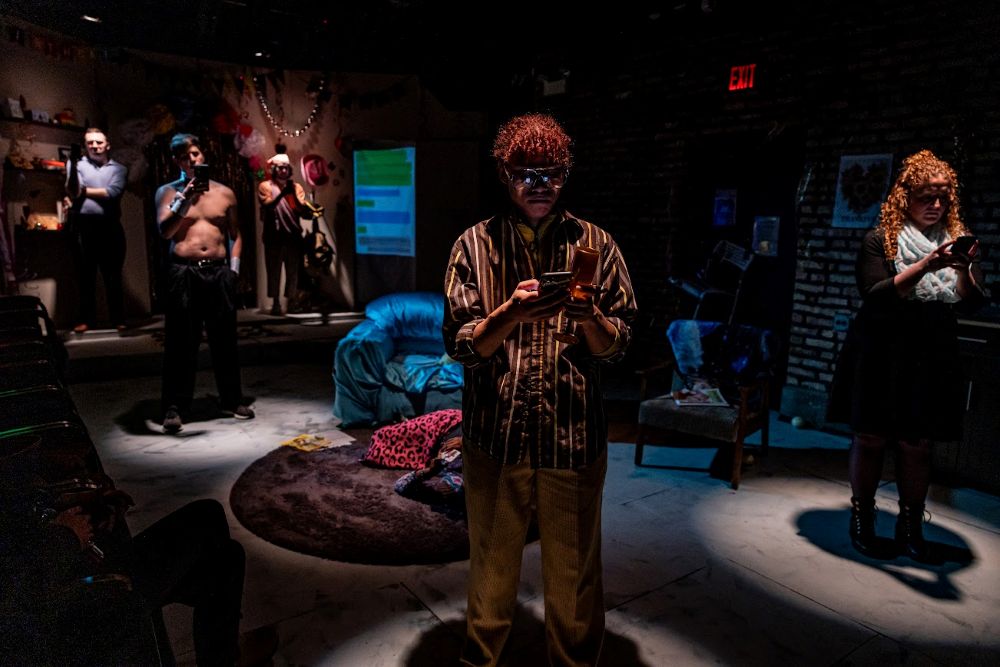
The Break Up was workshopped with Avalanche Theatre, now in residence at Rivendell Theatre Ensemble. Avalanche Theatre was found in 2019 and focuses on developing new plays by Chicago playwrights. It’s an incubator for young playwrights, a place for original ideas and plays to be workshopped and tested out through programs like Next Draft Series and monthly Show & Tell events. Avalanche is a unique space that focuses on elevating the voices of Chicago’s emerging playwrights such as Tarnas’ They Broke Up. "They Broke Up is one of the most fun, distinct, and laugh-out-loud plays we've come across at Avalanche,” says Avalanche Theatre’s Artistic Director Alexander Attea, who plays Brett in the production of They Broke Up. Originally written in 2024, the play has changed and evolved to eventually be the production now running at Rivendell in November, though it still needs work. The nearly three-hour production is exhaustive with repeated troupes and subplots like personal particle colliders that can be entirely removed without losing any of the dark humor or nonchalance that helps deliver the laugh-out-loud moments. Jokes can be delivered once with great effect, the second or third attempts at delivery cleaned up, and more attention and focus to what you’d want the audience to take away from the production. Is it purely absurdist and pointless? If yes, then why should we even care about the break up at all? Are we actually rooting for the break up or are we rooting against it? Not even the cast of characters had a strong opinion one way or another. Even with all that, The Break Up is an original play with potential to convey the apathetic viewpoint that marks an entire generation.
There are more important things in the world than a break up, yes, but if the whole point is to care about the break up, shouldn’t we focus more on that than the actual things happening in the world? Even if we’re completely unbothered and apathetic to it? You decide, or don’t, I don’t have an opinion one way or another. Avalanche Theatre’s world premiere of They Broke Up plays through November 22nd at Rivendell Theatre Ensemble (5779 Ridge Ave. Chicago). For more information and to purchase tickets, visit avalanchetheatre.com/event-details/they-broke-up.
A Mystery of Mysteries : David Parr: Time Traveler Transcends Logic at Chicago Magic Lounge
It wouldn’t be Chicago history without a few mysteries nestled amongst the ivy and six cornered paths. For every historical site or fact about the windy city is a stranger truth than any books or historians can truly capture. That’s one the magical things about this biggest small town, there is always something more than meets the eye, a history as deep and chilling as the great lake it rests against. I suppose that’s why it’s equally surprising and typical to find secrets hidden in its many neighborhoods. And sometimes those surprises are found hidden behind a laundromat in Andersonville.
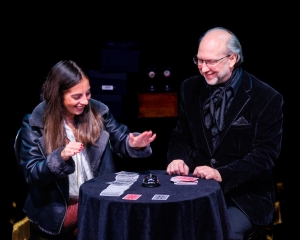
History has secrets. Master magician David Parr helps uncover them. In David Parr: Time Traveler, you are invited on an extraordinary journey where history, mystery, and magic collide. Blending captivating storytelling with astonishing sleight of hand, Parr explores forgotten legends, remarkable true stories, and unexplained mysteries, where history and folklore mingle in mysterious ways, and the impossible feels just within reach. Every performance is a reminder that the world is still full of surprises and mysteries, and that history is often far stranger than fiction. Join David for an unforgettable hour of wonder, curiosity, and theatrical magic that proves history still has a few secrets left to reveal.
Whether you geek out about magic, watch in a vain attempt at uncovering the trick, or are a die-hard skeptic, David Parr does not seem to mind. Embodying the mystic and aura of a magician pulled straight from the vintage posters that adorn the walls of venue, Parr is not your typical magician. He’s humble, curious, philosophical, and above all an entertainer. Weaving personal stories and historical storytelling, Parr crafts an incredible show that promises no two tricks are the same. It leaves the most skeptical people wondering if his magic was real, some of the tricks defying all logic. Throughout his set Parr poses questions but makes no attempt to answer them, leaving instead a mystery for each person to solve, as unique and complex as the magical tricks he creates. That aura possibly explains how David Parr stumped the famous Penn & Teller on their gameshow “Fool Us” in 2017, a feat few magicians ever mastered. How he did it remains a mystery, one that is now tucked away within the magic-lined walls of Chicago Magic Lounge.
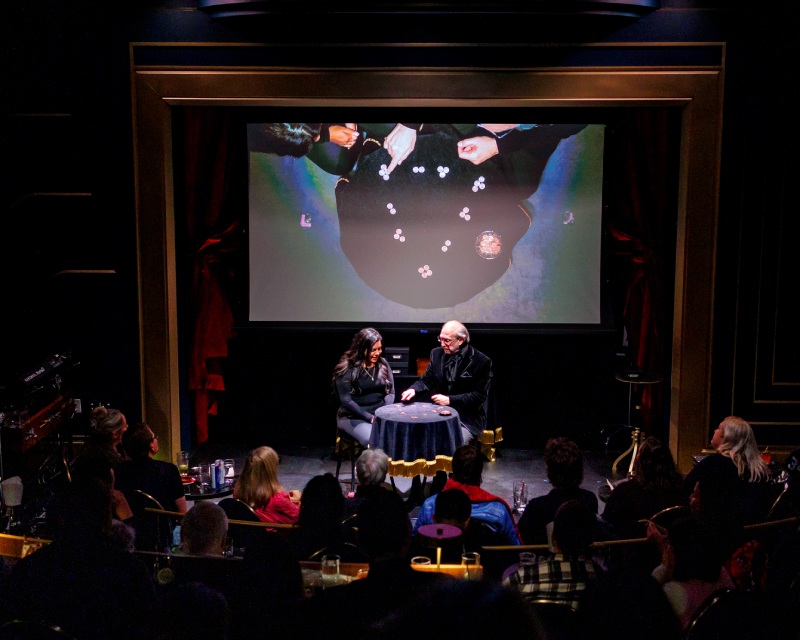
Photo by Sarah Elizabeth Larson.
Chicago Magic Lounge is unlike any venue in the city. Sure, the newly remodeled McCormick mansion boasts a similar style but it pales in comparison to this charming space. Chicago Magic Lounge is a signature speakeasy-style magic theater and performance bar in Andersonville, featuring close-up and stage magic from a rotating lineup of professional magicians from Chicago and around the world. Hidden behind a secret entrance, it offers an intimate night out with live performances, craft cocktails, and shareable small plates. Whether you're planning a date-night, celebrating something special, or looking for a distinctive night out in Chicago, this speakeasy experience is worth returning to. The space offers three unique spaces within its venue, and the real mystery is how this charming place has stayed a hidden haunt for so many years. The prices are extremely reasonable. The staff are some of the most lovely and welcoming people you’ll ever meet, eager to invite you in for a spell and bring you magic potions if you are so inclined. Magic lines the walls, cases of historical magical artifacts encased for viewing, posters of predecessors watching over natural born magicians demonstrating their skills with close-up magic. It’s truly a magical experience and one that can pay homage too but can never truly replicate.
History can often repeat itself but time as we know it is often fleeting. We never know how much time we have to see the things we want to see and experience everything Chicago has to offer. I personally believe I can live one hundred lifetimes and never truly see and experience everything this city has to offer. Perhaps that is why David Parr’s show resonates so deeply. Maybe he is on to something. Perchance time really is the greatest mystery of all. And what better place in the world to experience that than right here in Chicago? Don’t let this magic disappear, stop time a moment and see David Parr at The Chicago Magic Lounge. David Parr: Time Traveler will be presented on Wednesdays through December 16th. Tickets are available at www.chicagomagiclounge.com/time-traveler.
A Call You Want To Answer: Jerker, Or The Helping Hand speaks volumes in Uptown
There are no shortage of stories to be told in Chicago. Whether you’re visiting a museum, riding the L, or simply sitting on a lakeshore bench, you can find a story in every person you encounter, every landmark you see, even the very ground holds stories in Chicago. For every singular story there is a theatre, a center, or a space that offers a stage to allow those voices to be heard in nearly every neighborhood from prime downtown real estate to a small garden space. Whatever the stage, voices are given a platform and stories are shared. It is only for us to sit for a moment and listen to the stories, lest they never be told, or forgotten to time. That’s exactly what Jerker, Or The Helping Hand aims to do before it wraps on November 8th at the Open Space Arts.
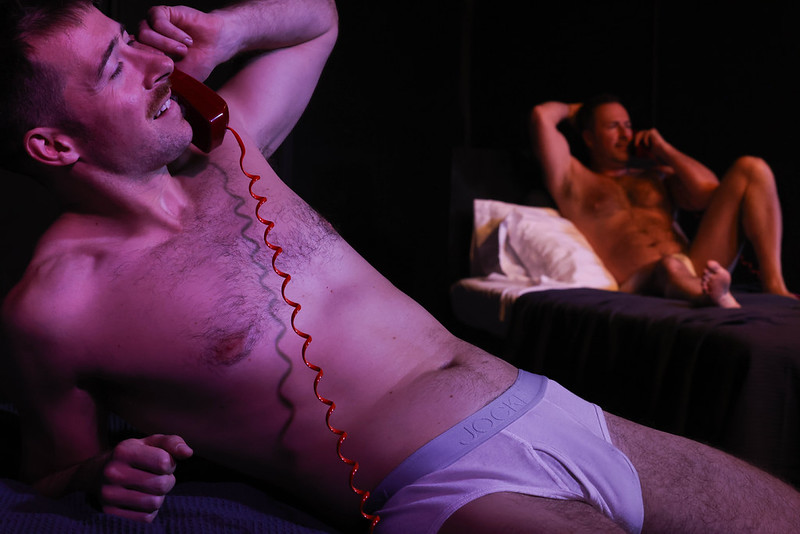
L-R: Joshua Bowen, Jason Bowen. Photos by Jeremy Lawson Photography.
Jerker, Or The Helping Hand is a pornographic elegy with redeeming social value and a hymn to the queer men of San Francisco in twenty telephone calls…many of them dirty. Set against the backdrop of San Francisco in the 80s, the intimate and minimalist set puts you right in the middle of a quick and steamy sex call. The two men lay in their respective beds, one hand holding their long landlines, the other holding their long…well, you can imagine. Over the course of the phone calls we learn about the context they find themselves in, their world slowly forming around them with each reference of the character’s flirty banter. Flirtation leads to vulnerability, vulnerability leads to friendship, and something deeper is being connected through the tangled red telephone cords, more than just casual sex. These men can’t truly be who they are, for fear of ridicule and a virus that terrified and decimated a community. They long to be seen, to be cared for and looked after, and most importantly safe from the ignorance and illnesses that plagued their friends and chosen families.
The story unfolds carefully. It is not preachy or presumptuous. It assumes the audience and viewers know enough about the aids epidemic and statistics to linger on the topic for too long. It was also so unknown during the period of time the play is set in. Jerker, Or The Helping Hand focuses instead on two men looking to play, release, and connect on a different level. It gives a voice to those voices lost to a time that is slipping further away; decades whittled down to facts and statistics. We hear from voices that unless we sit and listen risk being lost beneath the weight of something that was more than 40 years ago.
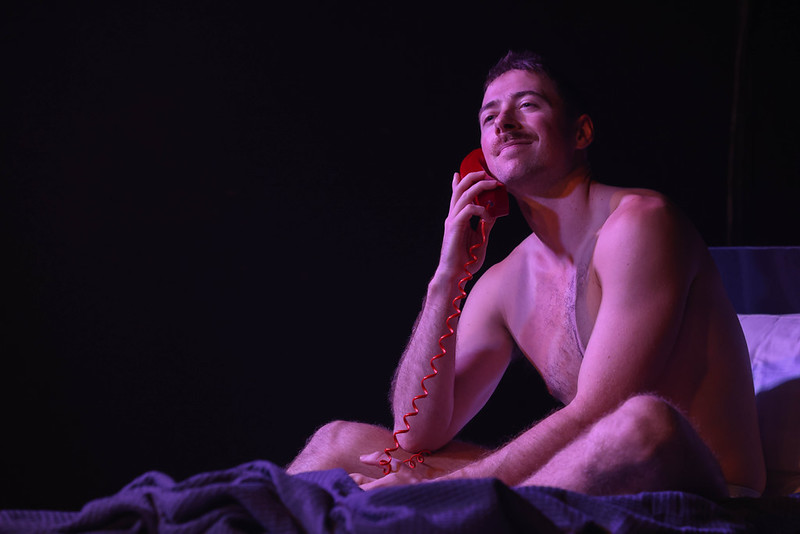
JR Solo: Joshua Bowen
Robert Chesley's Jerker, Or The Helping Hand is one piece of the four-play series ‘Before We Are History" now playing at the Open Space Arts Center. The curated and selected pieces spotlight early queer voices and aids-era works. Together, the plays offer a journey through a history that must never be forgotten. “Our hope is that we leave these performances with a deeper understanding of what the world lost,” says Artistic Director David Zak, “what survived, and what we still have the power to discover, preserve, and create together.” Contrary to what I tell myself, the 80s weren’t 20 years ago. Entire youthful generations haven’t grown up in the shadow of a virus that was once a death sentence. Though they’ll learn of the era it will be like more history books, clinical facts on a page. Though stories have been written there are thousands that have not. Open Space Arts shines a light on those voices in this beautifully curated series. It’s those voices, those stories, that truly make Chicago theatre what is it.
Jerker, Or The Helping Hand is performing a limited run through November 8, at the Open Space Arts theatre in Uptown (1411 W Wilson Ave., Chicago). Tickets are available at https://openspacearts.org/ Be sure to see it before 20 years turns into 40 years and 40 years turns into history.
Layered, Lovely, and Lasting; The Joffrey Ballet's Liliom Lights up The Lyric Opera

Sometimes when we reach into the past to resurrect or revive an old story, we find it doesn’t age well. The subject matter could be problematic, the material divisive, the cultural context lost through the fabric of time. Without proper context we tend to view these historical pieces through a modern lens. We’re quick to criticism, condemn, or simply say the story doesn’t resonate with newer audiences. But once in a great while, we reach back in history and find a piece that doesn’t require adaptations, modernization of the old piece simply adding to the allure of the story. Give that narrative to visionaries and dreamers and you might just get a production that future generations will pull from the archives, not to resurrect or revive, but revere. That one is a great while is here today in Chicago with the Joffrey Ballet’s premiere of Liliom.
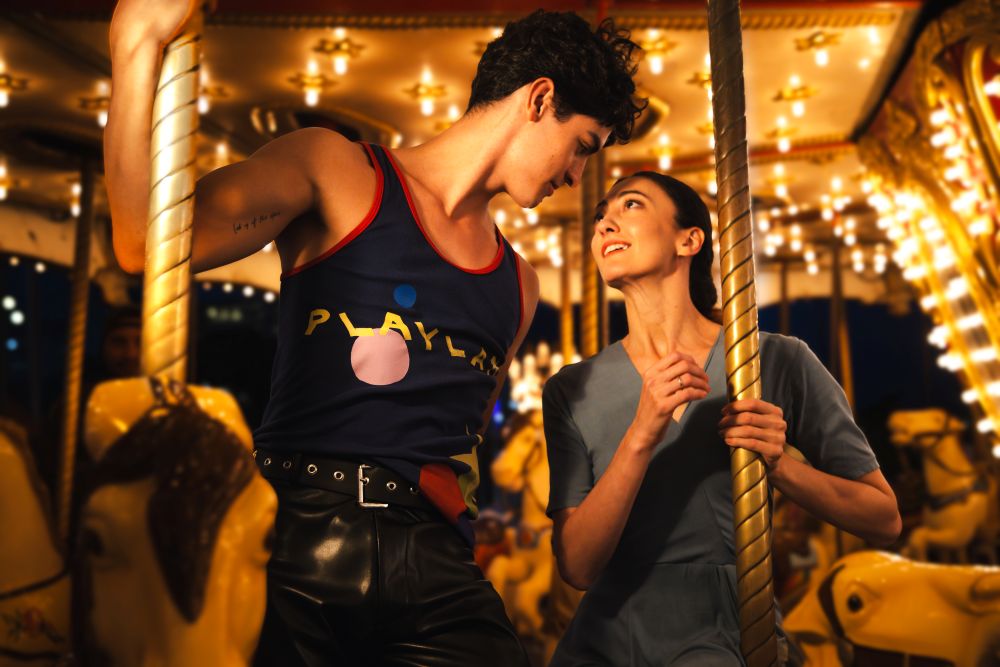
Joffrey Company Artists Victoria Jaiani and José Pablo Castro Cuevas.
Inspired by Ferenc Molnár’s 1909 play, Neumeier’s adaptation follows the story of Liliom (performed by José Pablo Castro Cuevas), a charismatic but self-destructive carnival barker (think of the ringmaster-like man enticing people to attend the carnival with an eh ‘come one, come all!’ ‘come on down!’ flare). Liliom falling fiercely in love with Julie (performed by Victoria Jaiani). Their whirlwind romance is eventually unraveled by pride, poverty, rage, and poor choices made under societal pressures. Set amid the dreamlike, faded glamour of an American amusement park during the Great Depression, passion turns toward crime—and ultimately, tragedy. Granted a chance to return to Earth after death, Liliom confronts the consequences of his choices and attempts one final act of grace. What remains is a stark reckoning with guilt and the fragile possibility of redemption.
In the resurrection of this play, and subsequent adaptation of the ballet, conversation, and coverage around Liliom. The history of the origin of the production isn’t all that complicated. The original stage production was written by Hungarian dramatist Ferenc Molnár in the early 1900s. That script became inspiration for Roger and Hammerstein’s 1945 musical Carousel and was made into a major motion picture in 1956 complete with a dreamlike ballet sequence. In 2011 the Hamburg ballet developed an adaptation of Liliom with legendary composer Michel Legrand. Since then no one has staged the ballet. The Joffrey ballet is the first American ballet company to bring the production to life and under the stewardship of choreographer John Neumeier has created a masterpiece that requires no comparisons or ties to its predecessors.
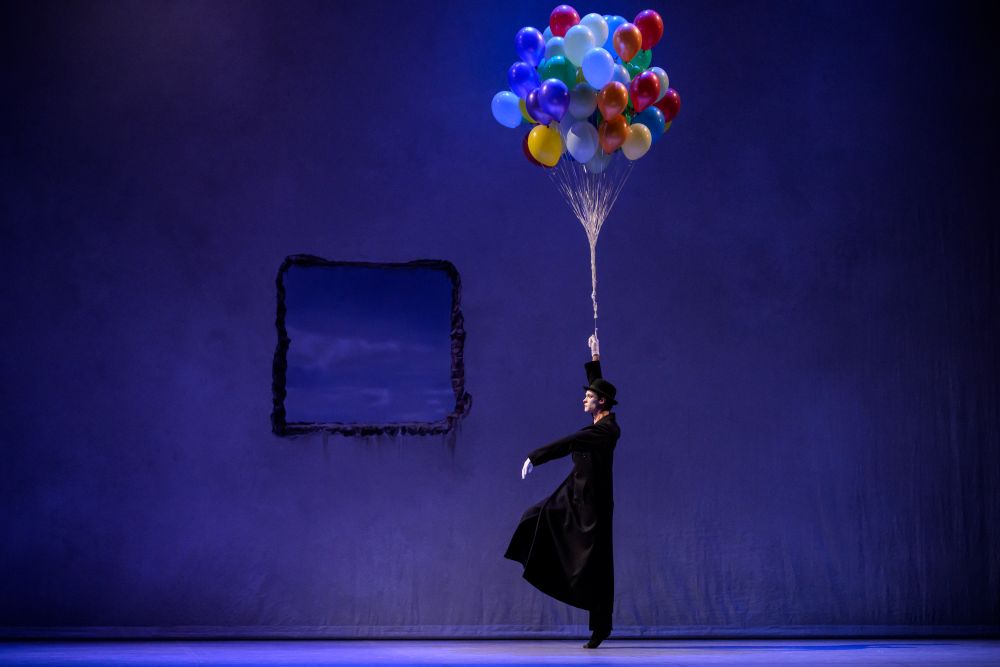
This ballet is unlike anything you’ve seen before. Neumeier and the Joffrey ballet bring a dark yet whimsical artistry to the stage and that duality is carried effortlessly throughout the production; the charismatic yet dark lead coupled with a naïve yet loyal woman, the balloon man symbolizing the ever present death holding colorful balloons that navigate through busy crowds and emerge in dark corners, the amusement park offering escapism and joy juxtaposed against the poverty of the great depression, the soft and classical orchestra contrasted with scatting jazz, the soft and delicate lines of traditional ballets melding seamlessly with the sharp angles of modern contemporary movement, heaven and hell, right and wrong, light and dark, the duality is what draws you in and never lets you go. The choreography, the music (two full bands!) the set designs, the dancing, Liliom is a feast for the eyes and a balm from the banal. The Joffrey Ballet has truly outdone itself and its safe to say it is Neumeier’s most profound artistic endeavors. The emotional depth and theatrical nuance he brings with his staging is articulated and crafted into the smallest details. Everything is intentional, everything is layered and structured and deep, with deeper meanings, foreshadowing, illusion, and mystic that adds to the beauty of this ballet.
There are still some theatergoers that will focus in on a single element of the production and completely write this off. That’s the mistake we can make when we resurrect or reimagine a piece from the past. Hey, even Shakespeare has critics. But when we focus in a single element we dislike, that is there for character and plot development to move the story forward we lose sight of the thousands of other details that make the production unproblematic. Liliom is layered, lovely, and lasting in a way that future generations will look back and admire with awe, not condemnation and judgement. Let’s hope this production does become an annual performance for not just the Joffrey but all ballet companies looking to bring beauty and light into the dark. So come one, come all, and get your tickets for Liliom, now playing at the Lyric Opera (20 N Wacker Dr, Chicago) through September 27th. You don't want to miss this one, folks!
Divergent Viewpoints Distract: The Birth of the Pill at Timeline Theatre
There are always two sides to every story. The writer or playwright will tell a story offering key details and scenes that move the story forward in the way that leads the audience to a message or conclusion the writer or playwright want to convey. The difficulty of any story writing, in any form, is what to include or what to exclude in your story. That is something that can be controlled. The other difficulty is trying to convey a message or point to your audience, one you want them to walk away with, chew on, think about. This difficulty is completely out of the writer’s control. Attempting to tell two sides of the same story adds a level of complexity for the writer and the audience and it’s not an easy feat to pull it off. The Birth of The Pill takes aims at just this style of storytelling, the world premiere play now playing at Timeline Theatre.
In the mid‑20th century, a radical dream begins to take shape: a simple pill that would give women full control over their reproductive futures. Championing this groundbreaking idea are feminist activist Margaret Sanger, scientist Gregory Pincus, gynecologist John Rock, and philanthropist Katharine McCormick—visionaries working under intense secrecy amid legal, scientific, and religious roadblocks. Meanwhile, in Puerto Rico, clinical trials raise ethical questions, as the lives and bodies of women like Ramona Delgado are exploited in the quest for scientific advancement. Commissioned and developed by TimeLine and based on the book by Pulitzer Prize-winning author Jonathan Eig (King: A Life), the world premiere of The Birth of The Pill explores the transformative power of vision and invention, alongside the costs of pursuing both by any means necessary.
The Birth of the Pill is not a lift and shift theatre adaptation of the book of the same name. The book was written as a non-fiction historical account of how “The Pill” came to fruition. It is clinical, literal, factual. It recounts the stories of the women (Sanger and McCormick) who spearheaded the campaign to develop The Pill on behalf of women everywhere. But The Birth of The Pill, like many historical accounts, does not discuss the lives of the very real, very lost voices of the very real women whose lives were forever changed and affected by the Trials conducted in Puerto Rico. Those women’s stories was a different story altogether, one the book’s author did not aim to tell. It wasn’t an intentional dismissal of the storyline, but a concurrent one, a differing viewpoint, a second side to the story.
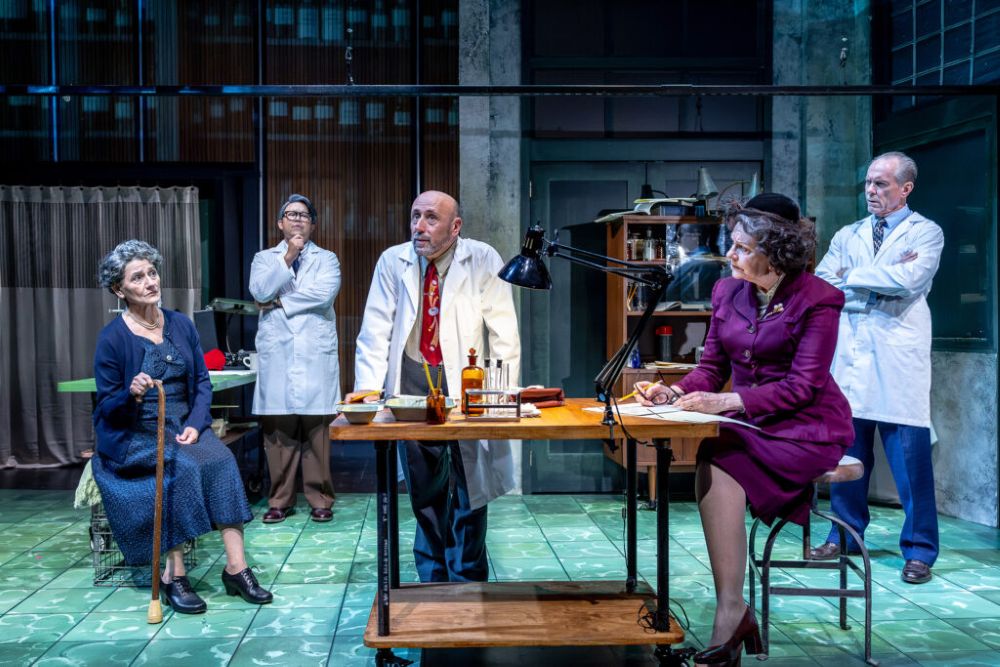
The cast of "The Birth of the Pill" at TimeLine Theatre Company.
The play, written by playwright Jessica Huang and directed by Sandra Marquez, aims to give that second storyline a voice, the story of the Puerto Rican women who were tested and experimented on in pursuit of this revolutionary form of birth control. The key actors in this play include Janet Ulrich Brooks as Margaret Sanger, María Victoria Martínez as Ramona Delgado, Mitchel J. Fain as Goody Pincus, and Mary Beth Fisher as Katharine McCormick. Through the narration of Ramona Delgado we are guided through history alongside Margaret Sanger from her post in the first ever Planned Parenthood in Brooklyn, NY, through the funding, research, and later development of The Pill. While well intentioned, the play takes a considerable detour from its source material at the critical point of human trials to examine that second storyline, namely, the toll and morality of human Trials. There is a poignant moment between the narrator and Sanger wherein a philosophical question is posed: Given everything you know, the impact it had, would you do anything differently? That is where this play should have ended.
The character of Delgado is a valiant attempt to write the women who trialed The Pill into the story of The Birth of the Pill but it’s a completely different perspective and is not given its due. Perhaps that was the intention of the playwright. Throughout the play, the main character, our narrator, is sidelined, dismissed, overlooked, even silenced. It’s a subtle and artistic representation of how the trial participants were treated. At a key point in the play we move away from the historical retelling of The Birth of the Pill, abruptly changing narratives. The light and humorous narration takes a sharp turnaround to become one with a modern viewpoint. It criticized the ethical and moral viewpoints of the main characters, their actions, their decisions, diverging away from the source material. Published in 2014, the book could not have accounted for or discussed the cultural, social, and moral impacts the 2020s had on the story of The Pill. I don’t believe the author was ill-intended by not accounting for the lives of the trial participants, or examining the moral and despicable acts committed in that state. The Birth of The Pill tries to rectify and almost apologize for this unintentional oversight leaving the audience with a hurried and heavy-handed message that leaves you questioning: which story was the play trying to tell? The story of the birth of the pill or that of the women who were tested on? It’s not the same story, it’s the second side to the same story.
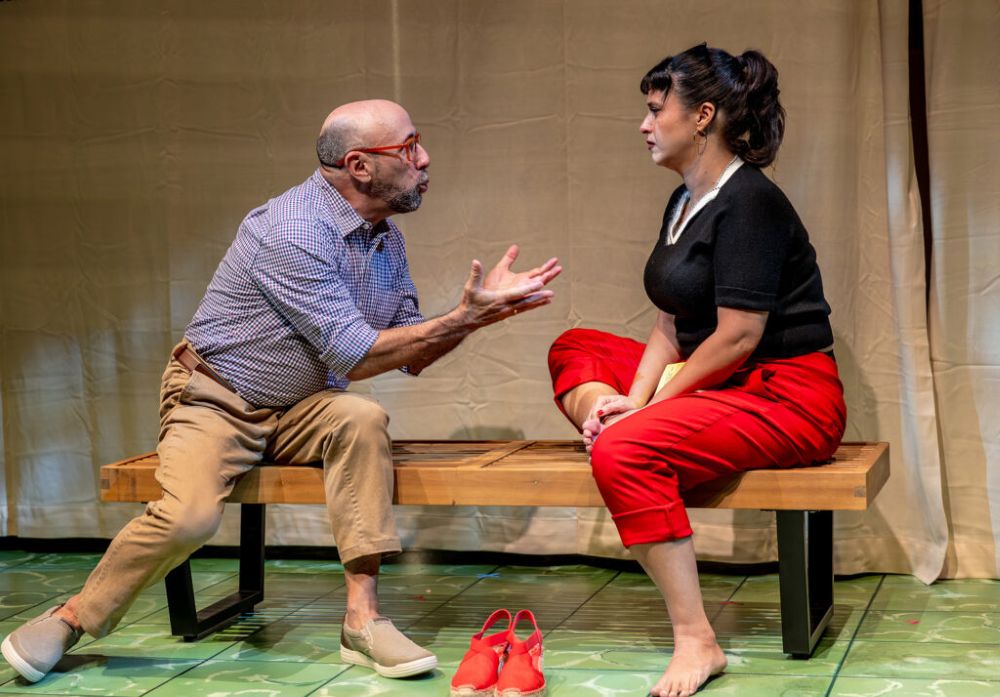
Jonathan Eig (Mitchell J. Fain, left) and Ramona Delgado (María Victoria Martínez, right) discuss the complexities of historical narratives.
Not every play can pull off the duality of storytelling, where two differing viewpoints are given the stage. The Birth of the Pill is a story worthy of telling and seeing. It was humorous, moving, challenging, and overall compelling. It can stand on its own, with a simple yet complex ending on a philosophical dilemma. It deserves to be told on its own, without a modern, critical perspective and narrative. Then there is the different viewpoint. Another side to the same story that deserves its own time, its own space, unhurried, told in full, with all the vitriol and venom many of the acts committed on the path to progress deserve. The Birth of the Pill play inadvertently, or possibly intentionally, provided a foundation and springboard for a new story to come to light, one that given its own voice, time, and space, would only add to the power of the original story. There are two sides to every story. This particular story deserves both to be heard, just not at the same time.
The Birth of the Pill Runs through October 4, 2026, at TimeLine Theatre (5035 N. Broadway, Chicago). Set you calendar reminders and be sure to get your tickets at https://timelinetheatre.com/events/birth-pill/.
*Extended through October 11th!
- The Birth of the Pill
- The Pill
- birth control
- Margaret Sanger
- Ramona Delgado
- TimeLine Uptown
- Timeline
- Timeline Theatre
- Timeline Theatre Company
- theatre
- chicago theater
- things to do in chicago
- weekend shows
- mustsee
- must see theatre
- whats happening this weekend
- Janet Ulrich Brooks
- María Victoria Martínez
- Mitchel J Fain
- Mary Beth Fisher
- Sandra Marquez
Love and Time On Our Side: The Notebook: The Musical at Broadway in Chicago
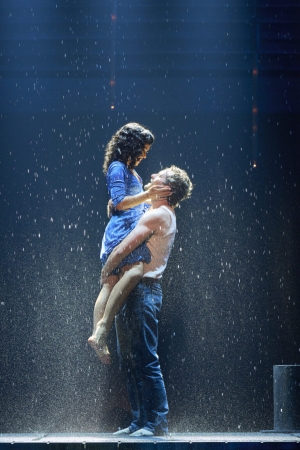
In times of stress, we often turn to familiar and comforting things: a favorite song, a dog-eared book, a movie we’ve seen twenty-seven times. We’re drawn back to the things we know because they have a certain salve to the severity and uncertainty around us. There’s a comfort in knowing what is coming, how something will turn out, that everything works out in the end (or doesn’t if that’s your jam). We can revisit the same story over and over again, play it in the background, speak it word-for-word, and still never tire of it. Even when the same story is told through a new medium, we gravitate towards it naturally, prepared to be comforted all over again.
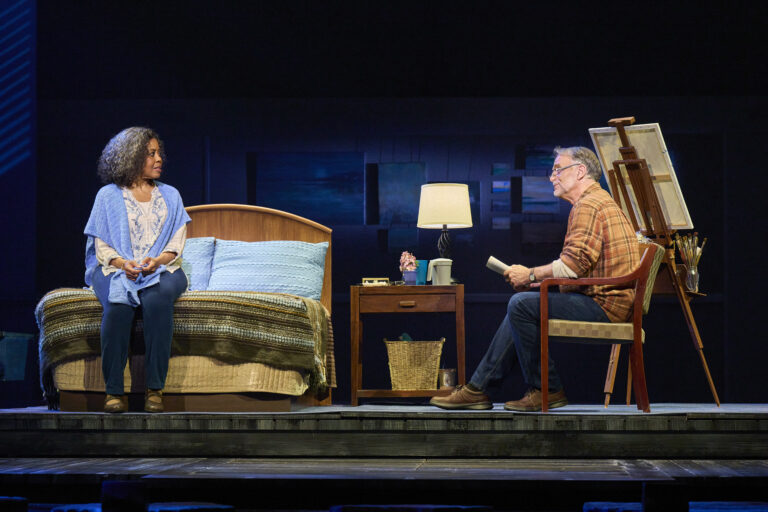
Sharon Catherine Brown (Older Allie) and Beau Gravitte (Older Noah) in The Notebook. All photos by Roger Mastroianni.
For many millennials, there is no better comfort show than The Notebook, now a musical presented by Broadway in Chicago through August 16th. The Notebook is a new hit musical based on the best-selling novel that inspired the iconic 2004 film. Much like the movie and the book the musical adaptation is based on, The Notebook: The Musical follows the love story of Allie and Noah, a young man and woman from different worlds, sharing a lifetime of love despite the forces that threaten to pull them apart.
Truthfully, the love story of Allie and Noah isn’t particularly groundbreaking; a rich girl and a poor boy fall in love, but societal pressures and expectations push them apart and challenge their choices, though (spoiler) their love overcomes and they find their way back to one another time and time again. One of the central themes of the story is about young love. It’s a love that grows and yet remains unchanged. It’s about a love that endures and prevails against the most wicked villain in the universe: time.
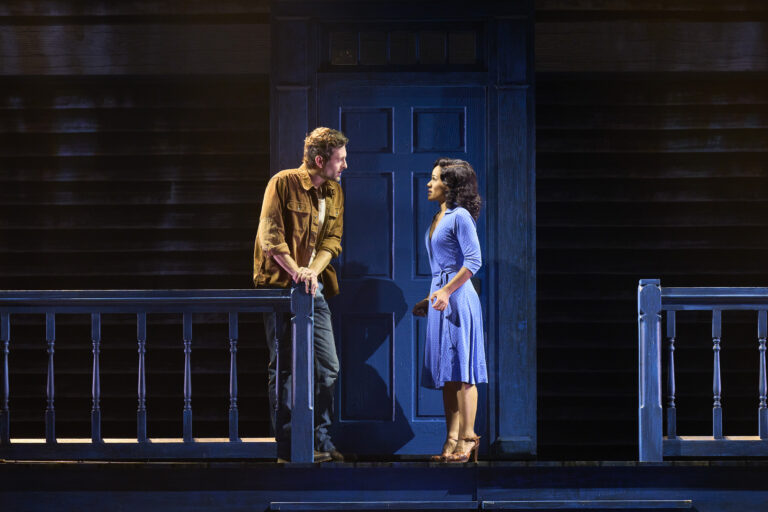
Ken Wulf Clark (Middle Noah) and Alysha Deslorieux (Middle Allie).
The Notebook: The Musical visualizes this simple love in the most compelling of ways that both the book and the movie cannot truly capture. Memories of Noah and Allie’s younger and middle selves drift across the stage as the elder versions watch with reverie, nostalgia, and sonder. The interactions with these wisps are brief and fleeting, just like time itself. Songs are reprised and echoed throughout the play just as memories do, tangible and yet somehow out of reach. The stage medium hurriedly tells the same story we know (and watch on repeat yearly), but it’s this franticness that only adds to the beauty of The Notebook. Stage productions have a limited time to convey messages they want the audience to walk away with. It’s this medium that truly captures the urgency and fleetingness of The Notebook; that time in linear, ever-present, and ticking away until there is none left. The production even hints at this central theme from the moment you enter the theatre, the sound of a distant, persistent ticking clock. Time is the enemy, and it’s in time that we drift between our past and present selves and reflect on the love between Allie and Noah. That’s what makes The Notebook so comforting. It’s time, and the time that is given to us; what more is needed in this world than to love someone so deeply, and to be so loved in return, that time doesn’t matter?
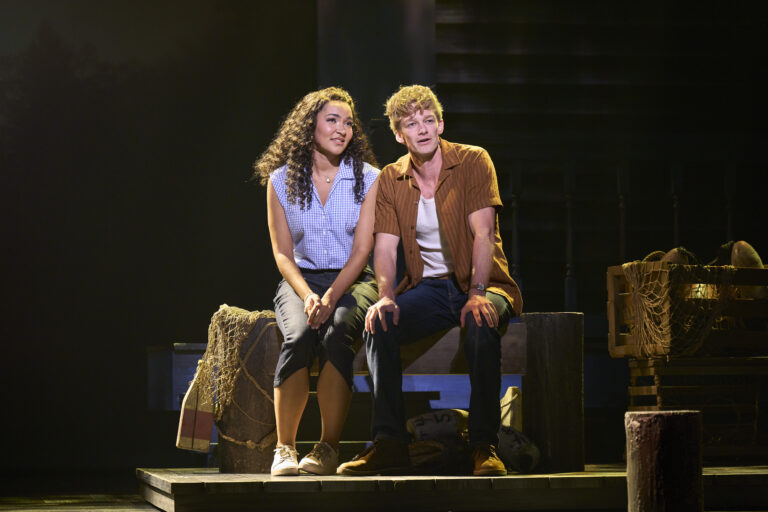
Chloë Cheers (Younger Allie) and Kyle Mangold (Younger Noah).
Truthfully, The Notebook: The Musical is not particularly a revolutionary or Tony-award-winning musical. But then again, the 2004 adaptation of the novel wasn’t winning Oscars. It’s a simple story told through a new medium with plenty of feet-kicking, giggle-worthy, heart-wrenching moments. The songs are sweet, simple, and performed with incredible vocals and an emotionally vulnerable cast that heighten the awkward, love-sick, truly sick events that make this simple story so beloved by an entire generation.
It might not be flashy. The songs might not make Broadway playlists. But this musical is worth every fleeting moment of your time. To those who the story resonates with, it will feel like a favorite book filled with marginalia, a movie you can quote word-for-word, a song that brings butterflies to your stomach after decades of hearing it. And what better way to spend your time than curling up in an auditorium theatre to watch the beloved love story? The Notebook: The Musical is now playing at the James M. Nederlander Theatre (24 W. Randolph St., Chicago) through August 16th. Don’t waste any time and get your tickets today.
All The World's a Stage and Chicago Merely The Best Player: 'As You Like It' in Chicago Parks this summer
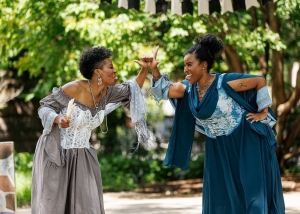
Is there anything more alluring than a summer night in Chicago? The lakefront beaches, the meandering pathways, the festivals and street foods, the hidden gardens where free art productions are staged, whatever you like, you can find it in the city during summer evenings. There is no shortage of parks to explore or cultural events to experience, thanks in part to the Mayor’s Night Out in the Parks program that partners with organizations to stage free artistic experiences in neighborhood parks all around the city. One such organization kicked off its summer series with a spectacular – and free – performance of Shakespeare’s As You Like It, now playing throughout Chicago parks through August 2nd.
Shakespeare’s As You Like It is a comedy that follows Rosalind and Orlando, two lovers who each run away from their own political and familial problems and escape into the Forest of Arden. Disguised as a shepherd boy, Rosalind finds Orlando and convinces him to woo her under the guise of curing him of his love for Rosalind. Multiple couplings occur, lessons of life and love are expounded on, and, as every Shakespeare comedy does, As You Like It ends with a wedding – four to be precise.
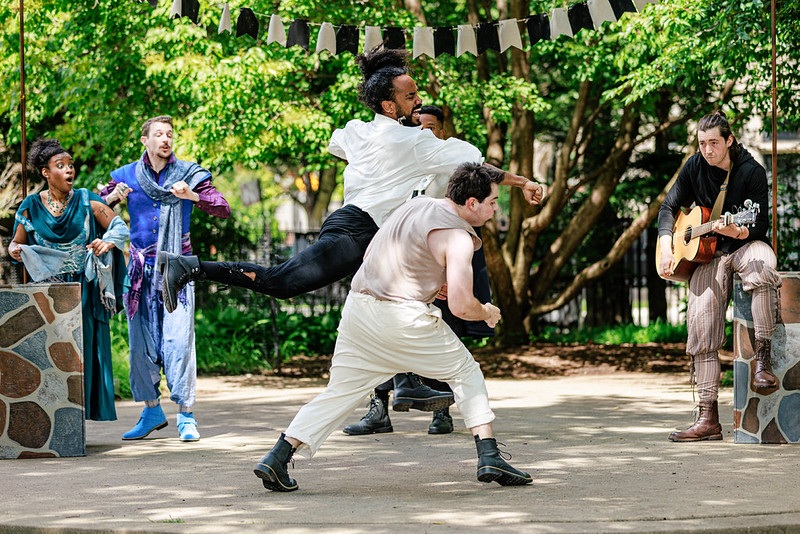
foreground - Thomas Russell and Connor O. Locklin. Photo by Steven Townsend, Distant Era.
As You Like It is the 2026 production of Midsommer Flight, a theatre troupe that stages high-quality, accessible performances of Shakespeare’s plays in Chicago. Directed by Producing Artistic Director Beth Wolf, this summer’s production continues to delight audiences and draw crowds, presenting free performances to Chicago communities that aim to bring people together. Midsommer Flight is an Arts Partner with Chicago Park District and a participant in the Mayor’s Night Out in the Parks initiative. They will be performing the classic Shakespeare comedy throughout the summer at different neighborhoods throughout the city, but if you think you’ve seen a Shakespeare production, (seen one, seen them all, right?) I beseech you to venture to one of the parks. At the best of times, Shakespearean stories can be difficult to follow: analogous phrasing, double entendres, prosaic old-timey insults, and slurs; it’s not always easy to follow. Midsommer Flight, however, gives the old texts modernity, witty asides, and an expressive atmosphere that makes the play easy to follow and understand. The acting is superior, and the inclusivity is a delightful and refreshing display of humanity at its finest. Talent of the Midsommer Flight cast would rival that of any Shakespearean theatre company, charging hundreds of dollars for seats, and staging productions in grand halls. And the best part? The productions are completely free to the public. The accessibility, the garden park scenery, and the flowy costuming truly provide a magical experience, embodying the spirit, humanity, and beauty of the arts.
There are many benefits to living in and around the Chicagoland area, but summertime really brings out the best and brightest Chicago has to offer. Night Out in the Parks is but one of the many incredible accessible programs bringing cultural events to neighborhoods to “amplify the artistic and cultural vibrancy of our city in every neighborhood and enhance quality of life across Chicago.” Find out more about Night Out in the Parks here. When initiatives such as this meet the grassroots talent and love shown by Midsommer Flight, magic happens. Whether you like it because it’s in your local park or you like it because it is free, there is truly something for everyone this summer in Chicago. You can truly have it just as you like it. As You Like It will be performed outdoors at six Chicago parks through August 2nd. Learn more about Midsommer Flight and its mission, and check out the list of upcoming performances at parks throughout Chicago and reserve your free space today!
- As You Like It
- Shes the Man
- William Shakespeare
- Shakespeare
- Shakespeare in Chicago
- comedy
- Comedy Chicago
- weekend shows
- things to do in chicago
- Midsommer Flight
- MidsommerFlight
- Thomas Russell
- Stephanie Mattos
- Ebby Offord
- Beth Wolf
- Chicago
- theatre
- Chicago Park Districts Night Out
- Night Out in the Parks
- Chicago Park Districts Night Out in the Parks
Poetry in Motion: Joffrey's Eugene Onegin enraptures at the Lyric Opera

There’s something magical about stories. Stories have the power to transcend time, reaching across the centuries to share their thoughts, ideas, and emotions. Tales of heartbreak, anguish, squandered youth, and missed chances written in the 1800s have a way of resonating with us in the modern age, the profound emotions perfectly encapsulated in the prose. The magic happens when that story is lifted from a page to be retold in a new medium for modern audiences to hear and see. In my opinion, there is no finer example of this transformation than what is currently showing at The Lyric Opera House in Chicago, The Joffrey’s Eugene Onegin, now running through June 14th.

The ballet tells the story of Eugene Onegin, a wealthy but disillusioned aristocrat, who is disenchanted with both city and country life. He ventures to the provinces after inheriting his uncle’s estate, restless and indifferent. There, Eugene joins his friend Vladimir Lensky on a visit to his fiancée Olga’s home, where he is introduced to the family, most notably her sister Tatiana. Tatiana is drawn to Onegin’s aloof sophistication and quickly falls in love. She writes him a heartfelt letter and, at dawn, asks her nanny to deliver it. Onegin rejects her, claiming he is unsuited to love or marriage. His refusal deeply wounds Tatiana. At Tatiana’s name-day celebration, a bored Onegin flirts with Olga. Lensky, humiliated and jealous, challenges him to a duel. What begins as wounded pride leads to tragedy. Shakespearean passions of unrequited love, conflict of youth, and the dangers of careless actions play out in this classic tale.

Eugene Onegin is heralded as the foundation of modern Russian literature. Written over the course of eight years in the early 1800s, the novel revolutionized storytelling by blending romantic tragedy with social satire. Its main character was a cautionary tale of the superfluous man, one who is educated, wealthy, cynical, bored, and aimless, whose disillusionment leads to his own moral demise.
Told in four acts, the Joffrey masterfully brings Alexander Pushkin’s “novel in verse” to life through the medium of dance. Choreographer Yuri Possokhov and composer Ilya Demutsky not only capture that complex and bastardous character of Eugene, but also the wide range of emotions conveyed in this story. The adoration, resentment, rejection, joy, anguish, and regret are told through long, elegant lines, sensual pas de deuxs set to a musical score that perfectly captures the emotions of the four seasons the play moves through. Set against a breathtakingly simplistic provincial set, dancers clad in silks as delicate as the changing winds, and a not-love story performed superbly by Joffrey’s José Pablo Castro Cuevas and Victoria Jaiani (Eugene Onegin and Tatiana Larina, respectfully), the Joffrey have truly outdone themselves. It is one of their most visually captivating ballets. Said simply, Eugene Onegin is poetry in motion, a classic tale reenvisioned in the delicate yet powerful medium of ballet.

Hundreds of years later, the story of a charismatic yet pouty man who let his emotions hold him back while driving him towards his own demise still resonates with audiences today. Pushkin’s prose found a way to reach across the centuries and navigate Lower Wacker to make it to the Lyric Opera stage, where dancers bring the story to life. If that isn’t magic, I don’t know what is.
Eugene Onegin is now playing at the Lyric Opera House (20 N Wacker Dr, Chicago) through June 14th. This is one story you don’t want to miss. Get your tickets today at Joffrey.org.
This review is proudly shared with our friends at www.TheatreInChicago.com.
C'est Drôle: Tartuffe, or, The Charlatan brings classic humor to Wrigleyville theatre

While many of my classmates were signing up for Spanish classes, I thought it would be terribly useful to sign up for French. French? In Southern California? What good would that possibly do? A degree and several trips to French-speaking countries later, and I’m proud to say French is not only useful, but I also find it in use in the very theatres I now have the privilege to patronize. Unbeknownst to many, theatre is deeply rooted in French, and French words span everything from the venue to the play’s structure and how we, as audience members, engage with the play. We often enter through the foyer (hearth or lobby), take seats in the balcony (borrowed via the French balcon), to become part of the audience (from Old French audience, meaning the act of hearing), to watch a drole (from the French adjective meaning amusing, or comical) production with witty repartee (from the French repartie, which means "to reply quickly.”) The French also gave us hundreds of pieces of work, none more famous than the master of modern comedy himself, Molière, with plays such as Tartuffe, or, The Charlatan, now playing at Stars & Garters Theatre.

Photo by Logan and Candice Conner, Oomphotography.
Tartuffe, or The Charlatan’s is a story that takes place in the home of the wealthy Orgon, where Tartuffe - a fraud and a pious charlatan - has insinuated himself. He succeeds in winning Orgon’s respect and devotion, then attempts to marry his daughter, seduce his wife, and seize the deed to his property. Tartuffe nearly gets away with it, too, but an emissary from THE KING arrives in time to recover the property, free Orgon and haul Tartuffe off to jail. The charlatan’s duplicity is finally exposed and punished, but not before the author mercilessly skewers the evil that men can commit with the right cult following. Tartuffe, or The Charlatan, is a comedy about the dangers that imperil those who would believe only what they choose to believe despite a mountain of evidence to the contrary.

Photo by Logan and Candice Conner, Oomphotography.
It’s easy to see why director Wm. Bullion chose to stage such a farce (borrowed from the Middle French word farce, meaning "to stuff", referring to short comic sketches that were “stuffed” between the scenes of serious religious plays). It’s a satirical piece written in rhyming couplets, which makes the play fast-paced, with an easy-to-follow storyline that has an almost musical, sophisticated quality. Despite being written in 1664, the story is not only relatable but humorously relevant today; a charlatan pulling the wool over a single man’s eyes who ignores everyone’s warnings and fact-based evidence to the contrary of what he believes, eerily and frustratingly relevant today. Hundreds of years after the controversial play was written, it still makes for a hilarious performance, and The Conspirators managed to stage a punk-esque (from the French suffix -esque denoting "in the style of" or "resembling") production that would make Molière himself proud, so long as The King was in good spirits.

(L-R) Anthony Soto with Tucker Privette. Photo by Logan and Candice Conner, Oomphotography.
Whether you catch a matinée (from the French matinée, meaning morning or daytime) or an evening show, don’t commit a Chicago faux pas (French meaning "false step”) and miss your opportunity to see this play. Tartuffe, or The Charlatan, is now playing at Stars & Garters (3914 N. Clark St., Chicago), through June 7. Tickets are $30 and may be purchased online at Humanitix.com. For more information about The Conspirators, please visit ConspireWithUs.org. J'espère que vous avez appris un ou deux mots de français. Maintenant, allons au théâtre!
This review is proudly shared with our friends at www.TheatreInChicago.com.




Latest Articles
-
 CELESTIA: A Heavenly Event
Written by Mary Beth EukerIn 1871 our broad city burned in the Great Chicago Fire. In 1875 St. Vincent de Paul church rose in Lincoln Park. It was constructed of Indiana limestone and still stands proudly at the corner of Webster and Sheffield like…
-
 Paramount's A Christmas Carol Stands Among the Season's Finest Gifts
Written by Ken PayneFew holiday stories are as deeply woven into the fabric of the season as A Christmas Carol, yet Paramount Theatre's lavish production in Aurora finds fresh magic within Charles Dickens' familiar classic. Combining spectacular stagecraft, heartfelt performances, and an infectious…
-
 Jackalope’s ‘Engines and Instruments of Flight’ Gives Wings to the Legend of Tony Kushner
Written by John AccroccoEngines and Instruments of Flight: A Fantasia in Three Acts by local playwright Calamity West is everything you’ve ever wanted to know about Angels in America but have been too afraid to ask Tony Kushner. Jackalope Theatre gives this fascinating…
-
 Steppenwolf Theatre Presents JESSIE MUELLER WITH SETH RUDETSKY – December 18 & 19
Written by Buzz Center StageSteppenwolf Theatre Company and Mark Cortale welcome back Tony Award winner Jessie Mueller (Beautiful: The Carole King Musical, Waitress) for a special holiday engagement. Catch the Broadway star live in Chicago before she heads back to New York next spring in the…
Does your theatre company want to connect with Buzz Center Stage or would you like to reach out and say "hello"? Message us through facebook or shoot us an email at This email address is being protected from spambots. You need JavaScript enabled to view it..
*This disclaimer informs readers that the views, thoughts, and opinions expressed in the text belong solely to the author, and not necessarily to Buzz Center Stage. Buzz Center Stage is a non-profit, volunteer-based platform that enables, and encourages, staff members to post their own honest thoughts on a particular production.