
Displaying items by tag: chicago theatre
Lookingglass' Untitled Vampire Play has bite
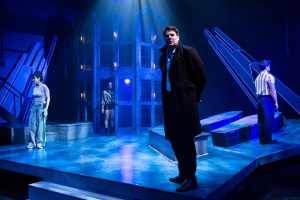
Lookingglass Theatre Company continues its tradition of staging visually inventive and thought-provoking world premieres with its latest production, Untitled Vampire Play. Written by Lookingglass Ensemble Member Kevin Douglas - who has previously crafted well-received work for the company, including Thaddeus and Slocum: A Vaudeville Adventure - this comedy-drama uses supernatural lore to dissect the vulnerabilities of modern relationships.
The story centers on a delightfully bizarre “meet the parents” scenario. Dom (Jordan Anthony Arredondo), an everyman bartender, introduces his parents to his new girlfriend, Val (Courtney Rikki Green). The twist? Val is a centuries-old vampire. But don’t worry - she gets her blood from ethical sources, not human victims. Dom’s parents laugh it off, though, thinking their son’s girlfriend has a few screws loose.
Meanwhile, Val’s “brother” Roderick (Walter Briggs) resurfaces, wanting to reconnect. In reality, they are former lovers, but after his betrayal, she ran away. Val doubts that he’s changed, but her progeny, Rose (Jin Park), gets sucked into his orbit despite being under Val’s supernatural control. As Roderick carelessly makes kills in Chicago, bodies begin piling up, drawing the attention of Dom’s mother - a police detective - and a vampire hunter descended from Van Helsing. Who said love was easy? The result is a look at relationships in all of their messy, bloody glory.
Briggs turns in an excellent performance as Roderick, playing the charismatic bad boy with ease. He channels the classic Hollywood vampire aesthetic with immaculate fashion and a distinct, formal vocal cadence that commands the room. Sure, he’s a villain, but he’s fun to watch, especially with the little flairs he adds to his characterization.
Kareem Bandealy is another standout, tackling two completely contrasting roles. He plays Dom's father, Louie, with a relentless barrage of corny vampire dad jokes, then completely transforms into Lance Tardis Van Helsing, a fierce vampire hunter with an equally fierce hair flip.
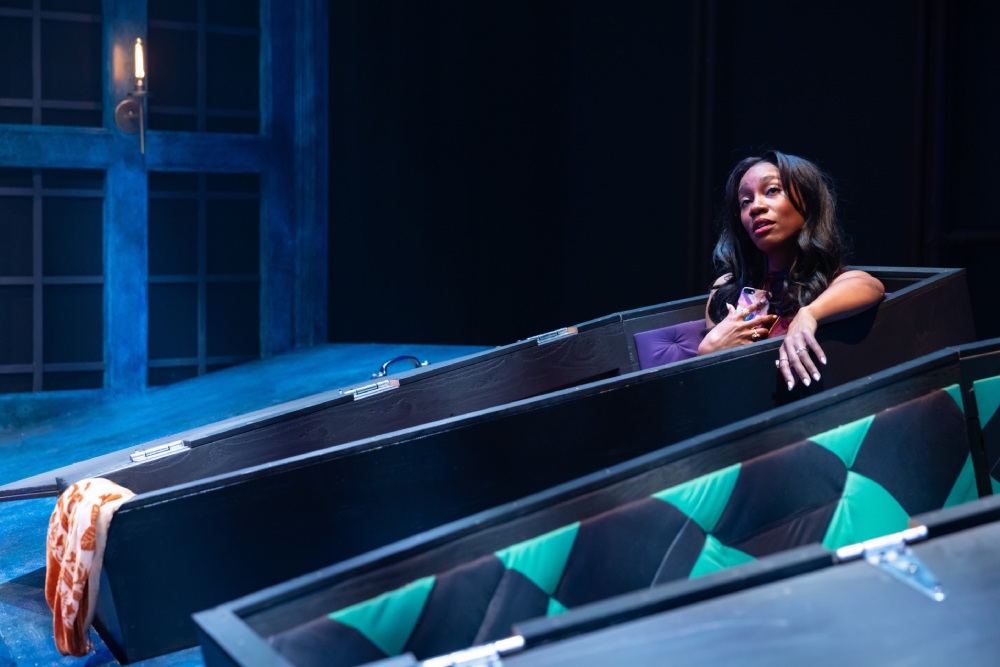
Courtney Rikki Green as Val inUntitled Vampire Play at Lookingglass Theatre. Photo by Justin Barbin.
Anchoring the whole cast, though, is Green, who brings immense emotional weight to her performance as the complex Val. Serving as the real window into this hidden world, Green charts her character's profound transformation, as Val wrestles with whether she is seeking genuine love or simply trying to outrun eternal loneliness.
Beneath the fangs, the play asks a deeply human question: What does it mean to love someone? It explores the underlying selfishness that often masks itself as romance. Val wants Dom to turn into a vampire so they can be together forever, viewing his reluctance as a rejection of her identity rather than a defense of his own humanity. Meanwhile, Dom uses Val as an emotional security blanket to quiet his own intense insecurities. Through these characters, Douglas examines how control, weakness, danger, and even lust can taint love, or at least the illusion of it.
The script could use a bit of trimming in its exploration, as there are moments that feel repetitive, alongside a few minor plot weaknesses. For instance, it seems odd that a police detective would wait so long to investigate self-proclaimed vampires once gruesome deaths with animal-like attack marks begin happening. Furthermore, one thing I certainly could have gone without was a gruesome scene where the vampires feast on a victim, using gummy worms to simulate intestines. Still, beneath those rough edges, the play’s core story has real spark, offering a fresh, funny twist on vampire mythology that keeps the audience engaged.
I’d be remiss not to praise the play’s design. The technical execution is a masterclass in atmospheric world-building. Scenic designer Alyssa Mohn delivers an expert landscape featuring coffins that seamlessly rise from and sink into the stage floor. This clever staging pairs beautifully with Andre Pluess’s precise sound design and Jason Lynch’s lighting choices - ranging from moody washes to stark spotlights and flashing accents - to wrap the theater in an escalating sense of intrigue and peril. The atmosphere creates moments when you’re not sure if you might be the next victim.
Inventively directed by Devon de Mayo, the production also incorporates fun moments of audience engagement, whether it’s handing theatergoers caution tape to hold at a crime scene or a rather messy vampire kill that sprays stage blood into the front row.
While it doesn’t entirely break new ground, Untitled Vampire Play is creative and visually arresting. At a time when modern relationships are being heavily dissected in media - such as in the hit Obsession - Untitled Vampire Play tosses its fangs into the conversation, leaving the audience to wrestle with what should encompass the core tenets of love.
Recommended.
Untitled Vampire Play is being performed at Lookingglass Theatre through July 12th.
This review is proudly shared with our friends at www.TheatreInChicago.com.
Tom Stoppard’s epic finale Leopoldstadt is an instant classic at Writers Theatre
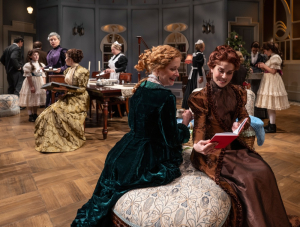
What would you do if you found out your heritage wasn’t what you thought it was? In Tom Stoppard’s case, he wrote a sweeping, epic play about it. Glencoe’s Writers Theatre brings Leopoldstadt to the Chicago area for the first time since its West End and Broadway runs in the early 2020s. Directed by Carey Perloff, a longtime friend and collaborator of Stoppard’s, this final stage play proves to be among his best.
Stoppard passed away late last year but he left a decades-long cannon of seminal stage and screenplays. When his semi-autobiographical play “Leopoldstadt” began performances in the West End in early 2020, he was sure it would be his last. Though he wrote it in a year, it took nearly 30 years to find the narrative. Stoppard, who was raised as a gentile most of his life, was told by a family member in 1993 he was of Jewish heritage and that many of his family members were murdered in the Holocaust. Stoppard escaped Czechoslovakia as a child and was raised in the UK entirely unaware.
A blended Jewish-Catholic family’s history in 20th century Vienna is divided neatly into four pivotal scenes with a sizeable cast of some of Chicago’s best. In the first scene, a Christmas party (1900), we’re shown a Vienna in which Jews were considered equals. Families had interfaith marriages and shared holiday celebrations. By the second scene (1924), WWI has redrawn the maps of Europe. Austria, as well as the family, finds itself in a precarious place. Scene three (1938) portrays an Austria fully committed to the Third Reich and family alliances are put to the test when the family is forced out of their home by the Nazis. The final scene (1955) happens in the aftermath of Austria’s reunification following WWII. This last scene mirrors Stoppard’s own life and serves as an emotional climax to a play that is often dense with political and historical theory.
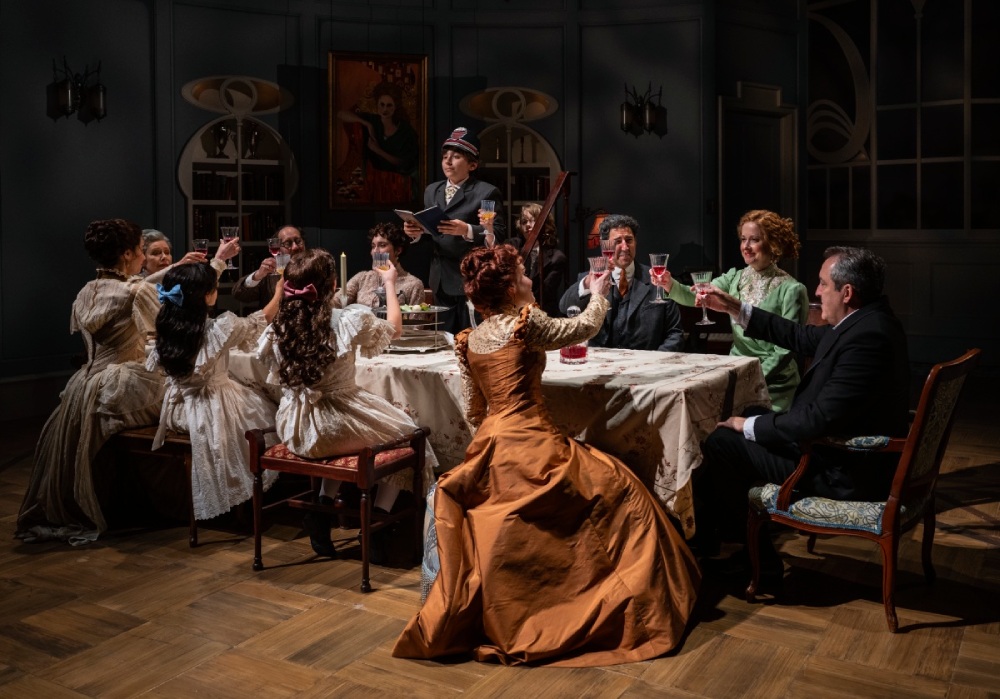
The cast of Leopoldstadt. Photo by Michael Brosilow.
Writers Theatre’s production is as faithful to the original as you can get. Carey Perloff directed the Boston and D.C. premieres too. Along with an all-star cast of Chicago heavy hitters, Perloff’s production will likely be remembered as the definitive Midwestern revival. Between Ken MacDonald’s set and Alex Jeager’s costumes, audiences are sure to be swept away to a different time and place that can feel eerily reminiscent to the present.
As the eras change so do the actors playing the characters. Stoppard’s script trusts that the storytelling is so engaging that audiences will figure out who’s who by the context clues, and he was right. Some may find the story hard to follow but thankfully a helpful lobby installation catches everyone up on the history of Austria during this time period.
Writers Theatre favorite Kate Fry plays a Catholic woman, Gretl, who marries into a prominent Jewish family. Her performance is at first charming but by the end heartbreaking. Jessie Fischer delivers a transformative performance, particularly during the final scene. Rounding out the male ensemble is Ian Barford as Hermann who plays a converted catholic, but it’s his deterioration that is unforgettable. Justin Albinder is given the meatiest part of the final scene and his ability to switch from one emotion to the next is some of the most natural acting of the evening.
Leopoldstadt is every bit as epic as something like Gone with the Wind. Much like the famed novel and movie, this play tells the story of a civilization, a family, lost to the tragedy of war. It’s a story of a family’s near extinction. Stoppard’s brilliance is on full display and how lucky are we to have this capstone for his illustrious career?
Through August 16 at Writers Theatre. 325 Tudor Ct, Glencoe, IL. 847-242-6000
https://www.writerstheatre.org/events/leopoldstadt
This review is proudly shared with our friends at www.TheatreInChicago.com.
Nunsense, Not Quite Immaculate - But Blessed With a Strong Cast
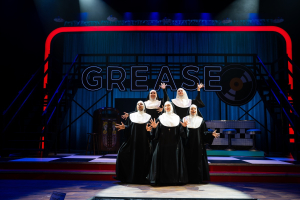
Following its recent winter production of Sister Act, Drury Lane Theatre returns to the convent with Nunsense, a light-hearted musical comedy which, as the title implies, is a lot of nonsense.
The premise is funny, albeit morbid. After an unfortunate mishap, 52 members of the Little Sisters of Hoboken die from tainted soup prepared by Sister Julia, Child of God. With limited resources, the surviving nuns can only cover the funeral expenses of some of their sisters - leaving the remaining four bodies in their convent freezer, awaiting burial. How can they solve this problem? Well, stage a variety show, obviously! After all, while these women are nuns, they all wanted a moment in the spotlight.
E. Faye Butler, who also directed Sister Act, returns to stage Nunsense and injects the same optimism into this show. Unfortunately, it lacks the same substance, failing to elevate its premise beyond the initial idea.
The origin of Nunsense seems to explain its structural weakness. In the early 1980s, playwright Dan Goggin created a line of tongue-in-cheek greeting cards featuring a nun offering witty, irreverent quips. The cards were a hit, and Goggin used them as a jumping-off point for a cabaret show, which was later expanded into a full-length musical.
Unfortunately, the script doesn’t have much narrative depth or structural momentum. It seems to wander through quips and gags, trying to find a laugh rather than developing character or plot. At one point, we learn that a health inspector will fine them if they can’t raise the money by tomorrow, but it doesn’t land as a serious threat or even a driving force for the remainder of the show. The problem even has a quick resolution when Sister Mary Amnesia remembers her identity and discovers she’s suddenly rich thanks to a contest - talk about a deus ex machina (mary-ina, if you will).
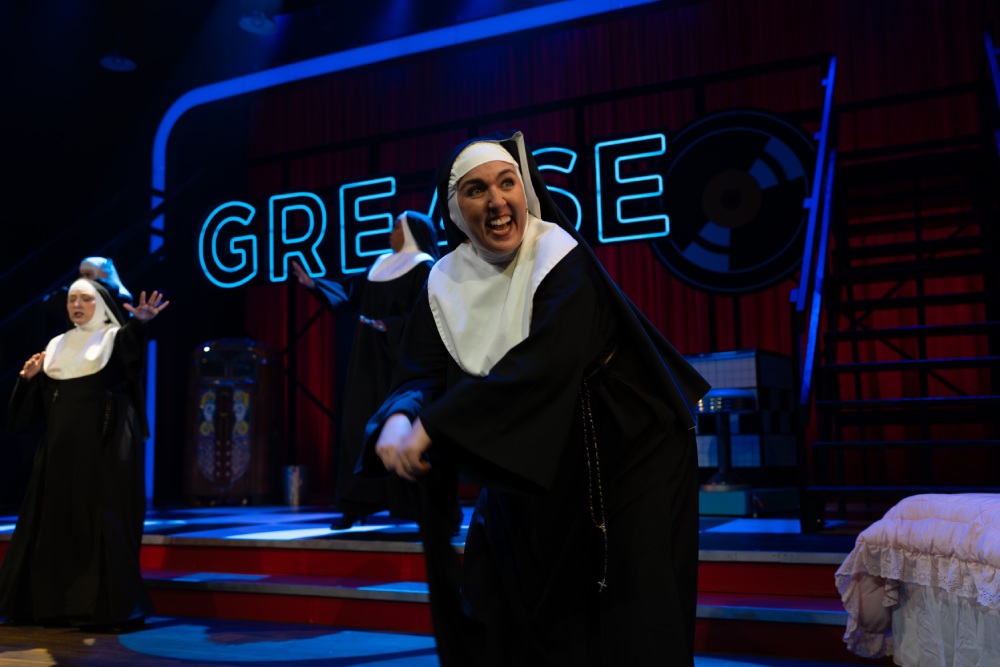
Rachel Carreras in Drury Lane THeatre's Nunsense. Photos by Caitlin Dennis.
The book’s weaknesses are unfortunate because the cast is genuinely strong. Every member brings spectacular vocals to the stage, effortlessly belting out musical numbers and sounding excellent throughout.
Sharriese Hamilton delivers a standout performance as Sister Hubert. Her sassy comebacks and vocal riffs are hilarious, especially her trill in their rap. Her big second-act number, "Holier Than Thou," takes the audience to church and gives the show a much-needed jolt of energy. Cory Goodrich, Rachel Carreras, Kelly Felthous, and Aurora Boe also do well in their solo moments, whether it’s physical comedy, playing with a puppet, or ballet. Felthous gets to shine with her audience work and banter, and it is fun to see the cast do callbacks to specific interactions, such as flirting with or chiding audience members.
The show succeeds best when it moves quickly. Without much plot, gags can get tired easily. For instance, the Reverend Mother accidentally inhales a drug found in the girls’ locker room and goes to pieces. The sequence goes on a few beats too long. Transitions also could be tightened so the show doesn’t lose steam between numbers.
Nunsense is a fun idea, but the script fails to execute it satisfyingly. It’s also unclear who the intended audience is; the PG‑13 tone might make it a slightly tougher fit for families, even though they’d otherwise be a natural demographic.
While each performer gets a well-deserved moment to shine, it is a shame that such a talented cast doesn't have better material to serve either their collective skills or a meaningful story. Drury Lane's Nunsense has its moments, but it never quite reaches divine heights.
This review is proudly shared with our friends at www.TheatreInChicago.com.
Where Identity Slides: Steppenwolf’s Mesmerizing Catch as Catch Can
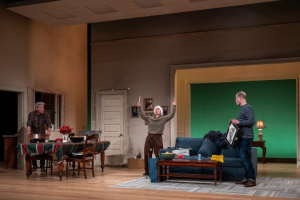
Mia Chung’s Catch as Catch Can, which premiered with Page 73 in New York in 2018, arrives at Steppenwolf Theatre - one of Chicago’s most dynamic and daring artistic institutions - with a production that immediately embraces the play’s slippery, shape-shifting nature. Chung’s script thrives on emotional volatility and fractured identity, and Steppenwolf’s staging taps into that energy from the outset, preparing the audience for a world where the familiar can tilt, distort, and reassemble without warning.
Catch as Catch Can begins with the familiar comfort of kitchen-table talk between two New England mothers, Roberta Lavecchia and Theresa Phelan. Under Amy Morton’s direction, those early scenes feel lived-in and deceptively ordinary - two longtime friends trading stories, worries, and family updates with the shorthand of people who have known each other for decades. But as the play unfolds, that everyday warmth becomes the launching point for a story that veers into far more disorienting territory. The return of Tim Phelan unsettles the delicate balance between the Lavecchias and the Phelans, stirring up old assumptions, unspoken resentments, and long-dormant family myths. What begins as a simple homecoming slowly reveals itself as a catalyst for emotional slippage, where memories blur, loyalties shift, and the characters’ sense of who they are - and who they have been to each other - starts to fracture. Morton guides this progression from domestic realism to psychological unraveling with remarkable control, allowing the play’s humor, tension, and creeping dread to coexist in the same breath.
The production’s boldest device - three actors portraying all six characters - becomes the heartbeat of the evening. Gary Cole (as Roberta and Robbie Lavecchia), Audrey Francis (as Lon and Daniela Lavecchia), and Tim Hopper (as Theresa Phelan and Tim Phelan) deliver performances that are nothing short of remarkable. Morton directs them with a sculptor’s precision, shaping each transformation through voice, posture, and energy rather than costume changes or props. The actors rarely add so much as an apron, a pair of glasses, or a purse to differentiate roles; instead, they rely on the smallest shifts in breath, cadence, or physical weight. Even the simplest physical actions - threading a needle, folding laundry, lifting a heavy picture onto a wall, or a mother rolling out her famous meatballs - become character markers, subtle cues that signal who is speaking without ever breaking the flow of the scene. At times, it feels as though six fully realized people are occupying the room, even though only three bodies ever stand onstage.
After the opening scene, it took me a few minutes to recalibrate to the production’s rhythm, especially as the actors began switching characters with such speed and minimal visual cues. But that adjustment period is brief. Before long, the doubling feels not only natural but essential, a kind of theatrical language the production teaches you how to read. Once you settle into its cadence, the transformations become thrilling rather than disorienting, sharpening the play’s emotional stakes and deepening its sense of unease.
The rapid-fire switching becomes its own kind of theatrical whiplash. An actor may leap from one character to another every other sentence, often without a single visual clue, and Morton ensures each pivot lands cleanly without losing an ounce of emotional clarity. The play becomes a fault line in constant motion, where identities slide, collide, and splinter beneath the surface.
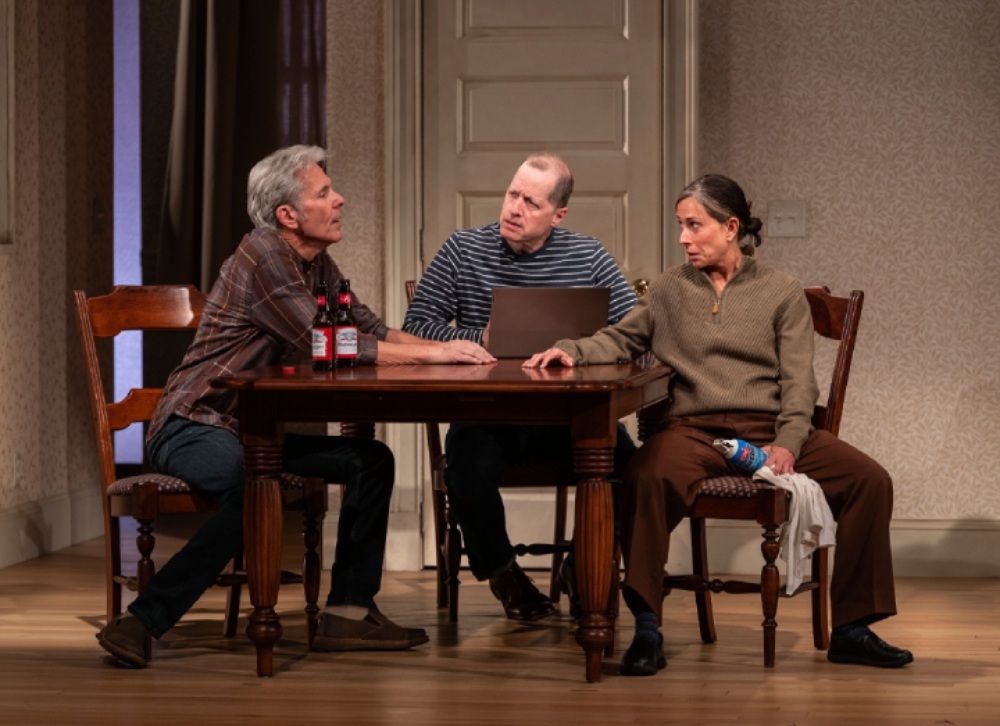
Gary Cole, Tim Hopper and Audrey Francis (L-R) in Steppenwolf Theatre's Catch As Catch Can. Photo by Michael Brosilow.
All three performers - Gary Cole, Audrey Francis, and Tim Hopper - are longtime Steppenwolf ensemble members, bringing a shared artistic vocabulary that sharpens every transformation onstage.
Cole toggles between Roberta’s brittle warmth and Robbie’s restless bravado with astonishing finesse. This production marks his first return to a Chicago stage in more than 25 years, and it is a triumphant homecoming. He is known to many for Office Space, Talladega Nights, HBO’s Veep, NCIS, and one of my favorite roles - Mike Brady in The Brady Bunch Movie and its sequel. Cole reminds audiences that his stage roots run deep. As Roberta, he carries a soft, fluttering concern that sits right behind the eyes; as Robbie, that same gaze sharpens into something quicker, hotter, and more impulsive. His ability to pivot between those energies with nothing more than a shift in breath or a recalibrated stance makes each transition feel both seamless and startling. It is a performance built on precision, but it never feels mechanical.
Francis brings an equally impressive duality to Lon and Daniela. In addition to being a Steppenwolf ensemble member, she now serves as the company’s artistic director alongside Glenn Davis, a role that underscores her influence on Chicago’s theatrical landscape. Known for standout performances in The Herd, Dance Nation, her work on Chicago Med, and directorial skill in You Will Get Sick, she grounds Lon with a quiet, blue-collar steadiness, a man who absorbs the world before reacting to it. Daniela, by contrast, is all edges and alertness, her movements tighter and her voice pitched with a nervous brightness that hints at deeper cracks. Francis masterfully switches entire gravitational centers. The clarity of her physical vocabulary makes each character instantly legible without a single costume change.
Hopper’s pairing may be the most haunting of the three. With Steppenwolf credits that include The Crucible, The Flick, and Buried Child, he brings a raw, unsettling honesty to both Theresa and Tim. His Theresa is a portrait of unraveling vulnerability, a woman whose emotional seams are beginning to split in ways she can barely articulate. His Tim, meanwhile, carries the quiet desperation of someone trying to hold himself together even as the ground shifts beneath him. Hopper plays both roles with a volatility that feels almost dangerous. The characters mirror and distort one another, creating an emotional echo that deepens the play’s sense of unease. Watching him slip between them is like watching a reflection break apart and reassemble in real time.
Together, these performances form the core of the production’s power. With Morton’s direction guiding every pivot, the trio creates the uncanny sensation that the stage is populated by twice as many people as are physically present. Their transformations are so quick and so clean that the audience must stay alert, tracking identities as they slide, collide, and reform. It is a feat of acting that is both technically dazzling and emotionally resonant, and it is the reason the play’s unstable world feels so alive.
As the story darkens - touching on mental health, racism, cultural tension, and the fragile scaffolding that holds families together - the doubling amplifies the instability. Chung threads moments of racial bias and coded language into the fabric of these families’ interactions, revealing how prejudice can hide inside the most casual exchanges and how easily it can rupture long-standing bonds. Morton understands that the play’s power lies in this slippage, and she allows the actors to push into the unsteady terrain without ever losing emotional truth. The result is a production that feels intimate yet vertiginous, a domestic drama that slowly cracks open into a haunting exploration of identity and the roles we inherit, perform, and sometimes cannot escape.
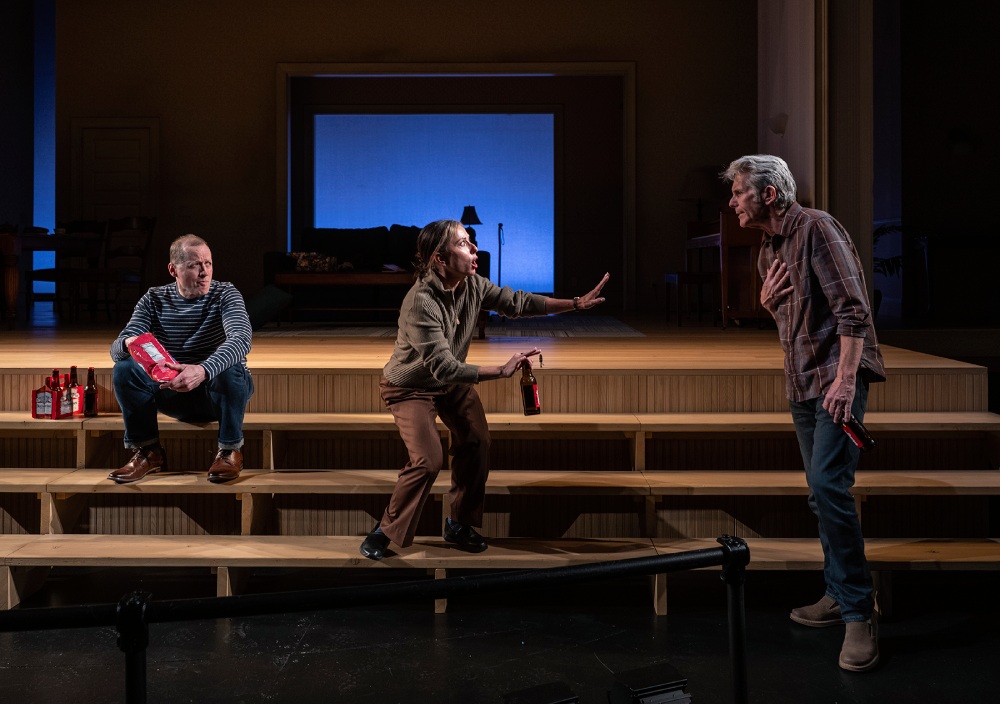
Andrew Boyce’s scenic design is a quiet marvel, giving the production a sense of dimensionality that feels both naturalistic and subtly disorienting. The main playing space is an open living room, flanked on one side by an entryway and a partial view into the kitchen, and on the other by a long hallway that suggests the deeper interior of the house. Just beyond the living room, another room is visible past a second hallway, creating the impression of a home that extends well beyond the edges of the stage. Boyce’s layout allows the audience to feel as though they’re peering into a fully lived-in environment, one with corners, thresholds, and unseen rooms that hold their own histories. Yuki Nakase Link’s lighting deepens this effect, subtly sculpting each corridor and doorway so the house seems to breathe with possibility - sometimes warm and inviting, sometimes shadowed with tension. It is a multidimensional design that grounds the play’s domestic realism while subtly reinforcing the sense that something inside this home - and inside these families - is evolving.
In their Artistic Director note, Glenn Davis and Audrey Francis frame Catch as Catch Can as a rare convergence of timing, artistry, and ensemble history - a production long delayed, now finally realized with the team that first set out to make it in 2020. They speak to the play’s uncanny pull, describing how Chung’s story has embedded itself in the company’s imagination, refusing to loosen its grip. For them, the doubling is not just a theatrical device but a test of the ensemble’s virtuosity, a chance for Steppenwolf to stretch its actors toward the edges of what performance can hold. And at the heart of their message is the idea that the play’s exploration of identity, home, and the selves we construct makes it a fitting capstone to the theatre’s 50th anniversary season - a reminder of how Steppenwolf’s long-standing commitment to family drama, artistic risk, and shared storytelling continues to shape its legacy.
Catch as Catch Can ultimately lands with the force of a quiet detonation, its emotional aftershocks lingering long after the final blackout. Morton and her trio of actors craft a world that feels both intimate and treacherous, a place where identity slips, refracts, and reforms in ways that are as unsettling as they are compelling. It is the kind of production that rewards close attention and invites conversation long after you’ve left the theatre - about family, perception, and the narratives we inherit without realizing it. Catch as Catch Can runs at Steppenwolf through July 12, with performances throughout the week, and it is very highly recommended for anyone who craves theatre that challenges, unsettles, and stays with you.
For tickets and/ or more show information, click here.
This review is proudly shared with our friends at www.TheatreInChicago.com.
Factory Theater’s Two Out of Three Falls is a Theatrical Event
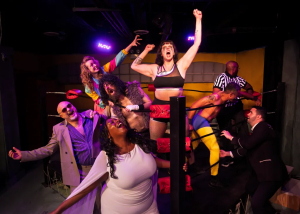
Those familiar with the Factory Theater space might feel themselves do a double take upon entering the theater for Two Out of Three Falls. Scenic Designer Manuel Ortiz completely transforms the space. The three-quarter thrust stage that has been there for years is gone – replaced by a wrestling ring that consumes an entire side of the theater. The ring is detailed, complete with lockers and wall decoration that completely transform that side of the space into a wrestling gym. To say that Ortiz outdoes himself in this endeavor is an understatement, because you might just find that the design is highly effective in drawing you into the thrilling vibe of the event.
Written by Bill Daniel, Two Out of Three Falls follows Johanna Goodish (Brittany Ellis), a wrestler struggling to step out of the shadow of wrestling legend King Kong Bruiser, also known as her father. Haunted by his literal ghost (Eric Frederickson), Goodish commits to the one act that she feels can set her free – challenging her father’s killer, Eduardo Quinones “El Moreton” (Sam Ramirez), to a wrestling match on live TV. If all goes according to plan, Quinones won’t live to see another day.
Directed by Ashley Yates, much of the production feels like a live wrestling match. As Goodish and her various opponents throughout the play take the ring, audience members at this Opening Night performance screamed and hollered. The design invites audiences to choose their opponent of choice, and you might just find that the intimate feel of the theater makes you feel like you are a part of the action. The work of Fight Designer Kate Lass and Wrestling Consultant Axel Rico shines in these scenes and certainly makes for an entertaining and lively evening.
The high-energy wrestling scenes act as a helpful contrast to some of the more intimate moments of the play – particularly within the relationship of Goodish and her manager, Meg Bishop (SaniaFaith). For so much of the story, Ellis brings a strong, confident character to Goodish. She is unafraid to fight back against her opponents, and she ensures that she is the last one standing at all costs. However, with Meg Bishop, we see a different side of Goodish. Ellis brings a quieter, more grounded character to these scenes. There is a vulnerability between Bishop and Goodish that you might just find helps us believe in this duo win. SaniaFaith and Ellis play off each other beautifully, bringing a genuine humor to the relationship that pushes it over the top.
The hype of the wrestling matches alone makes Two Out of Three Falls worth a watch. The stellar scenic design and strong ensemble make it a night of intrigue and fun.
Two Out of Three Falls runs through July 18 at the Factory Theater – 1623 W. Howard Street. For tickets and information, see the Factory Theater website.
RECOMMENDED
This review is proudly shared with our friends at www.TheatreInChicago.com.
BrightSide’s intimate staging of The Producers shines with Broadway-sized power
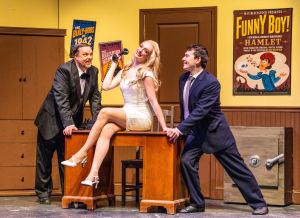
BrightSide Theatre’s The Producers storms into Meiley Swallow Hall with the kind of swagger only Mel Brooks can inspire: brash, brazen, and blissfully unconcerned with good taste. From the moment the lights rise, the show charges ahead with a manic momentum that feels both affectionately old school and sharply self-aware. It knows exactly what it’s here to do: go big, go bold, and never apologize for the mayhem.
Under the confident direction of Artistic Director Jeffrey Cass, this staging taps directly into Brooks’ outrageous, boundary-poking sensibility and never loosens its grip. Cass understands that The Producers thrives when its humor teeters on the edge, and he captures that gleeful imbalance with remarkable control. The original film premiered in 1967, the musical exploded onto Broadway in 2001, and if anyone wonders whether that brand of audacity still lands in 2026, the answer is an unequivocal yes. The Naperville audience laughed steadily from the first scene to the curtain call, proving that Brooks’ anarchic wit remains timeless.
BrightSide’s version brings the show’s wild premise to life with full comic force: washed-up Broadway producer Max Bialystock (Scott Kelley) and anxious accountant Leo Bloom (Michael Metcalf) concoct a get-rich-quick scheme to stage the biggest flop in theatre history. If the show collapses on opening night, they can pocket the investors’ money and disappear. Their hunt for guaranteed failure leads them to the worst script imaginable, the most misguided director in town, and a cast so spectacularly wrong that success seems impossible. But in classic Brooks fashion, the plan detonates in the most unexpected way, turning their surefire disaster into an accidental triumph and leaving the pair scrambling to survive the fallout.
That spirit of intentional ruin pulses through the musical numbers, each one another attempt to engineer catastrophe. “Springtime for Hitler,” the show-within-the-show’s notorious centerpiece, is crafted as an overblown, tasteless pageantry meant to repel audiences instantly. “Der Guten Tag Hop Clop” and “Haben Sie gehört das Deutsche Band?” push the absurdity even further, spotlighting a playwright and director whose delusions should have doomed the project. Even “Keep It Gay,” with its flamboyant insistence on excess, is part of Max and Leo’s strategy to stack the deck with choices so misguided they can’t possibly succeed. Ironically, the songs are so bold, so shamelessly theatrical, and so cleanly executed that the very elements meant to sink the show end up turning it into the hit they never wanted.
Scott Kelley’s Max Bialystock and Michael Metcalf’s Leo Bloom make a terrific duo, striking a lively balance between showmanship and panic. Kelley barrels through the role with larger-than-life bravado, while Metcalf’s tightly coiled nervousness plays off him beautifully. Their timing is crisp, their rapport effortless, and together they elevate every scheme, meltdown, and misstep.
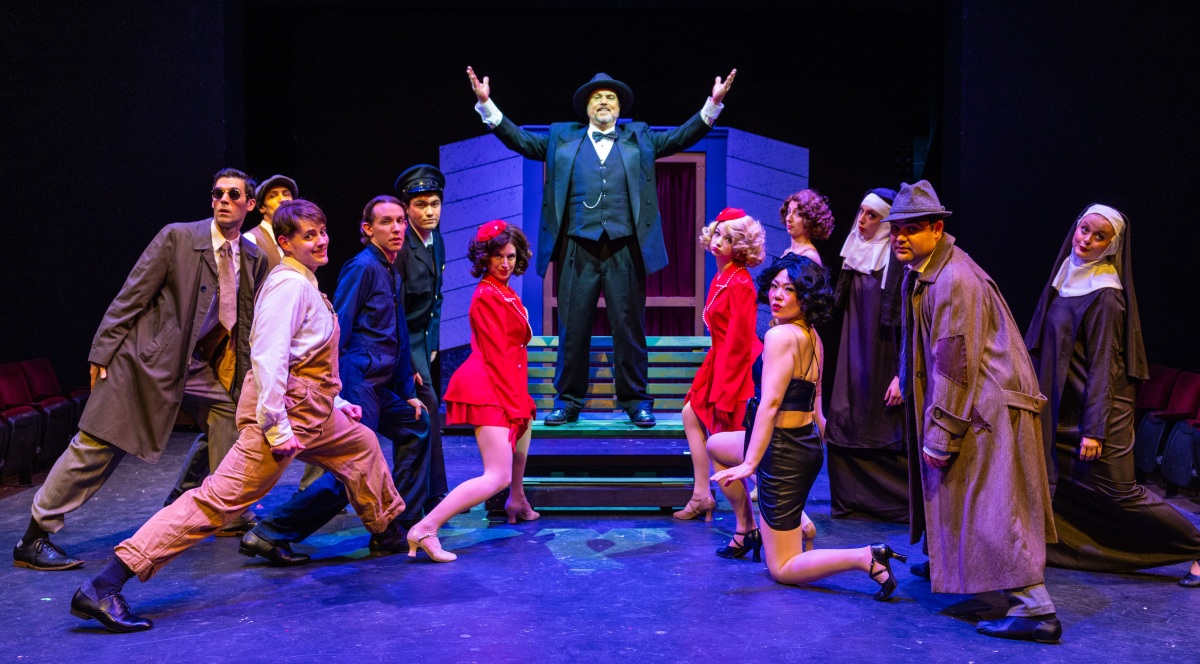
Max Bialystock (Scott Kelley) and Company.
Amelia Tam is outstanding as Ulla, the blonde bombshell Max hopes to lure to his “casting couch”. She is an amazing dancer with an equally outstanding voice, commanding attention the moment she steps onstage with a blend of radiant charm and razor-sharp comedic instinct. Her Ulla rises far above the familiar Swedish ditzy-blonde trope, becoming a spark of vitality who shifts the temperature of every scene she enters. Tam mixes wide-eyed innocence with sly intelligence, making each line land with extra bite. Whether stretching a vowel for comedic payoff or launching into “When You Got It, Flaunt It” with fearless gusto, she turns Ulla into a character who is not only irresistible but essential to the show’s rhythm.
The supporting cast is uniformly strong, powered by an ensemble that moves with clarity (credit to choreographer Mary Grace Martens), hits its jokes cleanly, and fills the stage with infectious confidence. Cheryl Newman shines as one of Max’s elderly ‘investors,’ delivering sharp comedic work while also contributing behind the scenes as costume designer - a pair of responsibilities she handles with impressive finesse. Michael John Lynch brings delicious flair to Carmen Ghia, the impeccably mannered yet cutting assistant whose every gesture blends elegance and threat. Myles Mattsey is memorable as Franz Liebkind, the unhinged playwright whose patriotic fervor is both alarming and hilarious, while John B. Boss transforms director Roger DeBris into a gleaming spectacle of theatrical excess. Together, they form a gallery of eccentrics who keep the show’s momentum high and its humor constant.
All the while, Phil Videkis provides excellent musical leadership, guiding the orchestra with crisp pacing and keeping the score bright, tight, and perfectly attuned to the show’s comic sensibility while supporting Thomas Meehan’s book with well-judged musical choices.
The staging makes clever use of an economical but highly effective set designed by Ariel Mozes, shifting smoothly from location to location without ever feeling limited. What the physical scenery lacks in large-scale opulence, it compensates for with smart configuration and adaptability, allowing the story to move quickly while keeping the focus on the performers. Enhancing that versatility is a programmable LED backdrop that becomes one of the production’s most dynamic tools, transforming into windows, rainbows, bursts of color, or even spelled-out words that heighten key moments. Together, Mozes’ resourceful design and the vivid LED wall create a surprisingly rich visual world that expands far beyond the modest footprint.
BrightSide Theatre once again demonstrates a sharp eye for material, adding The Producers to its growing list of savvy, crowd-pleasing selections. This staging delivers everything a Mel Brooks musical should: big laughs, confident performances, and a joyful sense of mischief that never lets up. It’s a lively, high-spirited evening that embraces the show’s outrageous personality while still finding its own clever touches along the way. This musical comedy is highly recommended, playing through June 28th at the Theater at Meiley Swallow Hall, an ideal summer outing for anyone craving a night of bright, unapologetic fun.
For tickets and/or more show information, visit https://brightsidetheatre.com/producers/.
Guest’s New Andy Warhol Play A Study in Primo Theater

When Terry Guest left Atlanta and arrived in Chicago ten years or so ago, a bracing reality check caused the young actor to make a bold pivot. Three years of auditions and zero bites on the acting front, he turned himself into a playwright and used a deceased uncle as his inspirational muse. At the Wake of a Dead Drag Queen was born, with Guest placing himself in the starring role. Rave reviews, real recognition and an impressive collection of Jeff Awards followed. As they used to say during the dawn of space exploration, “Houston, we have liftoff.”
That was in 2019 and since then the actor and playwright has been exploring other opportunities to extend his keenly astute vision about life and people into the theatrical ecosphere. More plays were written, last year At the Wake of a Dead Drag Queen was reprised and a brand spanking new dazzler by Guest just launched its world premiere at Jackalope Theatre in Edgewater a few days ago. If there’s any logic in the universe, it’ll enjoy a very similar reception to his inaugural tour de force.
Because it’s so creatively extravagant, Andy Warhol Presents: The Cocaine Play lives in a universe all its own. There’s enough drama and suspense to be slightly Hitchcockian, but it’s also unrelentingly funny. It’s arguably biographical, but not in any way you’d expect. Because it indulges in the supernatural, you can say it possesses strong elements of mystical realism. Nothing about it is predictable. And it has two endings. Both killer.
If you had to name one thing that forms its nucleus, it would be fame. The single name variety. Blinding individual glory. Guest probes into what it’s like to have it and what it means to crave it.
We get a sample of the first right at the opening when Marilyn Monroe appears resplendently before us and gives a little run down on what it’s like to be her. The instant recognition, the automatic smiles, the rapturous attention, the sheer adoration. But she isn’t “that” Marilyn. And she’s not really an avatar. You could say she’s a concept of the blond bombshell turned into flesh. Played with decadent deliciousness by Alexis Ward, she’s the psychological stand-in for the mega-star from Hollywood’s past.
A quick shift and we’re suddenly in a New York apartment with a woman, Edie Sedgwick, complaining to a friend about her inattentive, I-don’t-understand-him-at-all-anymore, husband. We’ve already learned from the friend she’s talking to, Andy Warhol, that we’ve gone back in time to the 1960s. And even though he’s a painter too and wears a bushy white wig, he’s not that Andy Warhol. Like Marilyn, Andy and Edie are facsimiles of the people we think they are. And like every other member of the four-member cast, everyone’s Black.

(L to R) David Michael Dowd, Jasmine “Jazzy” Cheri Rush and William Anthony Sebastian Rose II in ANDY WARHOL PRESENTS: THE COCAINE PLAY.
William Anthony Sebastian Rose II occupies the role of Andy, and a more droll, brilliantly glib performance will likely not be seen on another stage anytime soon. He and Edie’s husband Michael (David Dowd) are having a very hot little affair on the side. Regardless of how trivial or momentous, all interactions are laced with coke. Indulging in cocaine hits is so pervasive it’s like watching piranha in a constant feeding frenzy.
They’re all in the creative arts. Edie (Jasmine “Jazzy” Cheri Rush) is an actress married a painter. She and Michael are flat out rabidly ambitious, and both invest the sweat and tears to make it in their crafts. Unfortunately, their striving just doesn’t end up going anywhere. Andy’s less driven or sure of himself. Much more reticent. When an opportunity arises for him and Michael to catch some limelight, it’s Andy, after being pushed by his lover/friend, who prevails. His portrait of the late Marilyn Monroe catapults him to fortune and fame.
Guest not only wrote the Andy Warhol script; he also directs this three-act marvel that moves like a bullet train on freshly greased tracks. This production shows too that he’s a master at shaping performances. All four glow with a blindingly high gloss.
The play spans three decades. Sydney Lynne’s scenic design stamps all of them with genuine uniqueness and style. Dress transforms with the times too and, in this case, only Edie’s wardrobe changes noticeably as the years roll by. As costume designer, Maddy Shows makes sure they sync perfectly with the period and sing with class. Much the same can be said for Ayanna Bakari and that cavalcade of wigs she presents. Stellar.
Cohesive and boppin’ original music binds the play together from the very beginning to the absolute end, yielding what can only be called yet another delectable surprise bonus.
Fame, we later find, isn’t sitting all that well with Andy. Something about it is oppressive and Marilyn keeps showing up like a specter he’d really like to leave him alone for a while. Still treading water, Edie and Michael aren’t faring much better. She left for LA to try and make it in the movies since NY never ignited. Micheal continues to paint in the Big Apple and remains mired in the same obscurity. The chance at a long shot makes him desperate, brings his resentment regarding Andy’s success to the fore and sets him to scheming. After all, he rationalizes, Andy would never be where he is if it weren’t for him. Things then turn very dark and get just as hot. Hence the first ending that’s so intense there should be a way to one day to enshrine it in the National Archives.
It’s the second closing that comes out of nowhere that will blast your other sock off.
Andy Warhol Presents: The Cocaine Play
Through July 6, 2026
Jackalope Theatre
Broadway Armory Park
5917 N. Broadway Street
Chicago, IL 60660
For more information and tickets: https://www.jackalopetheatre.org/
Highly Recommended
Intimate and Unflinching: The Last Five Years at Oil Lamp Theater

When Jason Robert Brown’s The Last Five Years premiered at Chicago’s Northlight Theatre in 2001, it flipped the traditional rom-com musical blueprint on its head. Off came the rose-colored glasses, and what was presented was an intimate, searing, and structurally unique take on the modern relationship, inspired by Brown’s own love and loss. Now, twenty-five years later, this piece, directed by Christina Ramirez, returns to Chicagoland at Oil Lamp Theater in Glenview. The Last Five Years presents the entire course of a relationship between Jamie, a rising author, and Cathy, a struggling actress – from the first hello to the final goodbye – performed by only two actors, who take turns singing their hearts out in this vocally demanding score.
Structure is everything in this show. Jamie’s timeline starts from the high of their first date and moves chronologically, while Cathy’s story begins at the end and moves backward. They meet only once, in the middle, for their wedding, and then move in opposite directions.
Lili Galluzzo, playing Cathy, is an absolute powerhouse. She commands the stage with a voice that can belt to the rafters, packing an emotional punch with every note. Whether she is navigating the comedic neuroses of “A Summer in Ohio” or the crushing vulnerability of “I'm Still Hurting,” she conveys unvarnished emotion that anchors the production's vocal stakes.
As Jamie, Abraham Deitz-Green has an effortless, magnetic charm. From his opening number, he is clearly having fun, schmoozing the crowd and winning the audience over with ease. He infuses the ambitious young novelist with infectious likability. In fact, it makes it hard for the audience to decipher who is at fault more in this relationship, forcing them to question everything, just as the leads do.
Perhaps Cathy is too pessimistic? Years of career letdowns have tainted her perspective on life, and misery loves – needs – company. Maybe she can’t be happy unless Jamie is unhappy too. Or perhaps Jamie was always emotionally unavailable? As his career takes off, does he want to give himself sacrificially to another person, or does he want to be the new, shiny toy on the scene? Maybe he only wants to reap the benefits of love without caring for it. These are the questions the audience is wrestling with thanks to their strong performances.

Lili Galluzzo in THE LAST FIVE YEARS from Oil Lamp Theater.
But while individually the leads command the stage, their chemistry together left something to be desired. The musical’s structure itself doesn’t help much. After all, the majority of the time, they sing alone, interacting only with props. So, the anticipation of them finally being in the same timeline, sharing space, perhaps places an undue burden on the moment. Still, their big song together, which is also their wedding song, felt flat. The same charm that Jamie had when he landed his big break was gone, and the fire that Cathy had joking about Ohio was missing. Given that this was opening night, the chemistry may well evolve as the actors settle into each other’s timing, but in this performance it was noticeably absent. Since that crucial piece wasn’t there, it felt a little as if these characters never truly understood each other from the start. Were they truly lovers or just lines intersecting at a point?
Oil Lamp’s space is the perfect venue for this intimate show. The set really doesn’t need much; the songs are the main course. But the set was a bit of a distraction. Flat panels slid on and off stage to delineate different locations or the passage of time, but they were rather clunky when they were moved, like a stubborn shower door. At other times, Jamie entered from behind the audience, stepping directly in from the street. The sudden opening of the door and the outside light coming in pulled one out of the moment. The scenes that worked best were those which used lighting to direct your focus and shine on Jamie or Cathy as they untangled their vulnerabilities or drew you in with bursts of emotion.
The Last Five Years is a unique art piece, and its story is not for everyone. Can love and ambition mix, or are they oil and water? This untraditional, somber look at relationships offers unflinching moments, lush and playful songs, and questions you have to wrestle with – no doubt why it has found its way into the hearts of many musical theatergoers. Whether you're "Team Jamie" or "Team Cathy," fans of this modern musical will certainly fall in love with Oil Lamp’s rendition, thanks to the dynamic performances of its leads. They perform this high-wire act with skill and vocal precision, bringing this complex story to life with incredible emotional depth.
The Last Five Years plays at Oil Lamp Theater now through July 19th.
This review is proudly shared with our friends at www.TheatreInChicago.com.
Chicago Shakespeare's Brokeback Mountain Soars

Some stories refuse to fade with time, and Brokeback Mountain is one of them. What began as a modest short story by Annie Proulx in The New Yorker in 1997 grew into an award-winning literary work, an acclaimed film, and now a deeply moving stage adaptation by Ashley Robinson at Chicago Shakespeare Theater. Under the assured direction of Jonathan Butterell, this production achieves something rare: it honors the source material while creating an emotionally overwhelming theatrical experience that stands on its own merits.
Proulx's story unfolds in 1963, in a world where homophobia was not merely accepted but embedded within the culture. In rural America, far removed from urban centers and decades before meaningful LGBTQ+ rights protections, Ennis Del Mar and Jack Twist find themselves trapped between the lives they are expected to live and the love they cannot deny. Although the story concludes in 1983, its themes remain startlingly relevant. The prejudice that shaped their lives has not disappeared; it has simply changed forms.
Butterell's direction is masterful. He understands that the power of Brokeback Mountain lies not in grand declarations but in silences, glances, and opportunities missed. Every scene is infused with aching restraint, allowing the audience to feel the enormous weight of what remains unspoken. The result is a production that slowly tightens its grip on the audience.
Harrison Ball delivers a remarkable performance as Ennis Del Mar, capturing the character's stoicism, fear, and buried longing with heartbreaking precision. Opposite him, Jack Cameron Kay gives Jack Twist an irresistible warmth and optimism, making his refusal to surrender to a life of secrecy all the more poignant. Together, the two actors create a chemistry so natural and compelling that the audience becomes deeply invested in every stolen moment they share.
The supporting cast is equally extraordinary. Cordelia Dewdney's Alma Del Mar is nothing short of revelatory. Dewdney charts Alma's transformation from a hopeful young wife into a woman forced to confront painful truths with astonishing emotional depth. Her performance is so finely calibrated, so emotionally authentic, that it feels destined for award recognition. Every look, every hesitation, every moment of heartbreak lands with devastating force. It is one of the finest performances currently on a Chicago stage.
Thomas Cox and Kat Eggleston excel in multiple roles, helping populate the world around Ennis and Jack with richly drawn characters. Eggleston's work as the Balladeer provides a haunting thread that runs through the production, giving voice to emotions the characters themselves cannot express.
Tom Pye's scenic and costume design is stunning in its simplicity. With minimal elements, he evokes the sweeping grandeur of Wyoming's mountains and the claustrophobic domestic spaces that confine the characters for much of their lives. The contrast is striking. On Brokeback Mountain, Ennis and Jack briefly experience freedom. Everywhere else, they are hemmed in by expectations, obligations, and fear. Sammi Grant's dialect coaching enriches the production, lending authenticity to the Wyoming accents and further immersing the audience in the world of the play.
What makes this production particularly resonant is its willingness to confront the societal forces that shaped Ennis and Jack's tragedy. The play never becomes didactic, yet it clearly illustrates how homophobia was reinforced by cultural institutions, including religious traditions and biblical interpretations that were frequently used to condemn same-sex relationships and enforce rigid definitions of masculinity. Whether through family expectations, community pressure, or appeals to religious authority, the message was clear: people like Ennis and Jack were expected to deny who they were. The production allows audiences to witness the devastating human cost of those beliefs without reducing its characters to symbols or political arguments.
Although Brokeback Mountain is not a musical, musical elements are woven seamlessly into the storytelling, becoming an emotional landscape of their own. Rather than interrupting the narrative, the ballads deepen it, expressing feelings that the characters are unable to articulate. Combined with the breathtaking visual and emotional scope of the production, the music helps transform the story into something more.
What is most impressive is how contemporary the play feels. Nearly forty years after the events depicted, Brokeback Mountain remains a cautionary tale about the consequences of intolerance and the lives damaged when love is forced into secrecy. Yet it is also a story of resilience, desire, and the human need for connection.
Chicago Shakespeare Theater has delivered one of the most powerful productions of the season. Under Jonathan Butterell's direction, every artistic element works in harmony to create an evening of theater that is both intimate and epic. It would not be surprising to see this production enjoy a future life beyond Chicago. The quality of the staging, the strength of the performances, and the universal appeal of the material suggest a production that could fare exceptionally well in New York and beyond.
Brokeback Mountain is theater at its finest—beautifully acted, exquisitely directed, emotionally devastating, and utterly unforgettable. It is not merely a revival of a story; it is a production that reminds us why stories like this continue to matter. And in Jonathan Butterell's hands, it soars.
Highly Recommended
Running Time: 90 minutes
When: Through June 28
Where: Chicago Shakespeare Theater 800 East Grand Avenue in Chicago
Tickets: $65 - $125
Box Office: 312-595-5600
Info: www.chicagoshakes.com
This review is proudly shared with our friends at www.TheatreInChicago.com.
Poetry in Motion: Joffrey's Eugene Onegin enraptures at the Lyric Opera

There’s something magical about stories. Stories have the power to transcend time, reaching across the centuries to share their thoughts, ideas, and emotions. Tales of heartbreak, anguish, squandered youth, and missed chances written in the 1800s have a way of resonating with us in the modern age, the profound emotions perfectly encapsulated in the prose. The magic happens when that story is lifted from a page to be retold in a new medium for modern audiences to hear and see. In my opinion, there is no finer example of this transformation than what is currently showing at The Lyric Opera House in Chicago, The Joffrey’s Eugene Onegin, now running through June 14th.

The ballet tells the story of Eugene Onegin, a wealthy but disillusioned aristocrat, who is disenchanted with both city and country life. He ventures to the provinces after inheriting his uncle’s estate, restless and indifferent. There, Eugene joins his friend Vladimir Lensky on a visit to his fiancée Olga’s home, where he is introduced to the family, most notably her sister Tatiana. Tatiana is drawn to Onegin’s aloof sophistication and quickly falls in love. She writes him a heartfelt letter and, at dawn, asks her nanny to deliver it. Onegin rejects her, claiming he is unsuited to love or marriage. His refusal deeply wounds Tatiana. At Tatiana’s name-day celebration, a bored Onegin flirts with Olga. Lensky, humiliated and jealous, challenges him to a duel. What begins as wounded pride leads to tragedy. Shakespearean passions of unrequited love, conflict of youth, and the dangers of careless actions play out in this classic tale.

Eugene Onegin is heralded as the foundation of modern Russian literature. Written over the course of eight years in the early 1800s, the novel revolutionized storytelling by blending romantic tragedy with social satire. Its main character was a cautionary tale of the superfluous man, one who is educated, wealthy, cynical, bored, and aimless, whose disillusionment leads to his own moral demise.
Told in four acts, the Joffrey masterfully brings Alexander Pushkin’s “novel in verse” to life through the medium of dance. Choreographer Yuri Possokhov and composer Ilya Demutsky not only capture that complex and bastardous character of Eugene, but also the wide range of emotions conveyed in this story. The adoration, resentment, rejection, joy, anguish, and regret are told through long, elegant lines, sensual pas de deuxs set to a musical score that perfectly captures the emotions of the four seasons the play moves through. Set against a breathtakingly simplistic provincial set, dancers clad in silks as delicate as the changing winds, and a not-love story performed superbly by Joffrey’s José Pablo Castro Cuevas and Victoria Jaiani (Eugene Onegin and Tatiana Larina, respectfully), the Joffrey have truly outdone themselves. It is one of their most visually captivating ballets. Said simply, Eugene Onegin is poetry in motion, a classic tale reenvisioned in the delicate yet powerful medium of ballet.

Hundreds of years later, the story of a charismatic yet pouty man who let his emotions hold him back while driving him towards his own demise still resonates with audiences today. Pushkin’s prose found a way to reach across the centuries and navigate Lower Wacker to make it to the Lyric Opera stage, where dancers bring the story to life. If that isn’t magic, I don’t know what is.
Eugene Onegin is now playing at the Lyric Opera House (20 N Wacker Dr, Chicago) through June 14th. This is one story you don’t want to miss. Get your tickets today at Joffrey.org.
This review is proudly shared with our friends at www.TheatreInChicago.com.
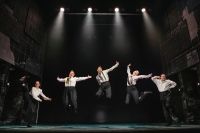
Operation Mincemeat: A Smart, Scrappy Musical That Shines When Its Cast Takes the Wheel
01 October 2026 in Theatre in ReviewIn the 2019 film Yesterday, a struggling musician wakes up in a world where The Beatles never existed. A similar…

SANCTUARY STORIES - A JOURNALISM THEATER PROJECT October 9-18 at the Athenaeum Center for Thought and Culture
30 September 2026 in Upcoming TheatreThrough music, documentary video, sound, photos and live actors, “SANCTUARY STORIES: A JOURNALISM THEATER PROJECT” captures in words and images…

Red Theater presents the world premiere of CHURCH HURT October 24 - November 21, 2026
30 September 2026 in Upcoming TheatreRed Theater is thrilled to announce the cast and production team of the world premiere of Church Hurt by Brynne…
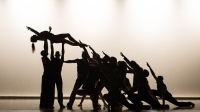
Ballets Jazz Montréal Makes Chicago debut at THE AUDITORIUM Saturday, November 7th
30 September 2026 in Upcoming DanceThe Auditorium (Chicago's landmark stage at 50 E. Ida B. Wells Drive) continues its 2026-27 Dance Season titled North American…

A Red Orchid Theatre Opens 34th Season with Chicago Premiere of HEROES OF THE FOURTH TURNING October 29 – December 6, 2026
29 September 2026 in Upcoming TheatreA Red Orchid Theatre is pleased open its 34th Season, exploring the theme of "world on fire," with the Chicago…

Lookingglass announces new leadership team
29 September 2026 in Theatre BuzzLookingglass Theatre Company today announced a new leadership structure that brings together four longtime members of its acclaimed ensemble and…
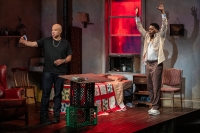
Steppenwolf’s Topdog/Underdog: When History Deals the Cards
28 September 2026 in Theatre in ReviewSusan-Lori Parks’ Topdog/Underdog, the Pulitzer Prize-winning masterpiece, is the kind of play that changes depending on when—and how many times—you…

MAMMA MIA! and HADESTOWN Return to Chicago in Spring 2027
28 September 2026 in Upcoming TheatreBroadway In Chicago is excited to announce two fan-favorite shows are returning to our stages this year: MAMMA MIA! and…
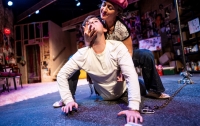
'I’m Going to Marry You Tobey Maguire,' Full of Laughs, Ends With a Fizzle
25 September 2026 in Theatre in ReviewHere’s a play that should be really good, based on its reputation alone. Written by Chicago comedy writer Samantha Hurley,…

ALL THINGS EQUAL: THE LIFE AND TRIALS OF RUTH BADER GINSBURG 2027 NATIONAL TOUR - tickets now on sale
25 September 2026 in Upcoming TheatreInnovation Arts & Entertainment, along with Broadway In Chicago, are thrilled to announce single tickets for ALL THINGS EQUAL: THE…

League of Chicago Theatres announces "It's Theatre Season" and celebrates the industry's impact
24 September 2026 in Theatre BuzzThe League of Chicago Theatres announces the return of It's Theatre Season, a campaign inviting Chicagoans and visitors to discover…

Steppenwolf Theatre Continues 51st Season with World Premiere of ADIRONDACK CHAIR CIRCLE October 22 — December 6
24 September 2026 in Upcoming TheatreSteppenwolf Theatre Company, the nation's premier ensemble theater company, is pleased to launch its 51st Season with the world premiere of…
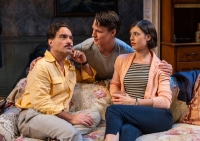
Lookingglass’ Kowalski Ignites a Battle of Wits Between Two Icons
24 September 2026 in Theatre in ReviewLookingglass Theatre’s production of Kowalski offers a gripping, fictionalized glimpse into the first meeting between two theater greats: Tennessee Williams…

Writers Theatre continues its 35th Anniversary Season with explosive, high-stakes boxing drama The Royale October 22 – November 29
23 September 2026 in Theatre in ReviewWriters Theatre, under the leadership of Executive Director Kathryn M. Lipuma and Alexandra C. and John D. Nichols Artistic Director Braden Abraham, continues…
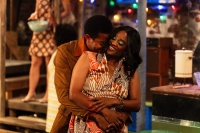
Detroit ’67: A Basement Becomes a City on the Brink
23 September 2026 in Theatre in ReviewDetroit was burning in the summer of 1967, inside one basement, life was still going on. That contrast is at…
Now Boarding: Bonnie’s Last Flight, a Sky‑High Comedy with Real Heart
23 September 2026 in Theatre in ReviewRivendell Theatre Ensemble closes its milestone 30th season with Bonnie’s Last Flight, a sly, sky‑high comedy set during a flight…

Teatro Vista Productions announces season
22 September 2026 in Upcoming TheatreTeatro Vista Productions, the Midwest's only Latine-led Equity theatre company, led by Executive Director Lorena Diaz and Artistic Director Wendy…
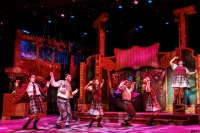
Step Right Up and Ride the Cyclone (The Musical) at Metropolis Arlington Heights
22 September 2026 in Theatre in ReviewIf anyone has ever told you to buckle up and enjoy the ride, they were talking about life—and even if…
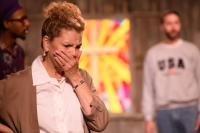
Funny ‘Prayer Circle’ Is Loaded With Laughs
22 September 2026 in Theatre in ReviewErik Gernand is resident playwright at Redtwist Theatre, and his Prayer Circle is absolutely laugh-out-loud funny. The strength of this…

Steppenwolf Presents GRACEFUL WARRIOR: AN EVENING WITH GARY SINISE - Tuesday, November 24, 2026
22 September 2026 in Upcoming TheatreSteppenwolf Theatre Company, the nation's premier ensemble theater company, is pleased to present Graceful Warrior: An Evening with Gary Sinise on Tuesday, November…

Acclaimed Mexodus musical makes Chicago premiere November 7-21 at Studebaker Theater
22 September 2026 in Upcoming TheatreStudebaker Theater, P3 Productions and Audible, in collaboration with Teatro Vista Productions, present the Chicago premiere of the groundbreaking, award-winning new hip-hop musical Mexodus, written and performed…

Arts in the Dark Parade moves to Columbus Drive due to dynamic growth, Oct. 24
21 September 2026 in Theatre BuzzLUMA8 and the City of Chicago return with the 12th Annual Arts in the Dark Halloween Parade, a family-friendly celebration…

American Blues Theater hosts its annual costumed fundraiser HALLOWEEN BOO BASH October 25th
21 September 2026 in Theatre BuzzAmerican Blues Theater, under the continued leadership of Executive Artistic Director Gwendolyn Whiteside, presents Halloween Boo Bash, its annual costumed fundraiser benefiting artists' wages…
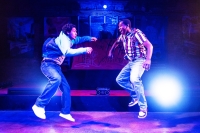
Definition's How We Got On: A Mixtape for the Stage
21 September 2026 in Theatre in ReviewWhat happens when three young people discover hip-hop and realize they might have something to say? Idris Goodwin’s How We…
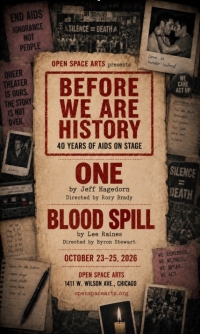
Open Space Arts Presents BEFORE WE ARE HISTORY October 23 – November 8
21 September 2026 in Upcoming TheatreOpen Space Arts presents BEFORE WE ARE HISTORY, a three-week theatrical exploration of LGBTQ+ theater created during and in response to…
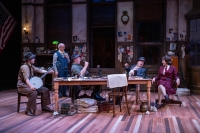
Northlight Delivers a Headline-Making, Hilarious Front Page
20 September 2026 in Theatre in ReviewNorthlight Theatre opened its new venue with Jeffrey Hatcher’s smart, rejuvenated adaptation of The Front Page. Commissioned by Artistic Director…
Chicago Shakes' Play On!: With a Syncopated Harlem Beat
20 September 2026 in Theatre in ReviewThere are some productions you watch, and then there are productions that make your heart swoon and your toe tap.…

Overshadowed's Flame of Fire Finds Humanity, Strength, and Forgiveness in a Tragic Chapter of Missionary History
19 September 2026 in Theatre in ReviewOvershadowed Productions’ Flame of Fire revisits one of the most polarizing true stories in mid‑century missionary history, and the result…
The Attic at Goodman Theatre Redefines Memoir Through Breathtaking Physical Storytelling
19 September 2026 in Theatre in ReviewAt intermission, I sent Ken, Buzz Center Stage’s managing editor, a text: “So thankful I made it!! It’s intermission, and…
Class is back in session with Victory Gardens’ World Premiere of The Humanities
19 September 2026 in Theatre in ReviewCoincidentally (or not), Victory Gardens’ new play about a controversial campus speaker opens just days after the one-year anniversary of…



Latest Articles
-
 Operation Mincemeat: A Smart, Scrappy Musical That Shines When Its Cast Takes the Wheel
Written by Maddie BurroughsIn the 2019 film Yesterday, a struggling musician wakes up in a world where The Beatles never existed. A similar theatrical case study could be done with every musical that might not exist without Hamilton; Operation Mincemeat should be first…
Operation Mincemeat: A Smart, Scrappy Musical That Shines When Its Cast Takes the Wheel
Written by Maddie BurroughsIn the 2019 film Yesterday, a struggling musician wakes up in a world where The Beatles never existed. A similar theatrical case study could be done with every musical that might not exist without Hamilton; Operation Mincemeat should be first… -
 MAMMA MIA! and HADESTOWN Return to Chicago in Spring 2027
Written by Buzz Center StageBroadway In Chicago is excited to announce two fan-favorite shows are returning to our stages this year: MAMMA MIA! and HADESTOWN. Current subscribers can add these to their season package when renewing by clicking here or calling (312) 977-1717. Group…
MAMMA MIA! and HADESTOWN Return to Chicago in Spring 2027
Written by Buzz Center StageBroadway In Chicago is excited to announce two fan-favorite shows are returning to our stages this year: MAMMA MIA! and HADESTOWN. Current subscribers can add these to their season package when renewing by clicking here or calling (312) 977-1717. Group… -
SANCTUARY STORIES - A JOURNALISM THEATER PROJECT October 9-18 at the Athenaeum Center for Thought and Culture
Written by Buzz Center StageThrough music, documentary video, sound, photos and live actors, “SANCTUARY STORIES: A JOURNALISM THEATER PROJECT” captures in words and images the lives and communities deeply connected with — and affected by — immigration in Chicago. This “living documentary” is a…
-
Red Theater presents the world premiere of CHURCH HURT October 24 - November 21, 2026
Written by Buzz Center StageRed Theater is thrilled to announce the cast and production team of the world premiere of Church Hurt by Brynne Frauenhoffer and directed by Jessica Love, running October 24 - November 21, 2026 at The Edge Off Broadway in Chicago’s…


Does your theatre company want to connect with Buzz Center Stage or would you like to reach out and say "hello"? Message us through facebook or shoot us an email at This email address is being protected from spambots. You need JavaScript enabled to view it..
*This disclaimer informs readers that the views, thoughts, and opinions expressed in the text belong solely to the author, and not necessarily to Buzz Center Stage. Buzz Center Stage is a non-profit, volunteer-based platform that enables, and encourages, staff members to post their own honest thoughts on a particular production.