
Displaying items by tag: Amy Morton
Steppenwolf’s Topdog/Underdog: When History Deals the Cards
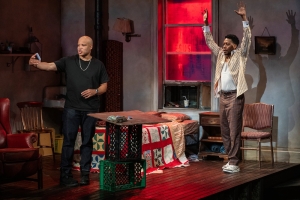
Susan-Lori Parks’ Topdog/Underdog, the Pulitzer Prize-winning masterpiece, is the kind of play that changes depending on when—and how many times—you see it. Directed by Kenny Leon, this revival stars Tony nominee Glenn Davis as Lincoln and Namir Smallwood as Booth, two brothers whose names alone tell us that Parks is preparing to play a very dangerous game with her audience.
The play was originally produced in Chicago by Steppenwolf Theatre Company in 2003, directed by ensemble member Amy Morton, with ensemble member K. Todd Freeman as Booth and David Rainey as Lincoln. More than two decades later, this revival demonstrates just how much material Parks packed into the story of two brothers living on the edge of survival.
Parks begins her own version of Three-Card Monte by giving us the names Lincoln and Booth. We already know the historical ending: John Wilkes Booth assassinated Abraham Lincoln. Parks puts that card on the table immediately—and then spends the rest of the play moving it around.
Lincoln and Booth are not historical figures, of course, but the names become a psychological trap. Lincoln works as an Abraham Lincoln impersonator, repeatedly allowing strangers to “assassinate” him as part of the act. The brothers themselves simulate the murder, turning history into performance and performance into something increasingly dangerous.
That is where Parks’ Three-Card Monte becomes so effective. We know the card. We know what is coming. Yet Parks keeps moving our attention elsewhere—to money, women, abandonment, brotherly rivalry, masculinity and the desperate need to survive. The audience is watching closely, thinking we know exactly where Parks is going. But like the mark in a Three-Card Monte game, we can never be completely sure which card we are actually watching.
The brilliance is that Parks gives us the ending and still manages to create suspense.
The question isn't simply, “Will Booth kill Lincoln?” We already know that story. Instead, Parks asks us to consider how and why these two brothers arrive at that moment. By the time the real gun is fired, we have become so invested in these men that the historical inevitability becomes a genuine emotional shock.
Having seen Topdog/Underdog several times, I’ve gained new insight into Lincoln and Booth with each production. I’ve always imagined these brothers as relatively young men—perhaps somewhere between 21 and 35 at the oldest. There is something about their desperation, their dreams and their constant jockeying for position that feels connected to men still trying to figure out who they are.
Seeing older actors inhabit these roles changes the equation. This production brings a greater sense of history and introspection to Lincoln and Booth. These aren't simply two young men making bad decisions. They feel like men who have accumulated years of disappointment, mistakes and missed opportunities. Their arguments have the weight of history behind them.
That being said, the acting is first-rate.
Glenn Davis delivers some of the best work I have seen in his storied career. His Lincoln carries weariness beneath the humor, as though every card trick, every performance and every attempt to maintain dignity has taken something from him. Davis understands that Lincoln is not simply trying to make a living; he is trying to hold onto an identity.
There is an extraordinary sadness to his Lincoln because he has found a way to make a living by pretending to be someone who, historically, has already been dead for generations. Every night he puts on the stovepipe hat, becomes Abraham Lincoln and allows strangers to reenact his assassination. The joke is that he survives the murder every night—until, of course, the night he doesn't.
Namir Smallwood is equally compelling as Booth. Smallwood has the remarkable ability to morph into whatever character is placed before him, and here he creates a Booth whose swagger and insecurity exist simultaneously. Booth wants to be seen, respected and successful, but beneath that ambition is a brother desperate to prove himself.
Their relationship is the heart of the play. They love each other, resent each other, depend on each other and compete with each other. They are simultaneously brothers and adversaries. One minute they can make each other laugh; the next, they are fighting over money, women or the invisible scorecard of who has accomplished more.
Arnulfo Maldonado’s set—a room in a New York City boarding house—captures the basic circumstances of their existence, but for me, it is far too sanitized for the gritty New York City world Parks has created.
Rooms like this were common, particularly in neighborhoods such as Hell’s Kitchen. They were tight. Space was at a premium. They were not necessarily neat or clean. These were places where people lived because they had few alternatives. The room should feel less like a place where two men are actually struggling to survive.
That distinction matters because Lincoln and Booth are in survival mode. The room is not simply their home; it is a pressure cooker. Every inch of space should remind us that there is nowhere for these brothers to escape—not from each other, not from their past and ultimately not from the consequences of their choices.
Kenny Leon's direction keeps the focus where it belongs: on two brothers trapped between history, memory and survival. He allows Parks' language, humor and repetitions to accumulate rather than rushing toward the inevitable conclusion.
Ultimately, Topdog/Underdog remains a remarkable piece of American theatre because Parks refuses to let history stay in the past. She takes two names everybody recognizes, places them on two Black brothers living in New York, and transforms a familiar historical tragedy into an intimate story about family, survival, masculinity and fate.
We may enter the theatre believing we know who Lincoln and Booth are and how their story ends. But Parks makes us see them as brothers first—two men desperately trying to survive each other, their circumstances and the histories they have inherited.
By the time the final card is played, the tragedy is no longer about Abraham Lincoln and John Wilkes Booth. It belongs entirely to these two brothers. And that is Parks’ greatest trick: she makes us think we are watching history repeat itself, when what we are really watching is the heartbreaking collapse of an American family.
Highly Recommended
When: Through Nov. 1
Where: Steppenwolf Theatre, 1650 N. Halsted St.
Running time: 2.5 hours (15 minute intermission)
Tickets: $20 -$142.50
312-335-1650
Where Identity Slides: Steppenwolf’s Mesmerizing Catch as Catch Can
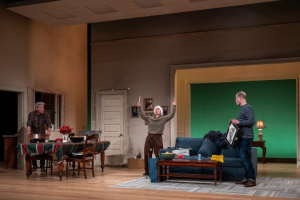
Mia Chung’s Catch as Catch Can, which premiered with Page 73 in New York in 2018, arrives at Steppenwolf Theatre - one of Chicago’s most dynamic and daring artistic institutions - with a production that immediately embraces the play’s slippery, shape-shifting nature. Chung’s script thrives on emotional volatility and fractured identity, and Steppenwolf’s staging taps into that energy from the outset, preparing the audience for a world where the familiar can tilt, distort, and reassemble without warning.
Catch as Catch Can begins with the familiar comfort of kitchen-table talk between two New England mothers, Roberta Lavecchia and Theresa Phelan. Under Amy Morton’s direction, those early scenes feel lived-in and deceptively ordinary - two longtime friends trading stories, worries, and family updates with the shorthand of people who have known each other for decades. But as the play unfolds, that everyday warmth becomes the launching point for a story that veers into far more disorienting territory. The return of Tim Phelan unsettles the delicate balance between the Lavecchias and the Phelans, stirring up old assumptions, unspoken resentments, and long-dormant family myths. What begins as a simple homecoming slowly reveals itself as a catalyst for emotional slippage, where memories blur, loyalties shift, and the characters’ sense of who they are - and who they have been to each other - starts to fracture. Morton guides this progression from domestic realism to psychological unraveling with remarkable control, allowing the play’s humor, tension, and creeping dread to coexist in the same breath.
The production’s boldest device - three actors portraying all six characters - becomes the heartbeat of the evening. Gary Cole (as Roberta and Robbie Lavecchia), Audrey Francis (as Lon and Daniela Lavecchia), and Tim Hopper (as Theresa Phelan and Tim Phelan) deliver performances that are nothing short of remarkable. Morton directs them with a sculptor’s precision, shaping each transformation through voice, posture, and energy rather than costume changes or props. The actors rarely add so much as an apron, a pair of glasses, or a purse to differentiate roles; instead, they rely on the smallest shifts in breath, cadence, or physical weight. Even the simplest physical actions - threading a needle, folding laundry, lifting a heavy picture onto a wall, or a mother rolling out her famous meatballs - become character markers, subtle cues that signal who is speaking without ever breaking the flow of the scene. At times, it feels as though six fully realized people are occupying the room, even though only three bodies ever stand onstage.
After the opening scene, it took me a few minutes to recalibrate to the production’s rhythm, especially as the actors began switching characters with such speed and minimal visual cues. But that adjustment period is brief. Before long, the doubling feels not only natural but essential, a kind of theatrical language the production teaches you how to read. Once you settle into its cadence, the transformations become thrilling rather than disorienting, sharpening the play’s emotional stakes and deepening its sense of unease.
The rapid-fire switching becomes its own kind of theatrical whiplash. An actor may leap from one character to another every other sentence, often without a single visual clue, and Morton ensures each pivot lands cleanly without losing an ounce of emotional clarity. The play becomes a fault line in constant motion, where identities slide, collide, and splinter beneath the surface.
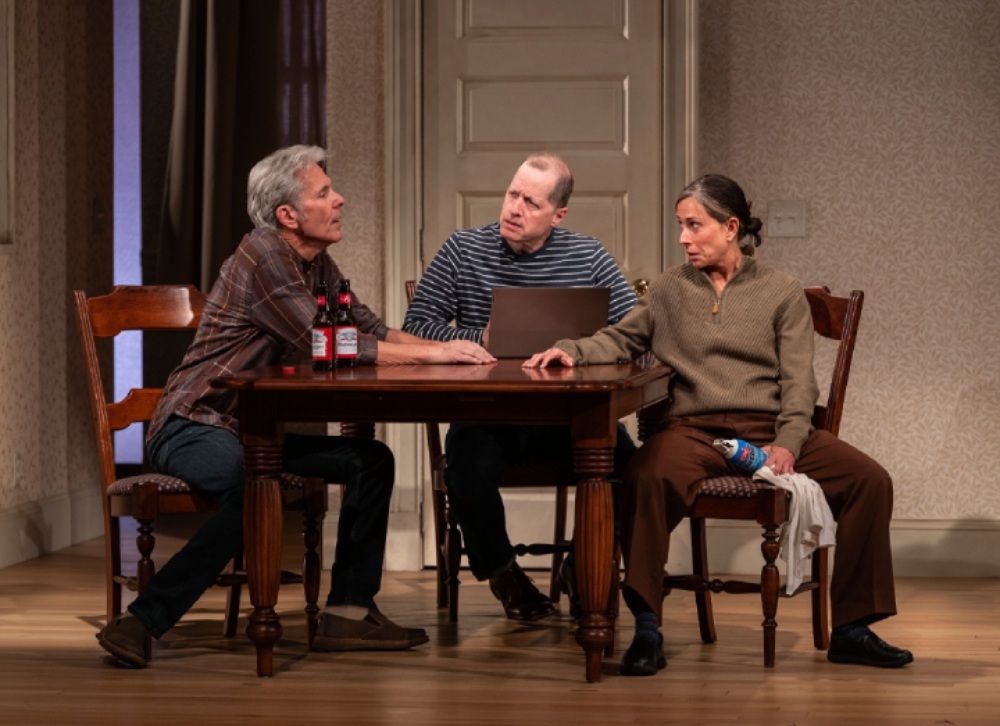
Gary Cole, Tim Hopper and Audrey Francis (L-R) in Steppenwolf Theatre's Catch As Catch Can. Photo by Michael Brosilow.
All three performers - Gary Cole, Audrey Francis, and Tim Hopper - are longtime Steppenwolf ensemble members, bringing a shared artistic vocabulary that sharpens every transformation onstage.
Cole toggles between Roberta’s brittle warmth and Robbie’s restless bravado with astonishing finesse. This production marks his first return to a Chicago stage in more than 25 years, and it is a triumphant homecoming. He is known to many for Office Space, Talladega Nights, HBO’s Veep, NCIS, and one of my favorite roles - Mike Brady in The Brady Bunch Movie and its sequel. Cole reminds audiences that his stage roots run deep. As Roberta, he carries a soft, fluttering concern that sits right behind the eyes; as Robbie, that same gaze sharpens into something quicker, hotter, and more impulsive. His ability to pivot between those energies with nothing more than a shift in breath or a recalibrated stance makes each transition feel both seamless and startling. It is a performance built on precision, but it never feels mechanical.
Francis brings an equally impressive duality to Lon and Daniela. In addition to being a Steppenwolf ensemble member, she now serves as the company’s artistic director alongside Glenn Davis, a role that underscores her influence on Chicago’s theatrical landscape. Known for standout performances in The Herd, Dance Nation, her work on Chicago Med, and directorial skill in You Will Get Sick, she grounds Lon with a quiet, blue-collar steadiness, a man who absorbs the world before reacting to it. Daniela, by contrast, is all edges and alertness, her movements tighter and her voice pitched with a nervous brightness that hints at deeper cracks. Francis masterfully switches entire gravitational centers. The clarity of her physical vocabulary makes each character instantly legible without a single costume change.
Hopper’s pairing may be the most haunting of the three. With Steppenwolf credits that include The Crucible, The Flick, and Buried Child, he brings a raw, unsettling honesty to both Theresa and Tim. His Theresa is a portrait of unraveling vulnerability, a woman whose emotional seams are beginning to split in ways she can barely articulate. His Tim, meanwhile, carries the quiet desperation of someone trying to hold himself together even as the ground shifts beneath him. Hopper plays both roles with a volatility that feels almost dangerous. The characters mirror and distort one another, creating an emotional echo that deepens the play’s sense of unease. Watching him slip between them is like watching a reflection break apart and reassemble in real time.
Together, these performances form the core of the production’s power. With Morton’s direction guiding every pivot, the trio creates the uncanny sensation that the stage is populated by twice as many people as are physically present. Their transformations are so quick and so clean that the audience must stay alert, tracking identities as they slide, collide, and reform. It is a feat of acting that is both technically dazzling and emotionally resonant, and it is the reason the play’s unstable world feels so alive.
As the story darkens - touching on mental health, racism, cultural tension, and the fragile scaffolding that holds families together - the doubling amplifies the instability. Chung threads moments of racial bias and coded language into the fabric of these families’ interactions, revealing how prejudice can hide inside the most casual exchanges and how easily it can rupture long-standing bonds. Morton understands that the play’s power lies in this slippage, and she allows the actors to push into the unsteady terrain without ever losing emotional truth. The result is a production that feels intimate yet vertiginous, a domestic drama that slowly cracks open into a haunting exploration of identity and the roles we inherit, perform, and sometimes cannot escape.
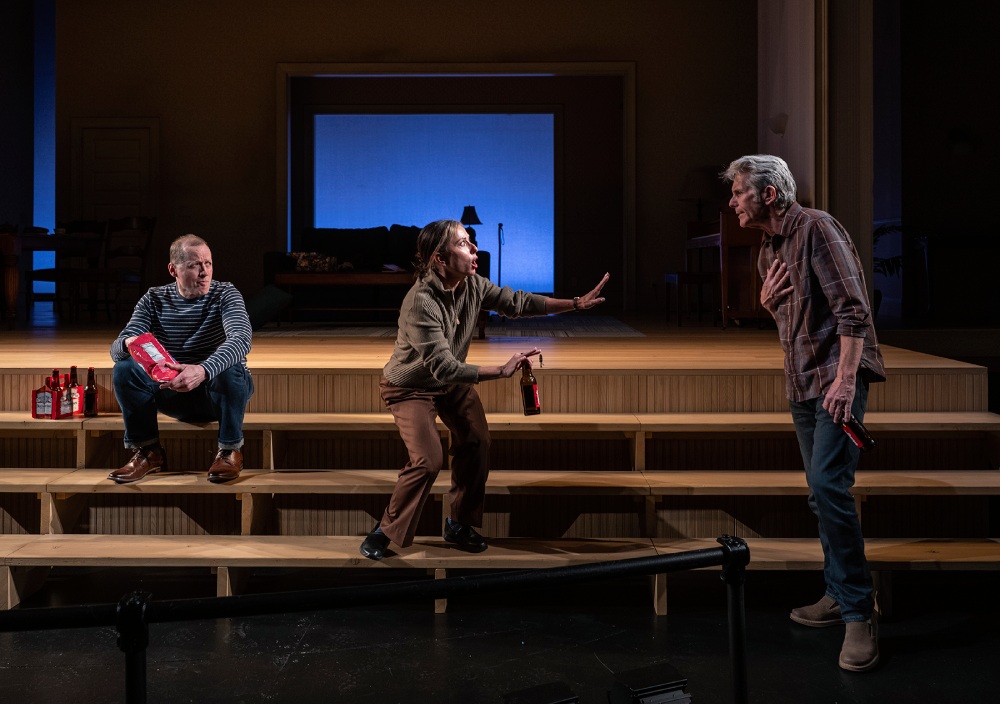
Andrew Boyce’s scenic design is a quiet marvel, giving the production a sense of dimensionality that feels both naturalistic and subtly disorienting. The main playing space is an open living room, flanked on one side by an entryway and a partial view into the kitchen, and on the other by a long hallway that suggests the deeper interior of the house. Just beyond the living room, another room is visible past a second hallway, creating the impression of a home that extends well beyond the edges of the stage. Boyce’s layout allows the audience to feel as though they’re peering into a fully lived-in environment, one with corners, thresholds, and unseen rooms that hold their own histories. Yuki Nakase Link’s lighting deepens this effect, subtly sculpting each corridor and doorway so the house seems to breathe with possibility - sometimes warm and inviting, sometimes shadowed with tension. It is a multidimensional design that grounds the play’s domestic realism while subtly reinforcing the sense that something inside this home - and inside these families - is evolving.
In their Artistic Director note, Glenn Davis and Audrey Francis frame Catch as Catch Can as a rare convergence of timing, artistry, and ensemble history - a production long delayed, now finally realized with the team that first set out to make it in 2020. They speak to the play’s uncanny pull, describing how Chung’s story has embedded itself in the company’s imagination, refusing to loosen its grip. For them, the doubling is not just a theatrical device but a test of the ensemble’s virtuosity, a chance for Steppenwolf to stretch its actors toward the edges of what performance can hold. And at the heart of their message is the idea that the play’s exploration of identity, home, and the selves we construct makes it a fitting capstone to the theatre’s 50th anniversary season - a reminder of how Steppenwolf’s long-standing commitment to family drama, artistic risk, and shared storytelling continues to shape its legacy.
Catch as Catch Can ultimately lands with the force of a quiet detonation, its emotional aftershocks lingering long after the final blackout. Morton and her trio of actors craft a world that feels both intimate and treacherous, a place where identity slips, refracts, and reforms in ways that are as unsettling as they are compelling. It is the kind of production that rewards close attention and invites conversation long after you’ve left the theatre - about family, perception, and the narratives we inherit without realizing it. Catch as Catch Can runs at Steppenwolf through July 12, with performances throughout the week, and it is very highly recommended for anyone who craves theatre that challenges, unsettles, and stays with you.
For tickets and/ or more show information, click here.
This review is proudly shared with our friends at www.TheatreInChicago.com.
Review: You Will Get Sick at Steppenwolf Theatre

If ever given the chance to see Amy Morton on her home stage at Steppenwolf–take it. She stars in the Chicago premiere of Noah Diaz’s ‘You Will Get Sick’ alongside fellow ensemble members Cliff Chamberlain, Namir Smallwood, Jordan Arredondo and Sadieh Rifai. Steppenwolf Theatre Artistic Director Audrey Francis directs this inventive new production with theatricality and compassion.
‘You Will Get Sick’ comes from writer and screenwriter Noah Diaz. It was previously seen at The Roundabout Theatre in which the late Linda Lavin starred to rave reviews. It’s the oddball story of a man with a secret (Namir Smallwood) who pays a woman (Amy Morton) to have uncomfortable conversations with the people in his life. At first the woman seems only motivated by money, but in time she becomes his unlikely confidant. The woman is preoccupied with her own dreams of starring in a local production of ‘The Wizard of Oz’. As his condition worsens, they live under the constant threat of attack from giant birds overhead.
The list of things that make this play unique is much longer than the list of things that make it familiar. On one hand, it’s not hard to draw a connection between the man’s wasting illness and his new friend’s obsession with being Dorothy Gale in ‘The Wizard of Oz’. This a story about a queer man and the illness that he will eventually succumb to. All the while, an off-stage narrator gives the internal stage directions for how the man feels. Each actor embodies several other unnamed characters that revolve around him in some way.
Sadieh Rifai portrays a handful of zany characters from nurses to new age theatre teachers, but as his sister receives bad news from Amy Morton’s character, her fury is electrifying. Rifai makes the most of Diaz’s gallows humor. Amy Morton’s performance is the centerpiece of the play though. As with her co-stars she wears a few unnamed character’s hats throughout the show, but as what’s described as “an older woman” who’s both a profit-driven jerk and a reliable caregiver–she’s complex and utterly realistic.
Diaz makes a point with ‘You Will Get Sick’ that illness in our society is seen as a moral failing. The man is ashamed for people to know he’s ill, but he’s even more embarrassed of his failing limbs. Namir Smallwood is heartbreaking as a man so lonely he has to pay people to be kind. Conversely, Cliff Chamberlain hilariously plays a swirl of toxically positive characters that seem to only exist to annoy those dealing with traumatic reality.
There’s something hard to define about ‘You Will Get Sick’, but instead of wondering what it’s about, perhaps Diaz wants you to feel what it’s about. Between the dreamy dialogue and Audrey Francis’ sumptuous vision for this production, there’s an emotional energy on stage that is quite literally magic in some parts. Even though there is tragedy in life, what this play explores is what can grow out of that and what parts of people do we carry with us after they’re gone?
Through July 20 at Steppenwolf Theatre Company. 1650 N Halsted St. 312-335-1650
*This review is also featured on https://www.theatreinchicago.com/!
Impeccable Production of Guards at the Taj is Must -See Theater

Guards at the Taj, now playing at Steppenwolf Theatre, is certainly among the best shows ever to play in Chicago.
Set in 1648, Guards at the Taj recounts a gruesome legend that surrounds the construction of the renowned masterpiece, the Taj Majal in Agra, India. That apocryphal story holds that Mughal emperor Shah Jahan, who commissioned the Taj, decreed that the architect and 20,000 artisans involved in its construction should be behanded – lest anyone ever again equal its magnificent design.
Playwright Rajiv Joseph works with this fable as fact and explores the behanding from the point of view of the two Hindustan Army Guards who will carry it out. We first see them stationed at a wall that we learn is shielding the construction site from view. As the play opens, we meet the dutiful and rational Humayan (Omar Metwally), at his post since dawn, eyes forward, posture erect. A few moments later, in scurries Babur (Arian Moayed), a dreamer whose uniform is askew and who is late for his post and struggles to stay focused and hold his sword properly.
The two, who have known each other since childhood, are closely bonded – but with the tensions and friction that inhabit any long-term relationship. Humayan aspires to a rise in rank, and wants to bring Babur along with him, even though he knows Babur's quirky personality could present risks.
Joseph, who won the 2010 Pulitzer Prize for his play Bengal Tiger at the Baghdad Zoo, gives us a sophisticated work, with banter by Humayan and Babur adeptly foreshadowing what is to transpire.
From the historical record, we know that the Taj Mahal was surrounded by a brick scaffold during construction, which was demolished to reveal the architectural wonder when it was completed. This moment in time becomes a turning point in the play, as Babur turns away from his position to be among the first in history to gaze upon the magnificent Taj Mahal. He soon convinces Humayan to do likewise. And through their expressions, we see the Taj Mahal as if for the first time as well.
From that moment at the wall, we soon shift scenes to find the two in the aftermath of carrying out the behanding, which is not at all as off-putting as it sounds. Director Amy Morton has carefully metered the presentation of horror so we recognize it without experiencing it too directly.
Joseph also faces us with a perennial question asked by civilized society – when should our personal moral compass override external authority? And subtly, perhaps, Joseph may be asking how such a heinous event could so readily be accepted as likely to be true - is it because it happened in the Far East?
The dialog in Guards at the Taj is enthrallingly naturalistic and contemporary, giving it an immediacy that penetrates any distance from the characters on stage. It is no wonder the script won a 2016 Obie Award for Best New Play.
The production of this work is nothing short of perfect, and the play itself is extraordinarily good. Written by Joseph expressly for its co-stars, Omar Metwally and Arian Moayed, this production feels more like a slightly delayed move from Broadway, where it received a highly regarded run in 2015. Amy Morton, a Steppenwolf ensemble member, directed both shows.
Likewise, the set, designed by Tim Mackabee for the original show and this one, ingeniously transforms from a blank stone wall outside the Taj Mahal, into a subterranean cell. Costumes by Bobby Frederick Tilley are outstanding, as the guards move through various degrees of formal military attire, to layered garb for their nefarious job.
The show runs through July 22 at Steppenwolf Theatre, and is very highly recommended.
Review: "HIR" at Steppenwolf Theatre

With “HIR” by Taylor Mac, Steppenwolf Theatre continues its legacy of pushing relevant and sometimes uncomfortable topics onto its audiences. Directed by Hallie Gordon, this is the Chicago premiere of Mac’s acclaimed 2015 Off-Broadway hit. This vivid production is sure to unsettle some subscribers, but that’s the point. Mac’s script offers up laughs and lessons and is able to gets its point across without coming off as preachy.
What a treat it is to see ensemble member Amy Morton back on the Steppenwolf stage. Morton is a frequent director at the Steppenwolf but has been scarce since her much-praised performance as Martha in 2010’s “Who’s Afraid of Virginia Woolf?” which transferred to Broadway. Morton plays Page, the mother of a transgender teen, Max (Em Grosland) and recently discharged soldier Isaac (Ty Olwin). She is also caring for her ailing husband (Francis Guinan) who has been incapacitated by a stroke. Page has unusual ideas about politics and lifestyle and is finally able to express herself the way she wants without an oppressive husband and societal restrictions.
Playwright, performer and singer-songwriter Taylor Mac (otherwise known as “judy”) is hot right now. His one-man “24-Decade History of Popular Music” was shortlisted for the 2017 Pulitzer. There’s no one quite like judy. HIR is essentially a fictionalized thesis on gender and politics in America. Guinan’s feeble character represents the fragile white male ego and Morton’s character is the at-times militant voice of the future. That future is without gender, without color, and without boundaries. Page seems to relish in abusing her once violent husband. An apt metaphor. Mac has a great sense of humor about the LGBT community and that shines through, but his script is also dense with a vital cultural insight that suburban audiences need to hear in the age of Trump’s America.
Hallie Gordon’s vision for this show is spectacular. Collette Pollard has created a fitting set for the chaos of this family. Gordon’s cast is top-tier. You can’t do much better than Amy Morton and Francis Guinan. Morton quickly becomes the focal point of the play and displays an overwhelming capacity for physical comedy and emotional honesty. You can’t take your eyes off her. Guinan is extremely brave to tread the boards in nothing more than adult diaper, or even braver, a full-face of clown makeup. Without uttering more than a few intelligible sentences, Guinan turns in a complicated but moving performance. This is likely to be one of the most talked about shows in Chicago, and good for the Steppenwolf for continuing to take risks.
Through August 20 at Steppenwolf Theatre Company. 1650 N Halsted Street. 312-335-3830 www.steppenwolf.org




Latest Articles
-
 Operation Mincemeat: A Smart, Scrappy Musical That Shines When Its Cast Takes the Wheel
Written by Maddie BurroughsIn the 2019 film Yesterday, a struggling musician wakes up in a world where The Beatles never existed. A similar theatrical case study could be done with every musical that might not exist without Hamilton; Operation Mincemeat should be first…
Operation Mincemeat: A Smart, Scrappy Musical That Shines When Its Cast Takes the Wheel
Written by Maddie BurroughsIn the 2019 film Yesterday, a struggling musician wakes up in a world where The Beatles never existed. A similar theatrical case study could be done with every musical that might not exist without Hamilton; Operation Mincemeat should be first… -
 MAMMA MIA! and HADESTOWN Return to Chicago in Spring 2027
Written by Buzz Center StageBroadway In Chicago is excited to announce two fan-favorite shows are returning to our stages this year: MAMMA MIA! and HADESTOWN. Current subscribers can add these to their season package when renewing by clicking here or calling (312) 977-1717. Group…
MAMMA MIA! and HADESTOWN Return to Chicago in Spring 2027
Written by Buzz Center StageBroadway In Chicago is excited to announce two fan-favorite shows are returning to our stages this year: MAMMA MIA! and HADESTOWN. Current subscribers can add these to their season package when renewing by clicking here or calling (312) 977-1717. Group… -
SANCTUARY STORIES - A JOURNALISM THEATER PROJECT October 9-18 at the Athenaeum Center for Thought and Culture
Written by Buzz Center StageThrough music, documentary video, sound, photos and live actors, “SANCTUARY STORIES: A JOURNALISM THEATER PROJECT” captures in words and images the lives and communities deeply connected with — and affected by — immigration in Chicago. This “living documentary” is a…
-
Red Theater presents the world premiere of CHURCH HURT October 24 - November 21, 2026
Written by Buzz Center StageRed Theater is thrilled to announce the cast and production team of the world premiere of Church Hurt by Brynne Frauenhoffer and directed by Jessica Love, running October 24 - November 21, 2026 at The Edge Off Broadway in Chicago’s…


Does your theatre company want to connect with Buzz Center Stage or would you like to reach out and say "hello"? Message us through facebook or shoot us an email at This email address is being protected from spambots. You need JavaScript enabled to view it..
*This disclaimer informs readers that the views, thoughts, and opinions expressed in the text belong solely to the author, and not necessarily to Buzz Center Stage. Buzz Center Stage is a non-profit, volunteer-based platform that enables, and encourages, staff members to post their own honest thoughts on a particular production.