
Displaying items by tag: K Todd Freeman
Steppenwolf’s Topdog/Underdog: When History Deals the Cards
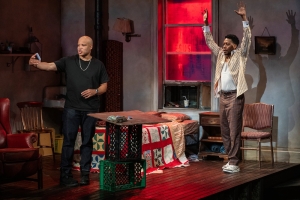
Susan-Lori Parks’ Topdog/Underdog, the Pulitzer Prize-winning masterpiece, is the kind of play that changes depending on when—and how many times—you see it. Directed by Kenny Leon, this revival stars Tony nominee Glenn Davis as Lincoln and Namir Smallwood as Booth, two brothers whose names alone tell us that Parks is preparing to play a very dangerous game with her audience.
The play was originally produced in Chicago by Steppenwolf Theatre Company in 2003, directed by ensemble member Amy Morton, with ensemble member K. Todd Freeman as Booth and David Rainey as Lincoln. More than two decades later, this revival demonstrates just how much material Parks packed into the story of two brothers living on the edge of survival.
Parks begins her own version of Three-Card Monte by giving us the names Lincoln and Booth. We already know the historical ending: John Wilkes Booth assassinated Abraham Lincoln. Parks puts that card on the table immediately—and then spends the rest of the play moving it around.
Lincoln and Booth are not historical figures, of course, but the names become a psychological trap. Lincoln works as an Abraham Lincoln impersonator, repeatedly allowing strangers to “assassinate” him as part of the act. The brothers themselves simulate the murder, turning history into performance and performance into something increasingly dangerous.
That is where Parks’ Three-Card Monte becomes so effective. We know the card. We know what is coming. Yet Parks keeps moving our attention elsewhere—to money, women, abandonment, brotherly rivalry, masculinity and the desperate need to survive. The audience is watching closely, thinking we know exactly where Parks is going. But like the mark in a Three-Card Monte game, we can never be completely sure which card we are actually watching.
The brilliance is that Parks gives us the ending and still manages to create suspense.
The question isn't simply, “Will Booth kill Lincoln?” We already know that story. Instead, Parks asks us to consider how and why these two brothers arrive at that moment. By the time the real gun is fired, we have become so invested in these men that the historical inevitability becomes a genuine emotional shock.
Having seen Topdog/Underdog several times, I’ve gained new insight into Lincoln and Booth with each production. I’ve always imagined these brothers as relatively young men—perhaps somewhere between 21 and 35 at the oldest. There is something about their desperation, their dreams and their constant jockeying for position that feels connected to men still trying to figure out who they are.
Seeing older actors inhabit these roles changes the equation. This production brings a greater sense of history and introspection to Lincoln and Booth. These aren't simply two young men making bad decisions. They feel like men who have accumulated years of disappointment, mistakes and missed opportunities. Their arguments have the weight of history behind them.
That being said, the acting is first-rate.
Glenn Davis delivers some of the best work I have seen in his storied career. His Lincoln carries weariness beneath the humor, as though every card trick, every performance and every attempt to maintain dignity has taken something from him. Davis understands that Lincoln is not simply trying to make a living; he is trying to hold onto an identity.
There is an extraordinary sadness to his Lincoln because he has found a way to make a living by pretending to be someone who, historically, has already been dead for generations. Every night he puts on the stovepipe hat, becomes Abraham Lincoln and allows strangers to reenact his assassination. The joke is that he survives the murder every night—until, of course, the night he doesn't.
Namir Smallwood is equally compelling as Booth. Smallwood has the remarkable ability to morph into whatever character is placed before him, and here he creates a Booth whose swagger and insecurity exist simultaneously. Booth wants to be seen, respected and successful, but beneath that ambition is a brother desperate to prove himself.
Their relationship is the heart of the play. They love each other, resent each other, depend on each other and compete with each other. They are simultaneously brothers and adversaries. One minute they can make each other laugh; the next, they are fighting over money, women or the invisible scorecard of who has accomplished more.
Arnulfo Maldonado’s set—a room in a New York City boarding house—captures the basic circumstances of their existence, but for me, it is far too sanitized for the gritty New York City world Parks has created.
Rooms like this were common, particularly in neighborhoods such as Hell’s Kitchen. They were tight. Space was at a premium. They were not necessarily neat or clean. These were places where people lived because they had few alternatives. The room should feel less like a place where two men are actually struggling to survive.
That distinction matters because Lincoln and Booth are in survival mode. The room is not simply their home; it is a pressure cooker. Every inch of space should remind us that there is nowhere for these brothers to escape—not from each other, not from their past and ultimately not from the consequences of their choices.
Kenny Leon's direction keeps the focus where it belongs: on two brothers trapped between history, memory and survival. He allows Parks' language, humor and repetitions to accumulate rather than rushing toward the inevitable conclusion.
Ultimately, Topdog/Underdog remains a remarkable piece of American theatre because Parks refuses to let history stay in the past. She takes two names everybody recognizes, places them on two Black brothers living in New York, and transforms a familiar historical tragedy into an intimate story about family, survival, masculinity and fate.
We may enter the theatre believing we know who Lincoln and Booth are and how their story ends. But Parks makes us see them as brothers first—two men desperately trying to survive each other, their circumstances and the histories they have inherited.
By the time the final card is played, the tragedy is no longer about Abraham Lincoln and John Wilkes Booth. It belongs entirely to these two brothers. And that is Parks’ greatest trick: she makes us think we are watching history repeat itself, when what we are really watching is the heartbreaking collapse of an American family.
Highly Recommended
When: Through Nov. 1
Where: Steppenwolf Theatre, 1650 N. Halsted St.
Running time: 2.5 hours (15 minute intermission)
Tickets: $20 -$142.50
312-335-1650
Reassembling the Broken Universe of Mr. Wolf

Rajiv Joseph’s Mr. Wolf is a striking departure from the warmth and humor of his recent King James. Where King James used the comfort of sports as a language of friendship, Mr. Wolf asks us to sit inside the fragile, fractured space of trauma. In Steppenwolf’s intimate production, ensemble member K. Todd Freeman directs with an unflinching precision that refuses to soften the material. His approach creates a space where silence weighs as heavily as dialogue, where each pause presses the audience closer to the raw pulse of grief, survival, and uneasy healing. This is a small play set against a very large world, and its intimacy makes it resonant.
The play centers on Theresa (Emilie Maureen Hanson), a teenager recently rescued after twelve years of captivity. Her abductor, Mr. Wolf (Tim Hopper), is not only a predator but also an astronomy professor who reshaped her entire worldview with cosmic metaphors, rigid theories, and apocalyptic visions. For Theresa, the cosmos—and Mr. Wolf—are inseparable. He does not see the stars as sources of wonder but as proof of his twisted logic.
Mr. Wolf bends the language of science into a doctrine of control. Whereas most scientists keep religion and science in separate spheres, he blurs that boundary, turning the vastness of the universe into a kind of scripture. He declares Theresa a prophetess of the cosmos, teaching her to view the stars not through physics and wonder but through his rigid, apocalyptic framework. Hopper embodies this chilling certainty with unnerving precision, a man who once lectured on the heavens but now orbits entirely within his own delusions.
Now reunited with her parents—Hana (Kate Arrington) and Michael (Namir Smallwood)—Theresa must navigate a world that feels as alien as the galaxies she once studied under his command. Julie (Caroline Neff), Michael’s new wife, hovers between empathy and helplessness, unsure how to reach someone marked by unspeakable experience while quietly grappling with her own grief.
The acting is superb across the board. Hanson captures Theresa’s uneasy balance of fragility and resilience. Arrington and Smallwood embody grief in contrasting shades—Arrington’s sharp-edged regret against Smallwood’s wounded stoicism—while Neff supplies a warmth the others cannot. Hopper, disturbingly calm as Mr. Wolf, delivers control with the cool precision of a man who has transformed astronomy into a theology of delusion.
The design team amplifies this unsettling intimacy. Walt Spangler’s set suggests a world we recognize—rooms, walls, familiar structures—that have splintered into pieces. Watching the play, we feel as though we are tasked with reassembling it, just as the characters try to piece together their broken lives. Dede Ayite’s costumes root the play in ordinariness, and Josh Schmidt’s sound and original music create an undercurrent of wonder. Rasean Davonté Johnson’s projections echo the celestial images that once defined Theresa’s captivity, lingering like ghosts of her indoctrination.
Freeman’s direction sharpens the play’s unease into something inescapable. Rather than offering distance, he compels the audience to witness the jagged rhythms of survival. Where King James thrived on joy and connection, Mr. Wolf strips us down to silence and difficult truths. It is a play less about resolution than endurance, and in Steppenwolf’s hands, it becomes a stark reminder of how trauma ripples outward—and how putting the pieces back together is never simple, but always necessary.
RECOMMENDED
When: Through Nov. 2nd
Where: Steppenwolf Theatre, 1650 N. Halsted St.
Running Time: 90 minutes
Tickets: $20 - $133.50
312-355-1650
*This review is also shared on https://www.theatreinchicago.com/!
When We Don't Know What To Do With Them, We Send Them Downstate

“Downstate” is a bit of a dog whistle for Chicagoland, suggesting a cultural distinction between urbanites in the north, and the vast agrarian expanses to the south – downstate - where trash goes, sewage flows, and where the state government builds prisons.
The word becomes generalized in Downstate, a new play by Pulitzer Prize winner Bruce Norris, which looks at the fraught issue of finding housing for convicted pedophiles after they serve time for their crimes. During parole, these men are returned to the” community,” but not to their home.
Instead they live in halfway houses operated by non-profits, sited in carefully proscribed areas that must be so-many hundreds of feet away from schools and other areas children may gather. The inhabitants are not allowed to go online, or possess a smartphone, keep alcohol, use Facebook, or move about freely.
Norris takes the less politically correct position of empathy in showing the suffering imposed on these pariahs, who in the world of #MeToo are unlikely to get a second thought. They are subject to regular inquisitions by parole officers, and a concatenation of rules and restrictions means there are few locations for them to live in such transitional halfway houses. So, they are shipped Downstate.
“I started doing a lot of reading about the things paroled sex offenders increasingly face– registries, residency restrictions, neighborhood watches, self-appointed vigilante groups,” says Norris. “These are post-incarceration punishments, that don’t exist for any other category of criminal.”
That in a nutshell is what Downstate is about: four men holed up in a house run by a Lutheran social service agency. They can go to work and come home, and that’s about it – even the local IGA grocery store is only 2,450 feet from the elementary school. They are indeed strange bedfellows, and Norris gives us the nuance of the caliber of their individual violations:
• the piano teacher Fred (Steppenwolf stalwart Francis Guinan) who had sex with two adolescent male students. Guinan, in an understated performance, shows the range that can be expressed within a very constrained character.
• Gio (Glenn Davis in an amazing, hyperbolic performance) a frenetic man on the make with a plan in his hand, whose crime was considered Category 1 (lower level) statutory rape of a young woman below age.
• Felix (Eddie Torres) who was convicted of incest with his daughter. Torres conveys the abject suffering and torment as he loses access to his family.
• A Broadway choreographer and accomplished promoter and musical artist, Dee, who fell in love with a 14-year-old boy in a road show of Peter Pan.
As Dee, K. Todd Freeman gives what will certainly become a definitive expression to the role. He is the settled voice of reason and a nurturant center of gravity within this ad hoc family of men, shopping for them and helping to make a home for them. As audience, we listen to Dee: he dishes and gives back as good as he gets – and he becomes our guide and the closest thing to a voice of reason.
Norris may be toying with us, then, by making Dee a very sympathetic character, while at the same time making him an unrepentant advocate for man-boy love – the movement that sees adult male love of minor boys as a victimless crime, and which advocates for release of those convicted of it.
“There’s not many cases of death by blowjob!” Dee asserts. Gio, for one, abhors Dee both for his gayness and for his pederasty, with some violent outbursts in the house as a result.
Norris focuses this tension with the introduction of Andy (Tim Hopper), a Northshore suburbanite who with his wife Em (Matilda Ziegler) comes to visit Fred to seek redress, to “process” the issue and obtain formal emotional closure by getting him to sign an explicit statement acknowledging his wrongs. Norris contrasts Andy’s suffering with the experience of Dee, who comes to the defense of Fred, while revealing that he, too, was abused as a child – and claims to be none the worse for it. Fred and Em bring all the conventional middle class psychological expression to their claims - but framed within the context of Downstate, it begins to sound more like "white people's problems."
Norris seems fearless in treading into such troublemaker territory. His Pulitzer winning Clybourn Park visited historic efforts in 1959 to block African Americans from moving into a white Chicago neighborhood, then returned 50 years later to watch a reversal of prejudice as whites tried to gentrify the same now-black area. Downstate will test its audience even further, since pedophiles are largely today's lepers.
Downstate is directed by Pam MacKinnon, and she had her hands full to balance the energy emanating from this remarkable company of performers. A call out to Cecilia Noble as parole officer Ivy - it's almost a thankless role to play the character who has a thankless job, in a play like this. But thank you, Ivy, for very good performance.
Of particular note, the production is a joint effort by Steppenwolf and the National Theatre of the U.K. It may surprise you to learn the cast is transatlantic. The flawless, broad, working class accent of extreme south suburban Effie (played by Aimee Lou Wood, a Manchester, England native) and the dulcet Kenilworth articulation of Em (played by Londoner Matilda Ziegler) were learned right here on Halsted street, under the tutelage of Gigi Buffington.
Downstate plays through November 18 at Steppenwolf Theatre in Chicago. After that it moves to the National Theatre London in January 2019.
Airline Highway Recognizes the "Invisibles"

Steppenwolf Theatre’s Airline Highway focuses on those who are mostly forgotten, unseen or unfortunately, even looked down upon by many. In this case the story revolves around a group of outcasts who inhabit The Hummingbird Motel in New Orleans that have come to call themselves “family”. Each comes with their own heartbreaking story or unfortunate set of life circumstances that has led their way to become motel dwellers. Mostly scratching and clawing for another day of food and/or shelter, audience members are face to face with a reality that is mostly hidden, or conciously forgotten, from our daily lives. We inevitably see the caring that is shared amongst each other in such a group and realize that a self-made family of “invisibles”, as they are referred to, have the same hopes, dreams and capacity for love, whether giving or receiving, as anyone else.
As one walks into the theatre they are first met with a highly impressive set that recreates an aging motel with brick façade complete with an office, large vintage stand up sign (perhaps 1950s) and a litter-filled parking lot that one could swear is actual concrete. We see a stairwell, several room doors, an abandoned Honda Civic and a backdrop of an evening sky. As the play progresses we are introduced to one colorful character after another – a laid back office manager, an enthusiastic hippie who considers himself a poet, a vibrant transvestite, an maturing hooker, a stripper who idealizes about having an office job and a handyman who is always trying to make a buck by offer to make repairs around the motel.
It is soon uncovered that the group is planning to throw a party for Miss Ruby, a near death elderly resident who once owned a famous strip club and has also taken her share of wrong turns in life. But this is no ordinary party –it is a funeral – a living funeral. It was Miss Ruby’s request to have a send off while still alive. As the party is being put together, we learn many revealing aspects about the past of each resident. We also see a family bond that rivals most. When Bait Boy returns to attend the party (now considered somewhat successful by the group’s standards), another dimension is added to the group’s dynamic. Adding to his questionable homecoming, Bait Boy, now “Greg”, brings his girlfriend’s sixteen year-old daughter who plans to interview the “subculture” for a high school paper. This is unsettling for some of the Hummingbird residents.

Airline Highway can be funny at times and it is often moving. A slew of wonderful performances by K. Todd Freeman as “Sissy”, Kate Buddeke (“Tanya”), Caroline Neff (“Krista”), Scott Jaeck (“Wayne”) and Gordon Joseph Weiss as the eccentric and loveable “Francis” make this story as believable as it is enjoyable. It is hard not to appreciate every privilege we have experienced in life after seeing this production. Maybe it’s a few bad decisions or perhaps it’s a couple runs of bad luck, but in Airline Highway we see that anyone is susceptible to conditions that can make a life spiral downward. We also see displays of strength, love and courage. There are times we simply envy the closeness of the group and the protectiveness they have for each other.
Flowing at a pace that allows everything to develop with its own organic freshness, Airline highway is a delightful story that brings strong personal ties to the forefront and recognizes the fact that families come in all shapes and sizes, connected by blood or not.
Brilliantly directed by Joe Mantello, Lisa D’Amour’s Airline Highway is playing at Steppenwolf Theatre through February 8th, 2015. For tickets and/or more information, visit www.steppenwolf.org or call 312-335-1650.
*Above photo: (left to right) Carloyn Braver and Carloine Neff
*Below photo: The cast of Airline Highway currently being performed at Steppenwolf Theatre (1650 N. Halsted)




Latest Articles
-
 Operation Mincemeat: A Smart, Scrappy Musical That Shines When Its Cast Takes the Wheel
Written by Maddie BurroughsIn the 2019 film Yesterday, a struggling musician wakes up in a world where The Beatles never existed. A similar theatrical case study could be done with every musical that might not exist without Hamilton; Operation Mincemeat should be first…
Operation Mincemeat: A Smart, Scrappy Musical That Shines When Its Cast Takes the Wheel
Written by Maddie BurroughsIn the 2019 film Yesterday, a struggling musician wakes up in a world where The Beatles never existed. A similar theatrical case study could be done with every musical that might not exist without Hamilton; Operation Mincemeat should be first… -
 MAMMA MIA! and HADESTOWN Return to Chicago in Spring 2027
Written by Buzz Center StageBroadway In Chicago is excited to announce two fan-favorite shows are returning to our stages this year: MAMMA MIA! and HADESTOWN. Current subscribers can add these to their season package when renewing by clicking here or calling (312) 977-1717. Group…
MAMMA MIA! and HADESTOWN Return to Chicago in Spring 2027
Written by Buzz Center StageBroadway In Chicago is excited to announce two fan-favorite shows are returning to our stages this year: MAMMA MIA! and HADESTOWN. Current subscribers can add these to their season package when renewing by clicking here or calling (312) 977-1717. Group… -
SANCTUARY STORIES - A JOURNALISM THEATER PROJECT October 9-18 at the Athenaeum Center for Thought and Culture
Written by Buzz Center StageThrough music, documentary video, sound, photos and live actors, “SANCTUARY STORIES: A JOURNALISM THEATER PROJECT” captures in words and images the lives and communities deeply connected with — and affected by — immigration in Chicago. This “living documentary” is a…
-
Red Theater presents the world premiere of CHURCH HURT October 24 - November 21, 2026
Written by Buzz Center StageRed Theater is thrilled to announce the cast and production team of the world premiere of Church Hurt by Brynne Frauenhoffer and directed by Jessica Love, running October 24 - November 21, 2026 at The Edge Off Broadway in Chicago’s…


Does your theatre company want to connect with Buzz Center Stage or would you like to reach out and say "hello"? Message us through facebook or shoot us an email at This email address is being protected from spambots. You need JavaScript enabled to view it..
*This disclaimer informs readers that the views, thoughts, and opinions expressed in the text belong solely to the author, and not necessarily to Buzz Center Stage. Buzz Center Stage is a non-profit, volunteer-based platform that enables, and encourages, staff members to post their own honest thoughts on a particular production.