

Bill Esler
'I’m Going to Marry You Tobey Maguire,' Full of Laughs, Ends With a Fizzle
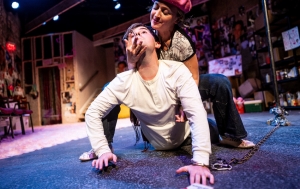
Here’s a play that should be really good, based on its reputation alone. Written by Chicago comedy writer Samantha Hurley, I’m Going to Marry You Tobey Maguire premiered off Broadway at The Cell Theater in 2023. Now Refracted Theatre Company has mounted it at The Den Theatre in Chicago, bringing its original off Broadway director Tyler Struble on board. Under Struble’s experienced hands, we get a vital, lively production of a retro piece, circa 2005.
As the title suggests, the play centers on Spider-Man actor Tobey Maguire (Jasper Johnson is just right for the role) who has become the fixation of a precocious and deranged eight-grade girl, Shelby Hinckley (an over-the-top good performance by Alex O’Shea). Hinckley, who leads her local chapter of the Tobey Maguire fan club, plots to capture Maguire, and successfully entraps him in her family basement. There she plans to marry him.
When we meet Shelby Hinckley, she is playing with dolls in an adjacent room, enacting scenes from the romance she imagines with Toby Maquire, who is just coming back to consciousness following a car crash engineered by Hinckley. The crazy premise included stuffing him into an oversized duffle bag. With the help of a friend she has maneuvered him into her basement, then chained him to a pipe. The room is a shrine to Maguire, plastered with posters and magazine images of him.
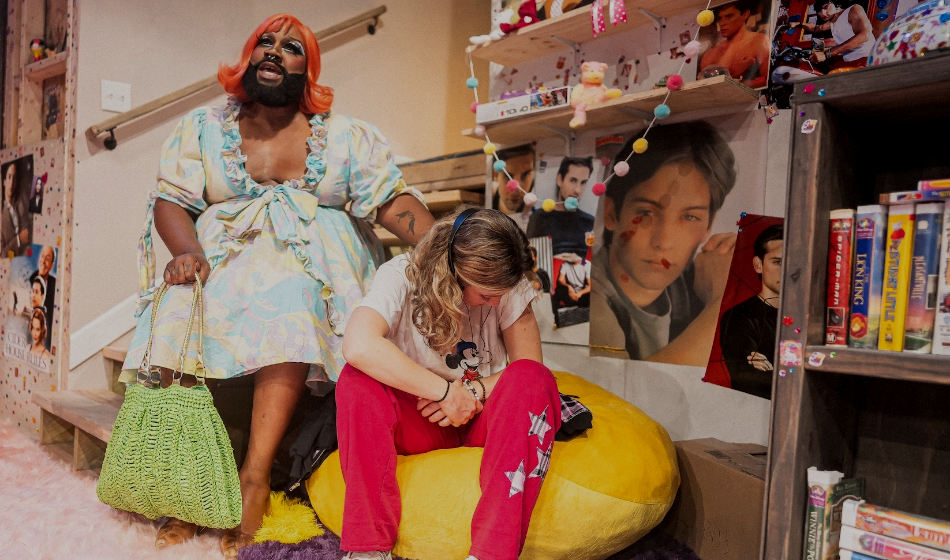
Lucey Stoole aka Ty Huey (left) and Alex O'shea
As he revives, Maguire imagines this must be some elaborate practical joke his agent has engineered, and begins shouting to him and bargaining for release. But no, Shelby arrives and explains his predicament is her doing. Unseen, Shelby’s Mom (Lucey Stoole aka Ty Huey) shouts barks down the stairs for Shelby to turn down the television, and never comes down to investigate, despite Maguire’s calls for help. Stool - Huey plays multiple roles in an imaginative performance as variously a real estate agent, paparazzi, and Maguire’s alter-ego embodied in a poster of him.
What Shelby hadn’t anticipated is that Maguire, the actual human being, is a cigarette smoker, a drunk and an addict, which is true from real life as well by Maguire's own admissions. Unwilling as he is to marry this 14-year-old girl (she figured he’d succumb to Stockholm Syndrome and fall for her), he resorts to sniffing spray paint fumes as his only available outlet for a high. Maguire is characterized as competing for roles with Jake Gyllenhaal (in real life it was Leonardo DiCaprio that was his competitive frenemy).
The play runs 105 minutes with no intermission, and we witness scenes of psychosis from Shelby and Maguire. The television screen, central to much of the action, transmogrifies artfully at one point and we see Maguire issue forth from it (ala the film Videodrome), a scene carried off well.
But the plot ultimately runs out of steam (Steven King’s like-minded Misery gets a shout-out by Shelby) though the play runs on without it. The charm wore off for me, though all three performers make the best of it and the show elicits plenty of laughs. All in all, it comes somewhat recommended. Refracted Theatre's I’m Going to Marry You Toby Maguire runs through Oct. 31 at The Den Theatre in Chicago.
Funny ‘Prayer Circle’ Is Loaded With Laughs
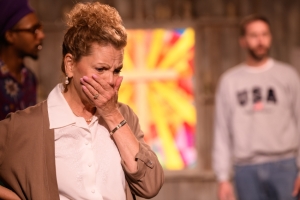
Erik Gernand is resident playwright at Redtwist Theatre, and his Prayer Circle is absolutely laugh-out-loud funny. The strength of this script is the characters—who are clearly defined and familiar types—and the performances, directed by Dusty Brown, are uniformly outstanding.
Set in the cramped loft of a church (with stained glass and roof vaults dominating a well-detailed set by Jeff Bain), we will meet the five members of the Prayer Circle (they call themselves “prayer warriors” for reasons that later become apparent) as they gather one by one for their spiritual endeavor. Doug (Kevin Waters) is already there when the lights come up, at the piano, singing carefully, spiritually (a snippet of the hymn "Blessed Assurance" I believe) with a beauty and intensity that suggests the conviction of the group we are to meet.
Waters’ singing is so good, conveying that his character Doug is intensely immersed in this vocal invocation. So much so he is caught off guard by the arrival of the irreverent Addy (Andi Muriel), who also happens to be his high school student in daily life.
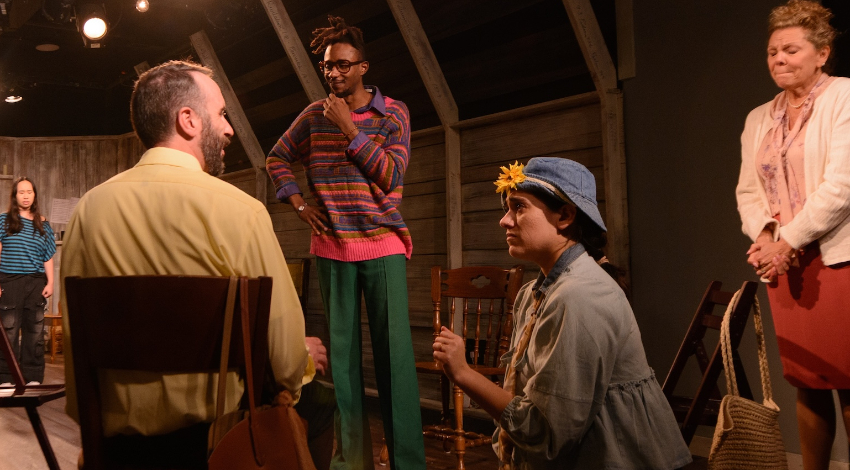
From left: Andi Muriel, Phillip C. Matthews, Kevin Waters, Macaria Chaparro Martinez, and Jaqueline Grandt in Redtwist Theare's Prayer Circle.
Muriel is a very good comedic actor, and her Addy dispels the possibility of too much seriousness as she conveys the quick-witted slapdash humor that can spring forth when young people have discovered the absurdity of the adults governing them. We also meet Carol (Macaria Chaparro Martinez), a 30-something enveloped in a cloud of earnestness: “You can call me Bible lady just don’t call me late for prayer circle.”
Soon enough Marilyn (Jaqueline Grandt) lands, that familiar church matron who is far more powerful than she should be, perfectly coiffed and clad with a designer bag. There is still one seat vacant, a result of the tragic death by cancer of a young mother DeeDee, who we learn was the wife of Pastor Evans (Phillip C. Matthews).
Marilyn is all in a dither, because the president declared a war last night in a televised speech. Marilyn tells the circle that she has summoned Pastor Evens to address the matter with the prayer circle, calling him from his bereavement leave, and the care of his motherless children. What could possess her to do such a thing?
We soon discover this prayer circle wields unusual powers with its prayers and hopes to enlist the involvement of the pastor in its spiritual work. Gernand’s script stumbles a bit in its structure, with a tad more procrastination in the plot reveals than a screwball comedy like this warrants.
We also don’t see the moral analysis that the playwright seems to want to make the characters face. The playwright seems uncertain about how seriously we are to consider morality when he brushes against serious concerns encountered by these faithful.
Nevertheless, the tremendous comic performances, especially by Jaqueline Grandt and Andi Muriel, make this a show worth seeing. Prayer Circle, running through November 8, 2026 at Chicago's Redtwist Theatre, comes recommended.
Gwydion Theatre Delivers More than a Satire in Lynn Nottage’s Por’ Knockers
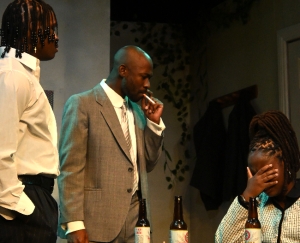
Lynn Nottage is a skilled playwright, and prolific especially considering the high quality of her works: Pulitzer winners Ruined and Sweat. Or the remarkable By the Way, Meet Vera Stark, a kind of All About Eve with the starlet’s Black maid in the Eve role. And then Intimate Apparel, which won wide and very deserved praise. While her scripts vary widely in storyline, they are loaded with very real, authentic characters.
So getting a chance to see an early Nottage work—Gwydion Theatre’s production of Por’ Knockers (1995)—has an especial appeal. It is Nottage’s second play, and it had a turbulent life after premiering Off Broadway in New York at The Vineyard Theatre. Then it went to London. After its London run was cut short, Nottage told The Guardian, “I still remember an audience member ripping up their programme into tiny shreds and throwing it like confetti, saying: ‘I am cancelling my subscription to the theatre!’”
It’s not that the play is bad. In fact it is very good. It was the subject that caused problems: five activists of the imaginary People's Diasporatic Party blow up an FBI building to protest the treatment of African-Americans in the U.S. The play centers on the tension and anxiety within that band of conspirators before and after their destructive venture.
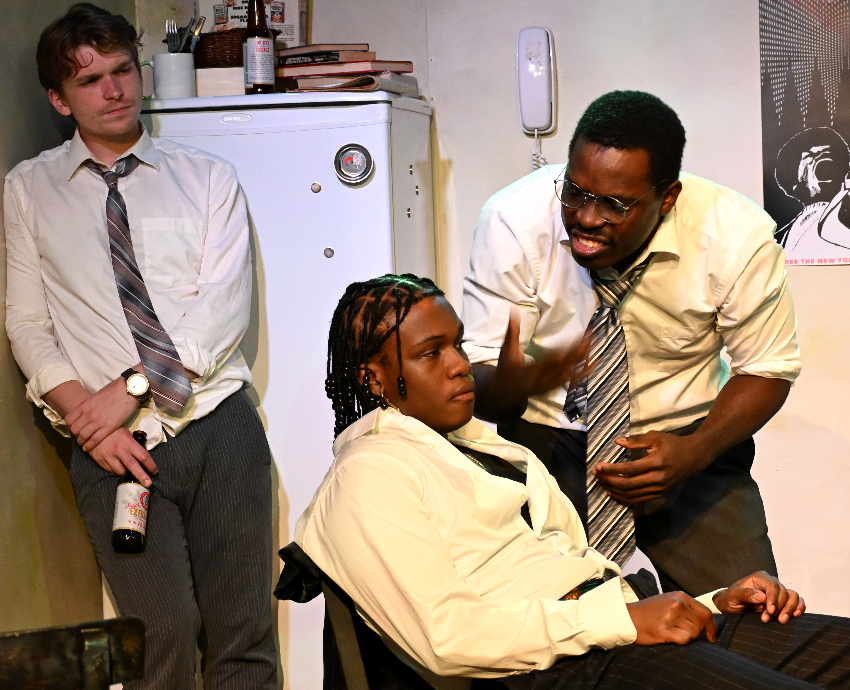
Grayson Kennedy (l-r), Joseph Percy and Dontaye Albert.
Por’ Knockers (the name refers to Guyanese gold panners) was having a successful and well-received run in London until Timothy McVeigh carried out a similar bombing of the FBI building in Oklahoma City. And so the script has been shelved since. Until Gwydion Theatre in Chicago succeeded in mounting this production at Greenhouse Theater.
“This play is so special to us at Gwydion,” says Grayson Kennedy, who is Gwydion Theatre’s Artistic Director. “It was a show that we have wanted to do since our first season.” (Kennedy acts in the show as well.)
Directed for Gwydion Theatre by Makari Robinson-McNeese, Por’ Knockers is widely regarded as a political satire, almost a parody of a “people’s revolutionary army.” But Nottage gives it a level of depth, with five fully-realized characters, each with different backgrounds and motives for the bombing.
In the opening scene of the one act, Nottage establishes the who's who: the mature, grounded Kwami (Kevin Aoussou is astoundingly good); the hyper-kinetic paranoid James (Dontaye Albert is remarkable); a thuggish Ahmed (Joseph Percy); the lone woman in the group, the academic Tamara (Justice Ford); and the lone vacillating white guy, Lewis (Grayson Kennedy is excellent). And then there is this oddly magical entry, Lance (Jimmie Roger III), a machete wielding Guyanese gold prospector visible only to Kwami, whose character happens to be Guyanese-American.
The group’s anxiety is palpable, each expressing it uniquely according to the personalities Nottage has drawn for us. Tempers flare, violence seems to bubble just under the surface as the characters play out their fears. As they leave the apartment for this carefully planned rendezvous with destruction, it is Kwami who exits last, straightening the furniture and quietly telegraphing to the audience a disdain for his fellows.
The passage of time throughout the show is registered by the subtly changing hues of daylight filtering through the window blinds. (Lighting Designer Emma Berry deserves praise for this subtle but important element.)
When they return, hours later, they are filled with excitement over the bombing, and soon enough trepidation builds about what will follow. Tamara offers words of reassurance. “We succeeded,” she says. But only four have returned. That hyper-kinetic paranoid James is nowhere to be seen, further heightening the anxiety in the room. He hasn’t followed the plan. When James does return, having ridden the train to the end of the line and back—“I wanted to make sure I wasn’t followed,” he tells them—he also delivers shocking news: the building was unexpectedly occupied, by children.
A portable radio that was to keep them up to date is malfunctioning because of bad batteries. Lewis delivers a “white man” pronouncement and orders Ahmed to get decent replacement batteries. This doesn’t go down well and violence threatens. Kwami, feeling internal pressure to be the patriarch and the decider on strategy, resists the role, then reluctantly takes it.
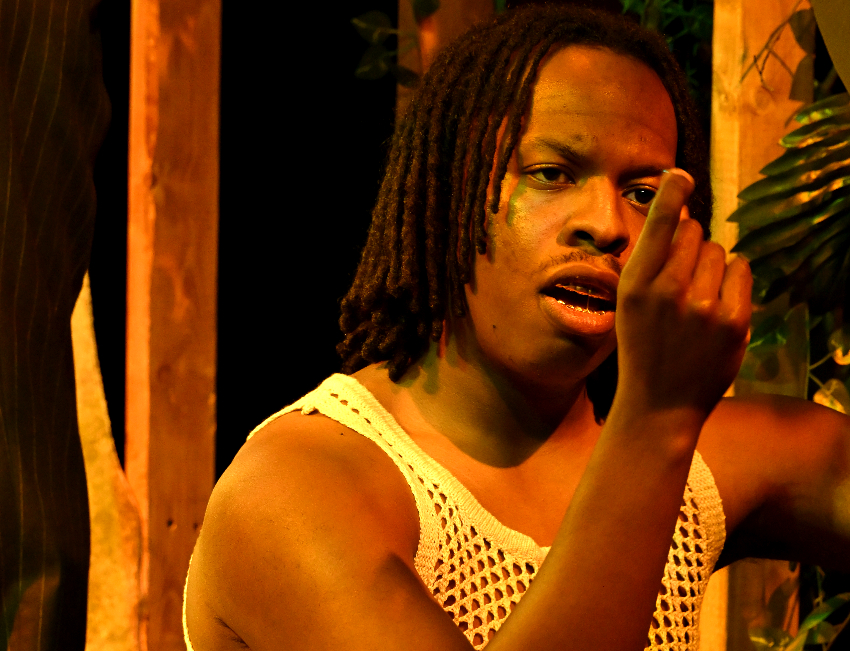
Jimmie Roger III
At this point, the play makes a departure. It remains a parody and these activists do seem inept, but they are also caught in an existential quandary. This takes shape in the lone land line on the wall, a 1990s touch tone wall phone, which will be their means to call the FBI and take claim for the bombing, and make a statement of their motives.
Over the remainder of the play, this brigade of the People's Diasporatic Party swings between ruminations on the morality of their action, or attacking each other. Percy’s Ahmed phrases his sense of their predicament, “I ain't afraid of death. I’m afraid of nobody noticing it. I want my death to be a defining event.”
That phone sits on the wall, a mute expression of the culmination of their destructive act: taking credit for it. Between the tense discussion, the five each take a turn at calling in, when the pressure of the moment drives them to the phone. Yet there is one constraint after another that inhibits them from successfully completing the call: first, they don’t have the number; then they are reluctant to pay 75 cents to “the system” to get directory assistance; after they tear the number from the phone book Lewis calls, and realizes he doesn’t know what to say and hangs up. Tamara calls, but becomes mired in voice mails and transfers and gives up.
Ford’s Tamara seems the most tormented by moral issues of having killed children. Notably, whenever Kwami wants to rally the group, he addresses them as “brothers” then throws in a lagging “and sister,” a low-key running joke for the audience, though not the characters on stage. Eventually the phone call gets through in a resolution of that conceit, which Nottage has used effectively to put each personality on display.
Early works by writers arrive unfettered by reputation and uncontaminated by any self-consciousness with which acclaim may impart. It is my feeling that early writing by authors of any medium allows us a window into that unbridled creative energy.
In Por’ Knockers Nottage inserts that sixth character, the silent, machete wielding Lance, who appears periodically, visible only to Kwami. He prowls the stage front during these brief magical interludes, humming or singing softly. When the other four see Kwami drifting away, he self-consciously explains he is channeling ancestors.
Nottage’s success has not diminished her work, but only affirmed her remarkability. Two subsequent plays like Ruined (its 2008 world premier was at the Goodman, where it returns as part of the next season) and Sweat both won Pulitzers, a first for a woman playwright. Nottage also wrote the book for two Broadway musicals: MJ and The Secret Life of Bees.
Por’ Knockers, which comes recommended, runs through October 4, 2026 at The Greenhouse Theatre.
Gabriel Garcia Marquez's Dark Children’s Tale Translates to Stellar Show in ’The Man Who Fell with the Rain’
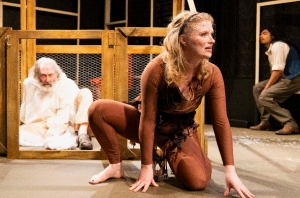
An exceptionally good show is now on stage at Chicago’s Trap Door Theatre. This wonder—The Man Who Fell with the Rain— has been translated through three languages on its way to the footlights in its U.S. premiere, right here on the tiny stage on Cortland Ave.
Originating in Spanish as a children’s tale by Columbian Nobel Laureate Gabriel Garcia Marquez, it was turned into a script by Andrei Kureichik, a Belorussian playwright, then translated to English by John Freedman. All that before being adapted and directed by Kay Martinovich for a perfect and very cogent rendering by the Trap Door players in its U.S. premiere.
The Man Who Fell with the Rain hews closely to Marquez’s original short work, “A Very Old Man With Enormous Wings: A Tale For Children,” while playwright Kureichik has unpacked the important details touched only lightly in the original. It becomes truly theatrical as we watch the story unfold that Marquez charted.
The script brings us an Old Man With Enormous Wings (Richard Cotovsky) who is discovered unconscious in the backyard of the Husband (Dan Cobbler) and the Wife (Laura Nelson). The couple also happen to have a two-week-old baby in their house, and a nosy know-it-all Neighbor Woman (Emily Lotspeich) is certain the winged creature is an aging angel who was intending on taking the baby. Her advice: beat him to death with a cudgel.
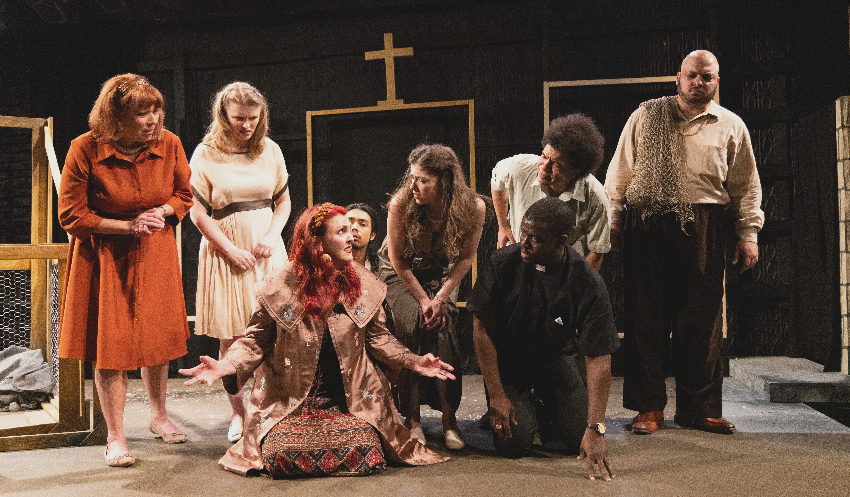
The cast of The Man Who Fell with the Rain at Trap Door Theatre through September 26, 20206
The couple take pity on the Old Man, and instead place him in their chicken coop, intending to keep his presence a secret. But word gets out and neighbors, and then spectators descend on their abode. The Old Man has regained consciousness and the couple try communicating—but he speaks only his own unknown tongue. Neighbors speculate on what to do with him, suggesting vriously to put him over the military and end wars; or make him a governmental magistrate; perhaps put him out to stud to generate a winged human master race.
The local Priest (Keith Surney) is called in, since the Old Man seems perhaps to be an angel, but there is nothing in the doctrinal books that explains the possibility of an aged, injured angel. So he writes his bishop, who writes his primate, who will then write the Pope for guidance. As this lengthy process continues, and the crowds grow, the couple decides to charge admission for a look at the Old Man.

Laura Nelson, Dan Cobbler, Emily Lotspeich, and (foreground) Richard Cotovsky in The Man Who Fell with the Rain.
Marquez and the playwright Kureichik provide us a scenic display of society, and the human comedy that so readily arises in its waters. The convoluted religious hierarchical pronouncements delivered by the Priest extend the fun of this strange state of affairs. Other characters arrive, including a girl who has become a Spider Woman (Gracie Wallace), all natural to the magical realism that is Marquez’s stock in trade.
Yet this show is not played for broad comedy. The story line and gradual revelations unfold with restraint. And it is the performances that director Martinovich has drawn from these performers that make this show stratospherically good.
Most memorable for me are two performances: Richard Cotovsky’s Old Man, whose mostly silent acting is magnetic as he quietly gets his bearings and increasingly engages the neighbors and spectators. And Emily Lotspeich’s Neighbor Woman, who is so perfectly recognizable from life. She moves from one certainty to another and always speaks authoritatively, even as her previous pronouncements have proven false. She knows, for example, that this Old Man should be fed a dangerous chemical which she supplies for $50—”Angel food is not cheap!” she declares.
When the Old Man goes dormant and the couple thinks he has died, she advises on his burial: cut off his wings, fold them over him, place a ring of 49 candles around him, then burn him. Despite her certitude, they decide to use a hot branding iron on the Old Man, and he immediately rises and flaps his wings. For his part, the Priest brings only questions, not answers, from the church. They are adsked if the Old Man has a navel, for example, to determine if he is human rather than angelic.
Yes it is a rather dark children’s tale. The Brothers Grimm are also dark, in the original text. What a fairy tale can do is describe to children (and grown-ups) the inexplicable behavior of adults. And the resolution of the play is positive and very satisfying. The townspeople are left as the Old Man found them, and we expect nothing changes, no one learns anything—just like real life.
Highly recommended, advanced ticket sales had driven an extension of the run of The Man Who Fell with the Rain even before opening night, but make haste. The extended run ends September 26, 2026 at Trap Door Theatre at 1655 W. Corland in Chicago.
Standing Room Only Crowd for Chicago’s Leading Theater Artistic Directors
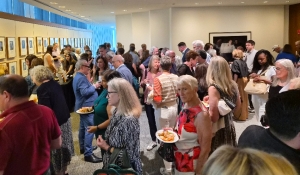
It must have been heavenly for the creative leaders of Goodman, Steppenwolf, Chicago Shakespeare and Court, Chicago’s top regional theaters, to be greeted by a standing room only crowd. But there they were, on a panel moderated by the eminent Chicago Tribune theater critic Chris Jones. The program was introduced by Marla Mendelson, MD, then by her daughter, Tova Wolff, who also happens to be artistic director at Refracted Theatre Company.
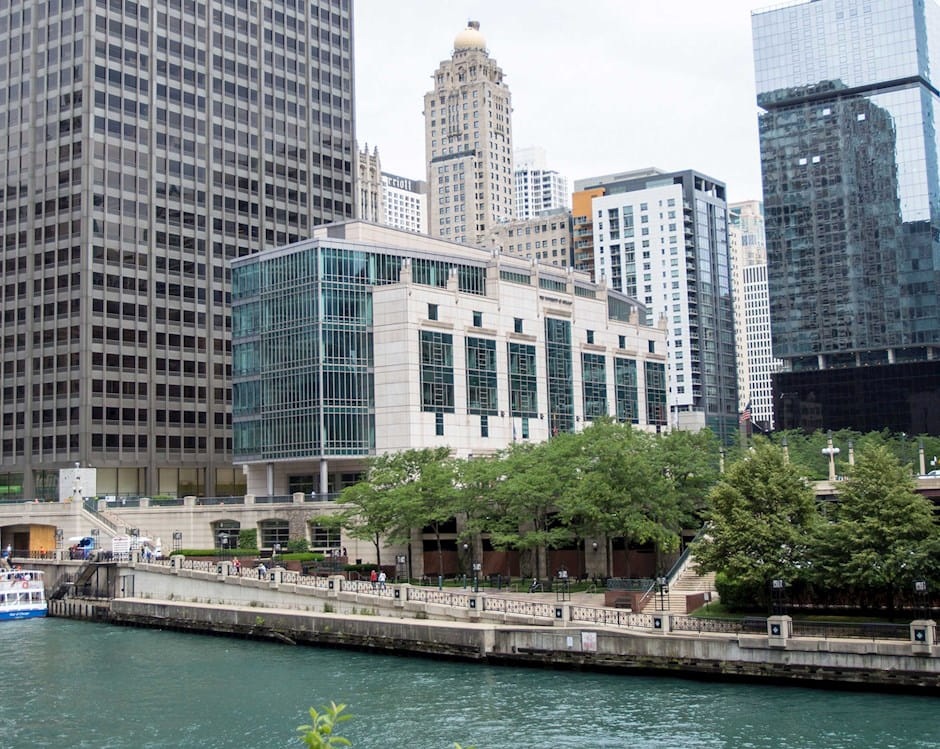
Held on the 6th floor of the airy University of Chicago Gleacher Center overlooking the Columbus Drive bridge at the Chicago River, the event was part of the Evening Inquiry Series founded by Mendelson and her husband Stephen Wolff, and arriving on the heels of a landmark report from the Arts Alliance Illinois that shows the creative sector is the sixth largest business sector in the state. In Chicago, where nearly half (47.5%) of the overall state’s direct creative economy output takes place, the sector supports 212,875 jobs, generates $50 billion in output, and generates $5.7 billion in tax revenue. It is Chicago’s 3rd largest industry (11.3%), larger than educational services (10.2%), retail (8.3%), and manufacturing (7.9%).
Citing that as a backdrop, moderator Chris Jones led the panelists through the discussion.
Also referencing the report, Edward Hall, artistic director at Chicago Shakespeare Theater noted, “This city has a very powerful, strong cultural economy as well, which I think feeds social and cultural life, but also it's an economic driver. And you haven't even begun to count the trickle-down effect of people's secondary spending when they fly into town and see Iceboy, or they see Lord of the Rings, whatever they come and see. They're taking cabs. They're going to hotels. They're spending money.”
Jones's questions led to the perhaps surprising revelation: subscriptions to theaters have dwindled. Audrey Francis, artistic director for Steppenwolf, said that at its height, Steppenwolf had 25,000 season subscription holders. “And now we have 5,000,” she said, which was the number when she started her tenure at the theater.
“It's challenged me as an artist to say, ‘Okay, this is the game,’” said Francis. “And it's not about, for us, necessarily what's popular. It's about how are we being our best to make sure that when you come dance with us, we're the best dance partner you have.” According to Francis, “Being challenged to evolve and to keep up and to say, ‘Okay, we can't keep doing the same thing. The rules are changing, and everybody's getting better, and how do we keep up?’”
Budget-wise, ticket revenue overall covers just half the operations of any of these theaters.What that means for theater operators is audience preferences and marketability to individual ticket buyers is a key driving force in the creative selection of scripts to be produced at larger Chicago theaters. Given that, how do artistic directors determine the roster of shows for each season?
What came up in the course of the panel is that there is serious tension (as might be expected) between including the established “canon” of playwrights—Eugene O’Neil, Ibsen, Chekov, Shakespeare, Shaw, etc.—and new works from rising talents around the country. Over recent years new works have risen in prominence, while the number of scripts from the old guard have diminished.
The event was preceded with an open bar reception and generous array of hor d'oeuvres, during which the audience mingled. There were actors, creatives from theater companies, and the regulars who attend these Evening Inquiries sessions at the University of Chicago’s Gleacher Center. As a theater critic for Buzz Center Stage, I recognized a number of publicists from theatrical groups and agencies that specialize in communications for this marketplace.
One woman I spoke to was the spouse of an actor. I also met a man who was a retired professor of drama from Bates College in Lewiston, ME, who complained heartily of the numerous new works in seasons just announced by the panelists’ theaters, to the exclusion of Shaw and other traditional canonical works. “What’s the best thing you’ve seen in the last year?” he asked me, his voice ripe with challenge. I answered unequivocally: “The Devil Comes to Town at Trap Door Theater.” (It was adapted and directed by Jeremy Ohringer who is also on the faculty at DePaul University.)
This was a perfect lead-in to the discussion of seasons filled with newer works, discovered through careful dramaturgy of who and what is trending around the country, which may be unfamiliar to Chicago audiences. There is risk attached to trying such unknown works as part of a mission for exposing audiences to what the theaters think they might or should like.
“If you go back to that origin statement about serious, mission-driven work, fully fifty percent of your annual income is box office dependent,” said Susan Booth, artistic director at Goodman Theatre. Producers can no longer rely on subscription ticket holders to weather through whatever they’re given in a season. “That box office number is a reality in our day-to-day life,” Booth said. “And I would love to hear from my colleagues on the panel about the challenge of selling mission-driven work versus selling popular work.”
Chicago Shakespeare’s Hall noted that theater lives in a perpetual recession. “There has never been a moment when I've heard any of my colleagues say, ‘What do we do with all this excess money?’ And theater has always been striving to do mission-driven work. And the idea that if you go popular, it's easy,” Hall said, “it's a lie, actually.” (Though the exception proving the rule perhaps are the lavish productions at Paramount Theatre in Aurora, generously underwritten by its neighboring casino profits.)
Avery Hoffman, who was named artistic director just last November at Court Theatre at the University of Chicago, described her theater’s audiences as many layered: the students and faculty on campus, individuals throughout the surrounding Hyde Park area, and the entire south side of Chicago, the city at large and the region. “This knowledge of your audiences is really, really important to that collective thinking, certainly to my collective thinking,” Hoffman said. “It means that our seasons maybe take a little bit longer to come to fruition. But then at the end of the day, you have a collective agreement about what your mission is, what shows that you're doing that serve that mission, and an audience that knows that mission and is there to support [it].”
A lengthy discussion covered the shifting role of these big regional theater companies from gatekeepers of what should be seen by audiences, to collaborative facilitators of what audiences want—even if that means bringing them unfamiliar scripts that meet their latent interests. Francis noted that the ensemble-powered company of Steppenwolf has long meant that the establishment of each season's offerings is the product of intense creative conflict, in the best sense of those words.
Best Question of the Night
After 30 minutes, Jones entertained a few questions from the audience, and the first out-of-the-gate came from a long-haired young man who cited the recent transfer of the a cappella musical Octet from Raven Theatre’s space on Clark St. to extend its run at the Goodman’s Owen Theater for three weeks this summer.
Goodman’s Booth responded that she had an immediate reaction when she saw Octet at Raven: “I thought the ceilings are just too low for these great voices.” And so it happened, but that is a rarity in Chicago. “The big theaters are often dark,” the questioner pointed out, and these successful storefront shows need to be able to get to bigger venues in order to extend their runs, rather than simply close to accommodate a subsequent planned production from their own season. "All of us are keenly aware that we benefit from the ecosystem," Booth said, referring to Chicago's many storefront and small theaters.
Of course, this is the natural ecosystem in New York, where Off Off Broadway shows frequently transfer to Off Broadway and sometimes on to Broadway—usually driven by proven audience demand. Why couldn’t that happen more frequently in Chicago? This led to an intriguing proposition from Chicago Shakespeare's Hall for a separate non-profit theatrical entity that might serve as a development center for co-producing shows, lef by Chicago's regional theaters.
Three cheers to University of Chicago and Mendelson's Evening Inquiry series for putting this remarkable discussion of theater on stage.
‘Anatomy of a Suicide’ Is Hard to Watch, But Not Because of the Subject
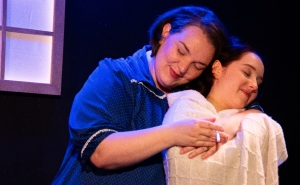
Perhaps surprisingly, Anatomy of a Suicide is not an overwhelmingly emotionally gripping play, nor is it horrifying. Instead, it vividly portrays the slow drip of suffering for Carol, a woman in the grip of depression, living always with suicidal tendencies. It also presents the impact of an intergenerational transference of Carol’s condition on her daughter and granddaughter. Written by British playwright Alice Birch and ably directed by Alex Mallory, it features Tatiana Pavela in the role of Carol, Taigé Lauren as her young adult daughter Anna, and Isabel Lee Roden as her granddaughter Bonnie.
Anatomy of a Suicide is hard to watch because of the design Birch has chosen for it. The central stories of these three women are performed simultaneously for two hours with one fifteen minute intermission. These focal storylines are in three different time frames, years apart. And some characters carry their roles between the timeframes. In other words, it is difficult to follow. A number of actors play multiple roles as numerous ancillary characters, adding to the challenge.
The program is helpful, but audience members are given just a barcode then told to silence their phones, so there is nothing to guide us as we watch. As a consequence, it is only by reading the program afterward, then studying the Wikipedia page for the play, that I could understand more of the details of what I witnessed.
Still, the broad lines of Anatomy of a Suicide on stage are clear enough to appreciate the heart of the story. All three actors are stunning in their roles. Pavela as Carol, whose life revealed, we are told spans the time frame of 1967-1985, registers the emotions that accompany what we now recognize as post-partum depression. We see every nuance of her internal strife as she struggles to meet societal expectations as homemaker and mother in that window of time when expectations of a woman’s place were unquestioned.
For those of us around then, it is an accurate portrayal of the menial roles women were expected to play in family life. And it puts in the spotlight how that period militated against women having an inner life, especially one that ran counter to the foreordained narrative line. Those who were depressed by childrearing or housekeeping bore the brunt of social opprobrium. And if their condition persisted, they might be subjected to brutal mental illness treatments, including shock therapy.
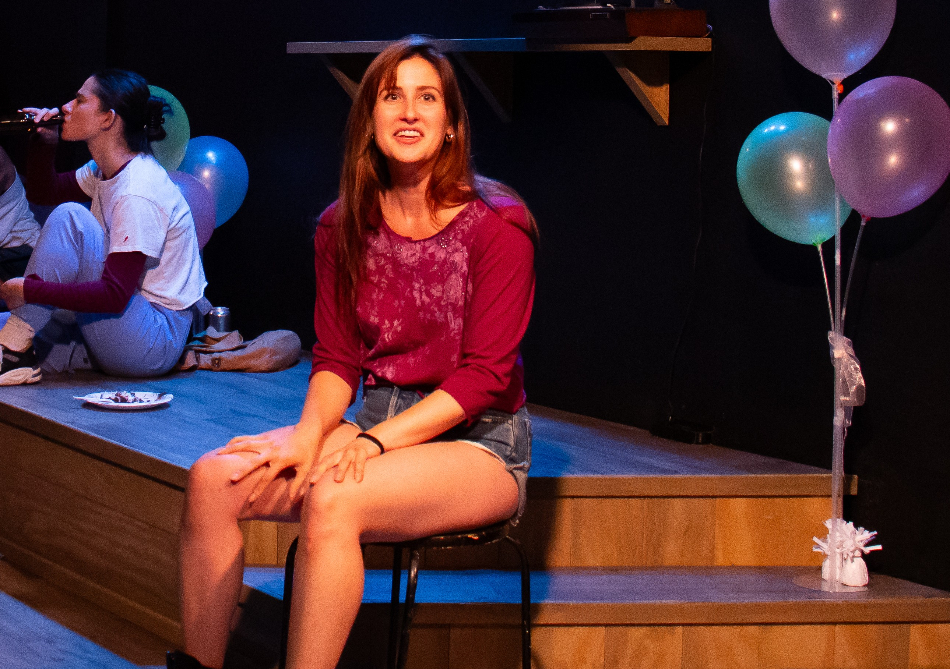
Isabel Lee Roden (left) as Bonnie and Taigé Lauren as Anna in Anatomy of a Suicide.
When we first see Anna, Carol’s daughter, portrayed in the window of 1994-1999 and in her twenties, she is being retrieved by her father, John (Josh Razavi) from a hospital where she was placed following a drug binge. The juxtaposition of these two characters, though in separate unconnected scenes, suggests a link between her mother Carol’s condition and Anna’s drug dependency. Anna emerges from her situation, finds her true love Jamie (Raúl Alonso) marries, and eventually bears a daughter, Bonnie.
We gather the pregnancy and birth are triggering emotionally for Anna. But most of her timeline on stage seems happy. She is a vibrant person. Her wedding day is full of joy; her father embraces her. Taigé Lauren's performance is full, rich and vibrant and it is a pleasure to see her on stage. Another actor, Laila Malak, plays a youthful version of Anna, and it seems that later, during Malak's tenure on stage, she and her father are nearby during a picnic at the moment of Carol’s suicide. This happens later in the play’s sequence, and explains retroactively why Carol was not at Anna’s wedding.
We meet Carol’s granddaughter, Bonnie, who seems to be on the spectrum of some neurodivergent condition. Isabel Lee Roden reflects an inertness in Bonnie, her lack of affect in engaging others. But in climactic moments, Roden leaps from reticence to full-throated dramatic presentation, a great performance that bides its time in deference to the character, but is always there.
To my mind, this is an actor’s play, one for theater professionals, but not something the average ticket buyer would want to see. The play is also burdened with a difficult to market title - Anatomy of a Murder or Anatomy of a Fall have worked, but Anatomy of a Suicide is an unlikely draw. With just 32 seats in the theater, I’m guessing co-producers JunkHeart and The Metal Shop Performance Lab do not have high expectations for revenue. Anatomy of a Suicide runs through August 30, 2026 at Redtwist Theatre in Chicago.
Mike Bartlett’s ‘An Intervention’ Zings in Chicago Premiere
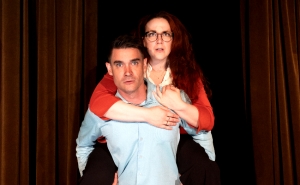
A new company, Heart of Gold Theatre, is presenting the Chicago premiere of Mike Barlett’s An Intervention. Bartlett is a noted British playwright, whose future-conjectural work Charles III received five Tony nominations in 2016, including Best New Play. Bartlett’s Cock (2009) and its companion work Bull (2013) played to accolades off-Broadway in New York.
Directed by Aaron Henrickson and just 75 minutes long in five acts, An Intervention is played against a velvet curtain with no set, intended by Bartlett to resemble a vaudeville comedy act. There we see two 30-something friends: character A is played by a sparkling Amanda Egle and B is played more circumspectly by Taylor Adams. They are caught in the middle of an energized, fast-paced repartee that when we first see them has been reduced to single-word declamations and terse phrases (“Oh.” “Yeah.” ‘You - “ “Yup.”)
Their tone conveys a dispute of some kind, but the audience doesn’t yet know what it’s about. “I don’t believe it,” says A; “Well it’s true,” B retorts. Context soon reveals it is over the matter of a military intervention in a Middle East war.
First performed in 2014, it was a period that saw the rise of ISIS, the Gaza War by Israel against Palestine, and the entry of the U.S.-led coalition into Iraq, among other conflicts. But the timeliness (and unfortunate timelessness) of the setting makes An Intervention very much of-the-moment.
The character A, we learn, has just come back from a protest against the intervention, only to learn that B, whom she counts as a trusted friend, supports it. He even encourages it to happen. She is crestfallen, and the argument moves on to the nature of their friendship.
Stepping down from the stage with one foot, B gives us his take on A in a lengthy aside. Later A will do likewise about B. So the argument is no longer centered on the politics or justice of the impending military action, but about how these two feel about each other.
What we see are two friends whose friendship is based on loving to argue. Well, actually, it’s a bit more than that. Because they love to argue about politics, for example, their regular argumentative battlegrounds form a vehicle for intimacy.
Subsequent acts—here are five in this tightly wound show—reveal more about their lives at large. Periodically the two reach through the curtains for props - a harmonica, wine glasses, and lots of liquor. The two also take issue with each other's personal lives. B charges A with being an alcoholic (another type of intervention), while A argues against B’s romance with a “harridan” and soon their friendship reaches a breaking point.
Many months later, in the last act, the threads are tied together in such a satisfying resolution that the continuously puzzling nature of that opening scene is successfully explained.
Adams, the founder and artistic director of Heart of Gold and (full disclosure) a personal friend, has brought us a play for the moment. When we argue, as Adams tells us in the program, aren’t we asking, “Why aren’t you the person I want you to be? Why can’t you be … less like that?”
Bartlett has written a “thinking” play in An Intervention, in which the dramatic tensions are equally “characters” in the work. So producer and co-star Adams has given us a deft bit of dramaturgy in bringing it to Chicago audiences.
The play examines the timely matter of how human beings can engage each other while bearing deeply held convictions that conflict. Nothing could be more important to our civic life than to seek guidance and clarity on this issue, which vexes us continuously. This is what theater is for.
The production also resurrects to the Chicago theater scene Pierce Hall in the landmark Chicago Temple Building. Pierce, fittingly, was home for the Silk Road Theatre Project, formed after 9/11 to address the challenges of backlash facing Asian, Middle Eastern, and North African communities.
Finally, because I know this producer and actor well, I have watched most of the steps along the way in development of the performance you will see. The passion a single individual must muster to licence a worthy script from a noted author, to secure a stage, to field a corps of able actors, director, lighting, costumes, and then to publicize and market ticket sales - well as the thousands working in this field in Chicago well know - it’s not an enterprise for the faint of heart. The inevitable rise and fall of the fortunes of a single production are familiar territory for this city’s theater producers. We in the audience are spared the sturm und drang. The lights come up and a polished presentation appears, as if by magic.Though magical, a stage show takes hard hard work.
Recommended, An Intervention runs through August 9, 2026 at 7:30 pm at Pierce Hall, the lower level theater in the Temple Building, 77 W. Washington Blvd., Chicago.
Absurdist Satire ‘Do You Feel Anger?’ Captures Toxicity in Workplace Today
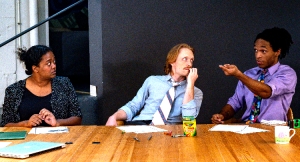
Set in a debt collection call center, Do You Feel Anger? captures how a toxic workplace manifests itself in today’s theoretically more “enlightened” world. Much of that toxicity, at least in this 2019 script by Mara Nelson-Greenberg, is propelled by male bonding and power.
But it’s not an oppressive tale. The artfully drawn script approaches this office from hell by showing what characters would be like if they are allowed to express emotional impulses with no filters whatsoever, and they do so to the max, without the slightest bit of empathy for their targets. The sorry state of affairs that results becomes a reduction to the absurd, with a pack of males hitting relentlessly on women both literally and figuratively.
With first-rate performances across the board and well directed by Kady Nordstrom for Here’s the Exit Theatre Co., the production (I saw the final performance June 28) was set in a site-specific location - an actual shared office space near Ravenswood and Montrose in Chicago was used for the performances.
At the opening Sofia (Dina Monk), recently hired as an empathy coach at a debt collection agency as a measure to fend off hundreds of lawsuits, clearly has her work cut out for when she begins to lead them through exercises intended to develop compassion for others. Though we never see them actually engaged in their debt collection work, one can only imagine how strong arming debtors makes for a noxious workday.
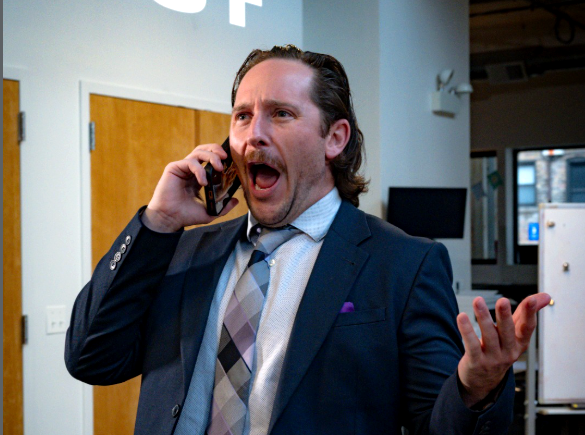
Joe Metcalfe as Jon in Do You Feel Anger?
The audience is introduced to Jon (Joe Metcalfe) first, already in character before the show begins, as he looks across our faces with a power-mongering smile, issuing blunt directives, at odds with his sinister grin, that we must turn off electronic devices and refrain from photos. This is our first warning of how it will go.
To Jon, Sophia’s training is a meaningless exercise. His oft-stated aim is to get her to sign off quickly on a document affirming the staff has successfully completed the course. He expects this effort to be over in two or three days. No, Sophia warns him, it will take four or five weeks. We learn that Jon is not just a boss, but an erstwhile participant in much of this bad behavior.
The very first of the workers to address Sophia is Eva (Laila Rodriguez), who lets slip that she is mugged daily (it is an absurdist work, after all), usually in the break room, by a masked marauder. After years of enduring this, Eva has given up hope, and fashioned what defenses she can. After Sophia begins to encounter lewd remarks from the males, Sophia offers her advice: her successful defense against relentless sexual approaches by the men is to have a boyfriend, which seems to suspend the advances. When Eva discovered her boyfriend was a murderer, she reluctantly dropped him, knowing what she would face back at work as an “unspoken for” woman.
We soon meet Eva’s co-workers: always-angry Howie (Hudson Therriault) barely constraining himself from running amok with a bat when his bile rises; then Howie’s co-worker and bro, Jordan (Makari Robinson-McNeese), a sweet and gentle soul who goes along to get along - further enabling the bad behavior, then joining in.
We watch Sophie struggle to generate empathy in the workplace, but everything we see suggests that Jon has given implicit permission to his workers to disregard it. But Sophie is effective and makes a small amount of headway. We see Eva build some trust as Sophie assures her she will have her back.
These office dynamics take a toll on Sophie, and gradually she also compromises. “Give me one more week,” she pleads with Jon, who works against her efforts, even adopting the woke language. “If you expect them to accommodate other people’s feelings, then their feelings should be accepted, too,” he argues. “I’d let these guys keep some of their customs.” Among them are entreaties to Eva for oral sex and jokes about piss charts.
This isn’t a play that delivers a hopeful resolution. Sophie joins in one of the men’s not-suitable-for-work jokes, and eventually conjures up her own imaginary boyfriend to keep the men at bay. Compromises aside, she carries on and makes some headway with the employees, including Jon. Nelson-Greenberg’s script suggests why the workplace might be better today than it was in the era of the 1960s Mad Men, but there are no guarantees of safety for women. What we really see is the shapeshifting nature of toxic masculinity in the office, now dressed up in new terminology, but still the same as ever.
Do You Feel Anger had its Chicago premiere at A Red Orchid Theatre’s stage in 2020 This site-specific revival at the Platform Coworking loft near Ravenswood and Montrose had some pluses, but minuses as well that detracted a bit. Seating was not on risers, so lots of craning your head to see the action. The loft was a plus for immersion in a realistic environment, but acoustics were less than perfect, as was lighting, and the occasional CTA train arrived at sometimes inopportune moments. But the play is so good it didn’t matter much to us in the audience. Here's the Exit Theatre Company, founded in fall of 2024, is worth keeping an eye on.
Funny, Incisive 'Southern Rapture' Skewers All Parties in 'Angels in America' Fracas
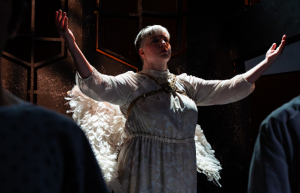
“Southern Rapture” quickly elicits loud guffaws from the audience, a heartening circumstancve, as it means playwright Eric Coble’s script is doing its job. Billed as a satire, it recounts the tumultuous week in real life leading up to the 1996 opening night of Tony Kushner's celebrated AIDS play, “Angels in America” in Charlotte, NC. But what might have been a tragic recount of small-minded efforts at artistic repression gets turned on its head, a potential tragedy mined for comedy, with an ending that is at once affirming and exhilarating.
This show at Theater Wit, produced by three-year-old Tin Drum Theatre Company, is loaded with broad humor, and is something of a backstage comedy as well. For purposes of the script, Charlotte becomes a generic southern city, and Kushner becomes Anton Finewitz, and his vaunted work is transformed into “Rapture in America.”
The show parodies not just the reactionary forces that sought unsuccessfully to keep “Angels in America” from the stage of a rising southern metropolis. It also takes aim at the theater company, its governing board, local government, and the national media that spun the controversy into the unnuanced, dualistic divisiveness that seems to have solidified as a way of American life today.
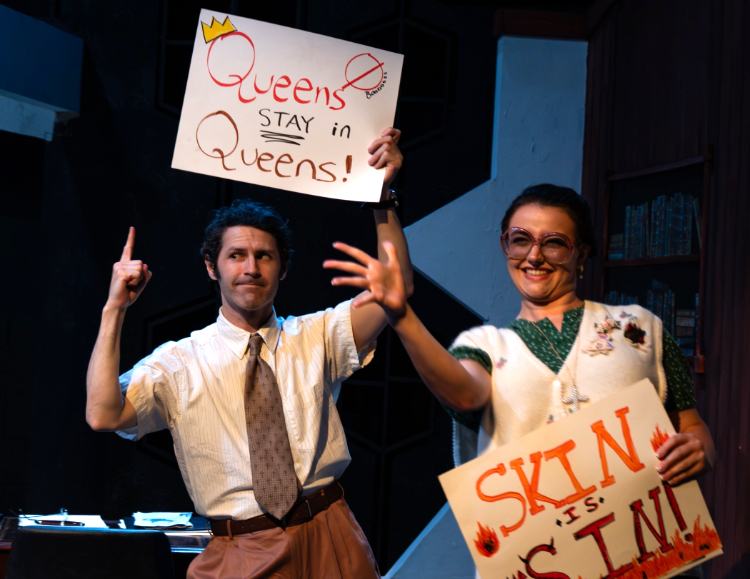
Andrew Bosworth as Reverend Dupree and Jenny Hoppes as Laverne Jackson protest the opening of "Rapture in America."
As “Rapture in America” barrels toward dress rehearsal, a big supratitle flashes the daily countdown to its local premiere. In an opening monolog to the audience, Marjorie Hooper proudly tells us, “The play’s won the Pulitzer, Tony, Drama Desk Award, an Evening Standard Award, the Rainbow Excellence Award and an ASPCA citation (that last one is a laugh line)—We’re one of only six theaters in the nation to get the rights to do the show outside of New York!” Indeed!
When word gets around there will be full frontal male nudity in the show, the gears of progress run unevenly, and almost grind to a halt. Company director Marjorie Winthrop (Shannon Leigh Webber) attempts to insulate her performers from the backlash, which comes in the form of Reverend Dupree (Andrew Bosworth) and a town gadfly Lavern Jackson (Jenny Hoppes). Jackson has read the script and counted the number of mentions of “cocksucker” and other notable perversions to the Charlotte Town Council. (In a content warning to the audience, Jackson’s list includes “one penis,” which indeed appears in the second act at Theatre Wit.)
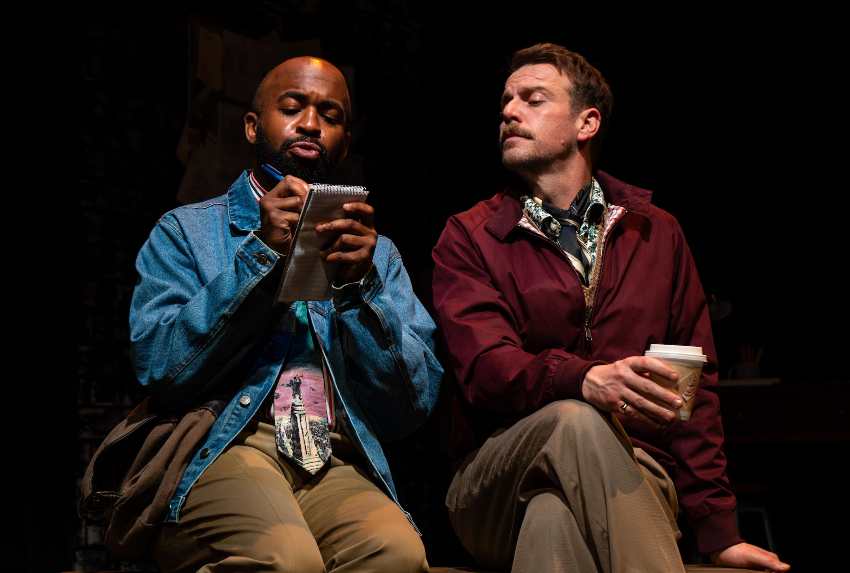
Theater critic Simon Larisher (Jordon Gleaves, left) conspires to promote "Rapture in America" with production director Donald Sherman (Michael Stejskal).
Charlotte Mayor Winston Paxton (Teddy Boone), ever even-tempered, tries to stay above the fray. His aspirations for transforming this growing city into a world-class metropolis have netted a symphony orchestra, a national sports franchise, and now, an important regional theater company, about to move into the big leagues. But the mayor is beginning to feel unsettled, praising the season’s opener, "The Odd Couple," and encouraging Marjorie to do something other than “Rapture.”
“There’s still gonna be plenty of art!,” the Mayor argues. “It’s just art we can all appreciate. Because that ‘Odd Couple’ was one of the goddam funniest things I ever saw in my life.” But Marjorie will have none of that, declaring the play "epic."
It even dares to cut through the slavish devotion accorded "Angels in America" and Kushner himself, asking a if this two-part six-hour "epic" work might be too much in a town that likes to get home in time to catch Jay Leno.
"'“Epic' meaning?" asks the mayor. "Three hours, two intermissions," Marjorie tells him. "And that’s just Part I. Part II is three hours too."
"Good lord, is this a play or a telethon?" asks the mayor, and the playwright punctures the unquestioned aura that seems to envelop Kushner and his fans.
Amid the brewing ontroversey, Marjorie conjures up a “bubble” for the players, a send up of that too precious psychobabble affectation that performers may have seen once or twice:
Marjorie: We’re in the bubble, say it with me.
Players: We’re in the bubble.
Marjorie: And what do we do in the bubble?
Players: We make art in the bubble.
Even theater reviewers get skewered in the no-holds-barred script:
“When I have something to say,” says beleaguered Mayor Paxton, “I’ll talk to a real reporter.”
“I am a journalist,” Simon Larisher (Jordon Gleaves) retorts, to which the mayor replies, no, “You’re a theater critic!” Ouch! Larisher helps raise the profile of the imminent production in concert with the publicity-hungry production director Donald Sherman (Michael Stejskal).
The playwright specifies just seven actors should play the 16 roles, and director Jason Palmer and the high-caliber cast carry this off wonderfully. Casting credits go to Teddy Boone. Particularly notable is Andrew Bosworth as the protesting preacher Reverend Dupree, and two of his nemeses: the playwright who has flown from New York into the fray, and company member Mickey Steadman, who will deliver the full monty. Bosworth plays the roles distinctively and we have no confusion.
Even more so for Mary Ann Bowman as the theater company board chair, the district attorney, and the over-the-top Nyla-Jean Geisy, a winged creature essential to the play within this play. Likewise for Gleaves, who carries off very well with the support of a good script four roles, including the TV host of “Night Line” and Franklin McManus, a highly effective lawyer given to flowery South Carolina colloquialisms.
Beyond its funny rendition of what it must have been like in Charlotte in 1996, “Southern Rapture” does something more. For me, it’s a reminder that we can recover from our seemingly intractable current state of social affairs. After all, we’ve done it numerous times in the last three decades, and even following the darkest of times in the 1950s with McCarthyism and the blacklisting of creatives.
Back in the real Charlotte, “Angels in America” opened to record ticket sales, and the protests withered in the face of ticket-buyer preferences. Though the theater company that produced it saw its funding cut in retribution, a successor there commissioned this very funny “Rapture in America,” which feels cathartic all in all.
Now “Angels in America” is the stuff of celebrated revivals, and no one blinks an eye. So we do make it through these times of darkness, the forces of Steven Miller, Trad Wives and Andrew Tate notwithstanding. And we will recover from our current predicament too.
Even with some clunkers among its running gags and jokes, “Southern Rapture” is highly recommended. It runs at Theater Wit through June 28, 2026.
This review is proudly shared with our friends at www.TheatreInChicago.com.
Inside a Real ‘Fire House’ You Are Immersed in Phantasmic Lives of Firefighters

Set in Chicago’s oldest fire station (now Firehouse Art Studio) the immersive play "Fire House” is only loosely tethered to a realistic portrayal of what fire fighters do. What it conveys is an impressionistic vision of the experience that fire fighters may undergo.
Produced by Chicago Shpatz, an experimental theater company created by Chicago artists Matthew Schlerf and Sivan Spector, just 25 audience members are led through each performance of the immersive experience "Fire House." After a trek up the 19th century staircase, director Spector guides us to a locker room, where a dispatcher (Nu A.M.), cigarette dangling from their lips, jumps between a squawking radio box and a Chicago map on the wall.
As a mix of sounds slowly gains meaning—other dispatchers voices, radio news fire reports, etc.—a number of firefighters are gathered around the table. It becomes clear that one is a recent arrival, perhaps a cadet graduate of the fire academy—the Newbie (Steven Hou) asking questions. Inquiring into the cause of a possible arson that Newbie asks earns a gruff answer: “Our only job is to stop fires.”
The Chief (Matthew Schlerf) establishes himself as the authority, barking terse directives. A card game is dealt by the Martyr (Capri Gared-O’Connell), the best actor of the lot, who is fully in character and delivers lines as we imagine a hustling fire fighter would.
Then Newbie loses a hand, and becomes subject to hazing —abashedly accepting a pink thong he is to wear. The Chief departs and later reappears wrapped in a towel, wet from the shower. “Has anyone seen my clothes?” the Chief bellows. Then he drops the towel, revealing he is wearing the thong. A joke that short circuits the Newbie’s hazing and conveys the camaraderie of the men. Other character types of fire fighters are present, The Muscle (Margo O’Connell), the Sage (Jarais Musgrove), dispensing wisdom. Bad blood between the Martyr and the Muscle ends up in slammed locker doors.
This site-establishing scene segues to another room, where the fire fighters move in unison, then silently take off at break-neck speed when an alarm sounds. Windows sometimes flicker red, suggesting flaming structures. Characters appear, seemingly residents caught in unexpected moments doing private things who have been caught off guard as fire fighters barge in. Another room features a model house, presumably for strategic firefighting planning. Another scene finds a dozing Chief disturbed as the Newbie flicks water droplets on his sleepy face.
The show evolves into other rooms, one that becomes a dance floor with a DJ, where some audience members splayed on the floor to have arms and legs manipulated by bystanders. Clearly we’ve moved into another dimension of “Fire House.” A motto is shone on a wall: “For a better world something may need to burn.” A wraith in white beckons us into an alcove where we are to write out an answer to “What are we willing to allow to be burned” and throw it into a raffle ticket roller cage. Later an audience member brings me the answer I entered: “My Books.”
And so it goes, mysterious, other worldly, experiential but unwieldy for those who want a clearly defined storyline. Just an hour, and we are returned to the lobby for post show chats and conviviality at the refreshment area. “Fire House” is a valiant step into immersive theater, perhaps less successful on the ground charted so well by the now-defunct Windy City Playhouse, or Rough House Theater’s quirky annual “House of the Exquisite Corpse.” Nevertheless “Fire House” is recommended for the venturesome enough to opt out of standard theater seating. "Fire House" runs through May 30 at Fire House Art Studio, 1123 W. Roosevelt Rd in Chicago.
This review is proudly shared with our friends at www.TheatreInChicago.com.




Latest Articles
-
 Operation Mincemeat: A Smart, Scrappy Musical That Shines When Its Cast Takes the Wheel
Written by Maddie BurroughsIn the 2019 film Yesterday, a struggling musician wakes up in a world where The Beatles never existed. A similar theatrical case study could be done with every musical that might not exist without Hamilton; Operation Mincemeat should be first…
Operation Mincemeat: A Smart, Scrappy Musical That Shines When Its Cast Takes the Wheel
Written by Maddie BurroughsIn the 2019 film Yesterday, a struggling musician wakes up in a world where The Beatles never existed. A similar theatrical case study could be done with every musical that might not exist without Hamilton; Operation Mincemeat should be first… -
 MAMMA MIA! and HADESTOWN Return to Chicago in Spring 2027
Written by Buzz Center StageBroadway In Chicago is excited to announce two fan-favorite shows are returning to our stages this year: MAMMA MIA! and HADESTOWN. Current subscribers can add these to their season package when renewing by clicking here or calling (312) 977-1717. Group…
MAMMA MIA! and HADESTOWN Return to Chicago in Spring 2027
Written by Buzz Center StageBroadway In Chicago is excited to announce two fan-favorite shows are returning to our stages this year: MAMMA MIA! and HADESTOWN. Current subscribers can add these to their season package when renewing by clicking here or calling (312) 977-1717. Group… -
SANCTUARY STORIES - A JOURNALISM THEATER PROJECT October 9-18 at the Athenaeum Center for Thought and Culture
Written by Buzz Center StageThrough music, documentary video, sound, photos and live actors, “SANCTUARY STORIES: A JOURNALISM THEATER PROJECT” captures in words and images the lives and communities deeply connected with — and affected by — immigration in Chicago. This “living documentary” is a…
-
Red Theater presents the world premiere of CHURCH HURT October 24 - November 21, 2026
Written by Buzz Center StageRed Theater is thrilled to announce the cast and production team of the world premiere of Church Hurt by Brynne Frauenhoffer and directed by Jessica Love, running October 24 - November 21, 2026 at The Edge Off Broadway in Chicago’s…


Does your theatre company want to connect with Buzz Center Stage or would you like to reach out and say "hello"? Message us through facebook or shoot us an email at This email address is being protected from spambots. You need JavaScript enabled to view it..
*This disclaimer informs readers that the views, thoughts, and opinions expressed in the text belong solely to the author, and not necessarily to Buzz Center Stage. Buzz Center Stage is a non-profit, volunteer-based platform that enables, and encourages, staff members to post their own honest thoughts on a particular production.