
Displaying items by tag: Scott Westerman
Paramount's A Christmas Carol Stands Among the Season's Finest Gifts
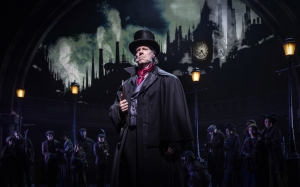
Few holiday stories are as deeply woven into the fabric of the season as A Christmas Carol, yet Paramount Theatre's lavish production in Aurora finds fresh magic within Charles Dickens' familiar classic. Combining spectacular stagecraft, heartfelt performances, and an infectious sense of holiday delight, the production embraces both the story's timeless sentiment and its enduring relevance. Whether encountering the tale for the first time or returning to it as an annual tradition, audiences are invited into a richly realized Victorian London where Dickens’ beloved tale unfolds with warmth, humor, and a sense of wonder that feels tailor-made for the holiday season.
For the uninitiated, A Christmas Carol follows the miserly Ebenezer Scrooge, a wealthy businessman whose devotion to profit has left little room for kindness, generosity, or human connection. On Christmas Eve, Scrooge dismisses the joy of the season, rebuffs charitable appeals, and treats his loyal employee Bob Cratchit with cold indifference. That night, however, his solitary existence is interrupted by the ghost of his former business partner, Jacob Marley, who warns that Scrooge's selfish ways have forged the very chains that bind him in death.
What follows is a fascinating passage through time as Scrooge is visited by the Ghosts of Christmas Past, Present, and Yet to Come. Each spirit reveals moments from his life, exposing long-forgotten joys, painful regrets, and the consequences of his hardened heart. Through these supernatural encounters, Scrooge witnesses the struggles and triumphs of those around him, including the loving but impoverished Cratchit family and the frail young Tiny Tim, whose fate becomes central to the story's emotional impact. As the visions unfold, Scrooge is forced to confront not only the man he has become, but also the possibility that his future is not yet written.
First published in 1843, Charles Dickens' A Christmas Carol has become one of the most enduring works in English literature. Written during a period of stark economic inequality in Victorian England, the novella helped popularize many of the charitable and family-centered traditions associated with Christmas today. More than 180 years later, the novella remains a cornerstone of holiday storytelling, inspiring countless adaptations while continuing to attract new audiences.
Under the thoughtful stewardship of adapter and director Trent Stork, Paramount's A Christmas Carol unfolds with a cinematic sense of scale while never losing sight of the intimate human moments that make Dickens' story so enduring. Stork's adaptation balances spectacle, humor, and emotional depth with remarkable confidence, while Matt Deitchman's lush arrangements, orchestrations, and original music provide a stirring musical backbone that enriches the storytelling without overwhelming it. The evening is further enriched by a series of beautifully rendered choral arrangements drawn from familiar Christmas carols. A standout sequence layers "O Holy Night" with several other seasonal favorites, creating a soaring vocal tapestry that showcases both the strength of the ensemble and the production's musical sophistication. Brenda Didier's choreography adds energy and festive charm throughout, and Music Director and Conductor Kory Danielson ensures the production's musical elements are delivered with grace and expressiveness, helping create a holiday experience that feels both grand and deeply personal.
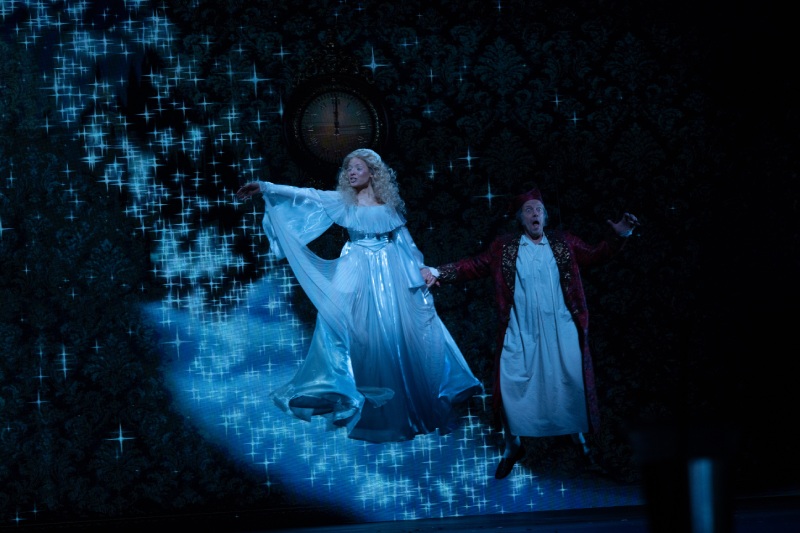
The Ghost of Christmas Past (Isabel Arianna Romero-Rodriguez) is the first spirit to haunt Ebenezer Scrooge (Michael Moreland Milligan) in Paramount Theatre’s new, reimagined holiday spectacular, A Christmas Carol by Charles Dickens.
At the center stands Michael Moreland Milligan, making a magnificent Paramount debut as Ebenezer Scrooge. Avoiding caricature, Milligan presents a layered and deeply human portrait of a man consumed by regret and emotional isolation. He charts Scrooge's transformation with conviction, allowing the character's growing self-awareness to emerge naturally rather than feeling rushed or overly sentimental. It's a commanding performance that anchors the evening and reminds audiences why Scrooge remains one of literature's most iconic characters. The accomplishment is hardly surprising given Milligan's extensive stage credentials, which include appearances on Broadway, a Fringe First Award for his acclaimed solo play Mercy Killers, and a featured role in the forthcoming Angel Studios film Hershey.
Also memorable is Scott Westerman as Jacob Marley, whose ghostly warning arrives with both chilling intensity and heartfelt concern. As Bob Cratchit, Shawn Pfautsch brings warmth, humility, and quiet strength, serving as the story's moral compass, while Aja Alcazar lends Mrs. Cratchit a tender resilience that enriches the family's most moving scenes. Isabel Arianna Romero-Rodriguez imbues the Ghost of Christmas Past with grace and mystique, guiding Scrooge through memories that are as poignant as they are illuminating. Meanwhile, Jared David Michael Grant radiates joy and generosity as the Ghost of Christmas Present, his exuberant performance embodying the spirit of the holiday season, while Ben Dow's imposing Ghost of Christmas Yet to Come provides some of the production's most striking and haunting imagery.
The supporting principals are also effective. Schyler Vargas shines as Fred, offering an infectious optimism that stands in stark contrast to his uncle's cynicism. Russell Konstans makes a lasting impression as the jovial Mr. Fezziwig, whose generosity serves as a powerful reminder of the path Scrooge abandoned long ago, while Michelle Duffy delivers memorable work across multiple roles, particularly as the warm-hearted Mrs. Fezziwig. Together, this exceptional company and creative team breathe vibrant life into Dickens' classic, crafting a production filled with good cheer, heart, and enough holiday spirit to warm even the coldest soul.
Paramount goes all out for this staging. Jeffrey D. Kmiec's breathtaking scenic design is a production unto itself, transforming Paramount's stage into a sprawling and richly detailed vision of 1840s London. Utilizing virtually every square inch of the theater's expansive playing space, the set creates a living, breathing city that feels both grand in scale and intimate in detail. From weathered street corners and bustling thoroughfares to the meticulously crafted interiors of Scrooge's gloomy chambers and the Cratchits' humble home, every environment possesses a distinct character and authenticity. The transitions between locations unfold with extraordinary fluidity, maintaining the story's momentum while constantly revealing new visual surprises.
Equally impressive are the production's projections and special effects, which infuse the performance with an added sense of magic and wonder. Whether conjuring spectral apparitions, transporting audiences through Dickens' snow-dusted London, or illuminating Scrooge's supernatural journey, these technical elements are executed with remarkable polish and imagination. Rather than serving as mere spectacle, the projections and effects enhance the storytelling, seamlessly bringing Dickens' otherworldly vision to life while preserving the emotional heart of the narrative. Combined, these elements create moments of genuine awe that make this already sumptuous production feel even more enchanting.
The visual storytelling is further elevated by Izumi Inaba's exquisite costume design, which fills the stage with period fashions that help define both social status and personality, adding another layer of authenticity to the Victorian setting. Greg Hofmann's atmospheric lighting design shifts effortlessly between warm holiday glow and spectral unease, guiding audiences through Scrooge's emotional and spiritual evolution, while Adam Rosenthal's sound design immerses viewers in the sights and sounds of Dickensian London. The result is a production whose visual and technical artistry continually deepens the storytelling, surrounding Scrooge's metamorphosis with a sense of mystery, atmosphere and holiday magic.
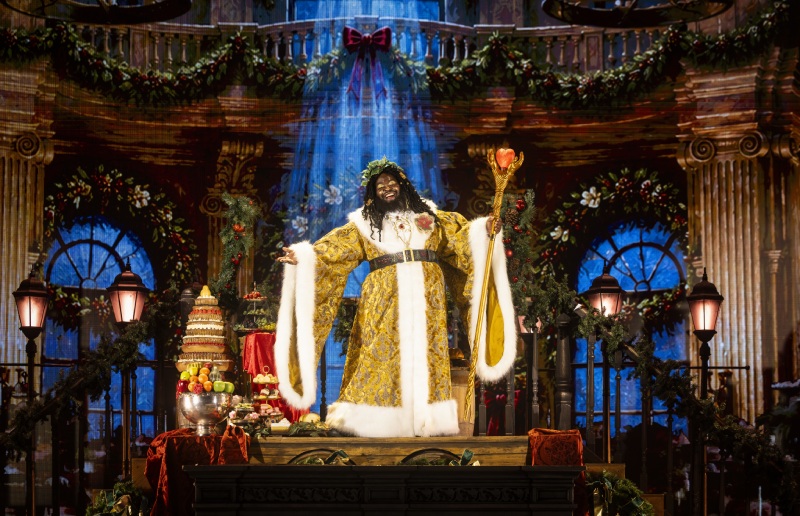
Jared David Michael Grant makes a grand entrance as The Ghost of Christmas Present.
Few stories have enjoyed the cultural longevity of A Christmas Carol. Since its publication, Dickens' tale has inspired countless stage adaptations, radio dramas, television specials, and feature films, with each generation finding its own way to revisit Ebenezer Scrooge's transformative journey. Few works of literature have demonstrated the staying power of A Christmas Carol, a fact reflected in the continued stream of new adaptations, including the recent release of Ebenezer starring Johnny Depp. Yet for all the versions that have come and gone, Paramount's production stands among the very best. Its combination of spectacular design, heartfelt performances, and genuine holiday magic places it firmly among the elite presentations of this beloved classic.
Goodman's legendary A Christmas Carol finally has some legitimate competition this holiday season. While Chicago audiences remain fortunate to have the downtown institution continuing its cherished annual tradition, Paramount's grand and emotionally resonant staging in Aurora proves every bit as compelling. Rather than competing for the same spotlight, the two productions complement one another, giving the region not one but two outstanding opportunities to experience Dickens' immortal tale.
Whether you're revisiting a cherished holiday tradition or introducing the story to a new generation, Paramount Theatre's A Christmas Carol delivers everything one could hope for from this timeless tale. Anchored by Michael Moreland Milligan's outstanding Scrooge, supported by a superb cast and creative team, and brought to life through breathtaking production values, it captures both the wonder and the heart of Dickens' masterpiece.
Highly recommended, A Christmas Carol continues at Paramount Theatre in Aurora through January 3rd. Don't miss the opportunity to experience one of the season's finest theatrical gifts.
For tickets and/or more show info, click here.
Review: Superior Donuts at The Artistic Home at The Den Theatre

“You can’t raise kids without hope.” says terminally pessimistic Arthur Pryszbyszewski in Tracy Letts’ 2008 play “Superior Donuts” now running at The Artistic Home at The Den Theatre. Directed by Artistic Home ensemble member John Mossman, “Superior Donuts” tells an authentic Chicago story in the cozy kind of theater our city is known for.
Originally produced by Steppenwolf on the heels of Letts’ Pulitzer Prize landmark “August: Osage County”, this play feels almost lighthearted by comparison. “Superior Donuts” swaps the blues of the Oklahoma plains for the desperation of Chicago’s Uptown neighborhood, before the Target opened on Wilson.
Arthur Pryszbyszewski, impeccably played by Scott Westerman, is a complicated, introverted middle aged man who’s devoted himself to keeping the family donut shop in business long after its heyday. One morning he finds his shop vandalized and in walks Franco, a young man with big dreams but even bigger debts. Franco is an aspiring novelist with no shortage of things to say on virtually every topic. His stream of conscious babble eventually helps Arthur open up.
Letts’ has a real knack for gritty stories, but what he does especially well is cleanly written scenes. Playwriting doesn’t have to be complicated. “Superior Donuts” excels much like his other work in that each characters’ desires and disappointments are clearly laid out. You’re never wondering what the point of a scene is. That is to say, Letts never leads you into the weeds.
In two briskly paced acts, “Superior Donuts” is both a male-driven comedy and a hard-hitting drama. Letts explores what happens to neighborhoods when small businesses close. You don’t just lose the business; you lose pillars of neighborhoods. Arthur is a reluctant pillar but his paternal affection for Franco becomes his greatest achievement.
Featuring a cast of Artistic Home ensemble and newcomers, Mossman's’ production is stacked. John N. Williams is well suited to the awkward but endearing Franco. Ensemble member Kristin Collins plays CPD officer Randy Osteen, Arthur’s burgeoning love interest. Collins’ Chicago accent and mannerisms are incredibly comforting.
“Superior Donuts” is not only a love letter to Chicago’s Uptown neighborhood but also a world you don’t mind spending a little more time in. In fact, it was adapted into a relatively successful CBS tv series in 2010.
Artistic Home reinterprets “Superior Donuts” at a time when Uptown has more or less been gentrified. No longer on the cusp as depicted in the play. In 2025, it feels more like a heartwarming period piece that true Chicagoans will fondly remember.
Through December 6 at Artistic Home at The Den Theatre. 1331 N Milwaukee Ave. 773-697-3830
Citadel's 'A Jukebox for the Algonquin" - The Reality of Life in a Senior Center sets the Stage for Tunes, Friendship and Rebellion!

Citadel’s latest production, A Jukebox for the Algonquin, truly captured my heart. It’s a refreshing reminder that as we age, life doesn’t lose its spark—it merely shifts to a new rhythm, one filled with laughter, camaraderie, and unexpected joys. This delightful offering beautifully showcased the vibrant lives that still await us in our twilight years, proving that fun and bond know no age limit.
Radiating vibrancy and warmth, this production showcases the spirited lives of its characters who discover purpose and happiness in life’s simplest yet most impactful moments. More than just a theatrical presentation, it’s a heartfelt and uplifting depiction of aging with grace, infused with humor and emotional depth.
Paul Stroili's A Jukebox for the Algonquin stands out as a true treasure of the stage, effortlessly blending sharp humor with heartfelt emotion in a celebration of the intricate tapestry of life. Transporting audiences to the delightful Placid Pines Senior Care Center in upstate New York, this play radiates with originality and charm. It introduces us to a spirited ensemble of senior residents who, driven by a nostalgic longing for their youth, devise an unexpectedly daring scheme to fund their dream of owning a jukebox—by selling marijuana. Yep! And let’s just say that the journey is as wildly entertaining as it is endearing.
The jukebox emerges as a powerful symbol, resonating far beyond this specific story. It reflects a hope from the struggles of many residents who, isolated and yearning for connection, are left grappling with a lack of stimulation, music, and activities. These individuals are confined to neglected, unrenovated sections of sprawling senior complexes, spaces that corporate priorities have relegated to the margins. This pattern has become disturbingly prevalent, as corporate-driven changes focus on enhancing facilities for wealthier, younger seniors, while leaving lower-income, older residents behind. At Placid Pines, this disparity is starkly evident: the entertainment room offers little more than a fish tank with dying fish and shelves stocked with donated books—the heartfelt contribution of a single paralyzed resident, whose spirit reflects the quiet resilience of the overlooked community.
With vividly drawn characters, sharp and vibrant dialogue, and deeply touching moments, Stroili explores themes of enduring friendship, unwavering resilience, and the determination to transcend the boundaries of age. The play shines in its remarkable ability to uncover life’s beauty and humor in the most unexpected places. The camaraderie and ingenuity of the residents will have you laughing out loud, shedding a tear, and cheering them on throughout their unforgettable adventure.
Helmed by Director Scott Westerman, this Chicago Theatre debut is sure to touch your heart. Set within the lively recreation room of the Placid Pines Senior Care Center, this production sparkles with energy and charm, brought to life by a vibrant cast of residents, each with personalities as dynamic as the tunes on a jukebox. Leading the charge is Kenneth Johnson as Johnny, an exuberant Yankees enthusiast and the driving force behind the gang’s mission to acquire a jukebox. Johnson’s effervescent energy and magnetic stage presence make Johnny both endearing and immensely enjoyable to watch.
Adding depth and balance to the production is Bob Sanders in the role of Dennis, Johnny’s steadfast best friend and the voice of reason amidst the group’s lively escapades. Sanders delivers a warm and nuanced performance, anchoring their dynamic with sincerity and poise. Ellen Phelps lights up the stage as Annie, her lively and animated personality adding flair and excitement to every scene she graces. Elizabeth Rude completes this delightful ensemble as Peg, capturing the role with subtle charm and a compelling presence. Together, these four seasoned actors weave a narrative rich in humor, camaraderie, and heart, crafting a performance that is simply captivating.
Bringing a humorous twist to the story is Patrick Thornton as Chuck, the janitor affectionately referred to as the “dust mop guy.” Thornton’s charismatic and witty portrayal adds moments of lighthearted fun that resonate effortlessly with the audience. Rounding out this exceptional cast are Karla Corona and Joshua Thomas, who embody Placid Pines staff members with finesse, seamlessly bridging the interactions between the spirited residents and enriching the production with their well-rounded performances.
This ensemble delivers a performance that is not just entertaining but genuinely heartwarming, showcasing a narrative filled with humor, passion, and a sense of community. With their skillful portrayals, they transform the recreation room of Placid Pines into a vibrant stage where laughter, drama, and connection take center stage.
I found it especially moving how the production cleverly employed the jukebox as a symbol for life’s playlist. Much like the selections we make on a jukebox, we can choose our moments, embrace our decisions, and immerse ourselves in the harmonies of both our past and present. Citadel has masterfully created a work that strikes a chord, offering the audience a fresh perspective on the richness of life’s adventures and the bonds that can thrive in its later chapters.
A Jukebox for the Algonquin is a touching tribute to friendship, community, and the timeless spark that fuels our lives, no matter our age. It beautifully prompted me to reflect on the richness of life’s later chapters, highlighting the joy of embracing them with curiosity and a zest for living. This production is an absolute delight and a perfect pick for anyone in search of inspiration and heartwarming entertainment.
Currently being performed at the Citadel Theatre in Lake Forest, this production is a must-see for theater enthusiasts. The Citadel Theatre's intimate setting and exceptional cast bring Stroili's vision to life, making A Jukebox for the Algonquin an unforgettable theatrical experience. It’s not just theater—it’s a triumph. This joyous and moving exploration of life’s complexities leaves audiences with a renewed appreciation for the enduring vibrancy of the human spirit. What an absolutely wonderful play!
Performance Schedule: April 18 – May 18, 2025
- Previews: April 16 & 17, 2025, at 7:30 PM
- Regular Performances:
- Thursdays, Fridays, Saturdays at 7:30 PM
- Sundays at 3:00 PM
- Wednesdays at 1:00 PM (April 23, April 30, May 7)
Newly Added Dates:
- Wednesday, April 30, 2025, at 1:00 PM
- Saturday, May 17, 2025, at 2:00 PM
For tickets and/or show information, click here.
*Extended through May 25th
*This review is also featured on https://www.theatreinchicago.com/!
Review: Gods & Monsters at Theatre Wit

“James was deeply aware of the anguish associated with denying others their authenticity; His famous Frankenstein wasn’t a murderous monster. His heart’s desire was friendship cleverly bestowed upon him by a blind man”. Norm Woodel
Frame of Reference Productions In Association with The Woodel Inspiration Fund has embarked on a daring and poignant new stage adaptation of "Gods & Monsters," based on Christopher Bram's 1995 novel "Father of Frankenstein" and its acclaimed 1998 screen version. This production, under the innovative direction of Paul Oakley Stovall and the creative script by Tom Mullen, brings to life the fictionalized final days of James Whale with a fresh perspective and a profound exploration of identity, empathy, and the human condition.
Scott Westerman as James Whale delivers a masterful performance, capturing the complexity of a man whose health and career are in decline, yet whose spirit remains fiercely alive. Westerman’s portrayal is both haunting and tender, embodying Whale’s struggles with mortality and his reflections on a life marked by both brilliance and tragedy. His nuanced performance allows the audience to feel Whale’s pain, his moments of joy, and his gradual descent into the depths of mental decline.
Rashun Carter as Clayton Boone is a revelation. In a bold move, Boone is reimagined as a Black man, a decision inspired by Whale’s own casting of Black activist Paul Robeson in "Show Boat." Carter, who I recently saw in “Judy's Life's World” brings depth and sensitivity to Boone, portraying him as more than just a muse or object of affection; he is a fully realized character whose presence challenges and ultimately changes Whale. The chemistry between Westerman and Carter is palpable, their interactions charged with warmth and a delicate balance of power and vulnerability.
Doreen Calderon as Maria Ramirez, Whale’s housekeeper, provides a compelling performance that adds another layer of richness to the narrative. Calderon’s Maria is both protective and candid, her Mexican heritage bringing a new dimension to the story. This character’s evolution reflects the broader themes of race and empathy that Mullen seeks to explore. Calderon’s ability to convey strength and warmth in her role makes her a standout in the cast.
Ethan Check as Edmund Key and Michael Stejskal as David Lewis offer strong supporting performances, each bringing their unique dynamics into Whale’s world. Check’s Edmund Key, a figure from Whale’s past, and Stejskal’s David Lewis, Whale’s loyal companion, both serve as crucial elements in understanding the protagonist’s internal and external conflicts.
The decision to center the theme of race in this adaptation is executed with sensitivity and insight. Mullen’s script honors Bram’s original work while introducing contemporary resonances that feel both timely and timeless. The narrative weaves together the personal and the political, showcasing how Whale’s identity and experiences shaped his empathy for the marginalized—a trait that is evident in his cinematic masterpieces.
Paul Oakley Stovall’s direction ensures that the story remains intimate and character-driven, even as it tackles broad societal issues. Stovall’s understanding of the material’s emotional core allows for moments of genuine connection and introspection. His approach, combined with Mullen’s articulate script, brings out the universal themes of loneliness, aging, and the desire for intimacy in the face of repressed desires and past traumas.
Most of the action unfolds within the mind of James Whale, brought to life through the creative vision of set designer Ben Lipinski and the collaborative efforts of lighting and projections designer Mike Tataj. They seamlessly weave time and place together, creating a cohesive tapestry of scenes. The use of scrims with projected scenes pays homage to Whale’s legacy as a filmmaker. This production boasts the highest production values I have seen thus far this year.
In conclusion, "Gods & Monsters" is a triumph, primarily due to the compelling bond between Whale and Boone. This thoughtful, provocative, and deeply moving adaptation honors its source material while offering fresh insights. The powerful performances, meticulous direction, and insightful script coalesce to create a theater experience that resonates on multiple levels, emphasizing our shared humanity and the transformative power of empathy. This production not only tells the story of James Whale but also mirrors society, highlighting the ongoing struggles and triumphs of those who dare to be different, all through the lens of Whale and Boone's evolving friendship.
Highly Recommended
When: Through June 2
Where: Theatre Wit 1229 Belmont Avenue
Running time: 1 hour, 30 minutes
Tickets: $12.75 - $47.75 (student & senior tickets)





Latest Articles
-
 CELESTIA: A Heavenly Event
Written by Mary Beth EukerIn 1871 our broad city burned in the Great Chicago Fire. In 1875 St. Vincent de Paul church rose in Lincoln Park. It was constructed of Indiana limestone and still stands proudly at the corner of Webster and Sheffield like…
-
 Paramount's A Christmas Carol Stands Among the Season's Finest Gifts
Written by Ken PayneFew holiday stories are as deeply woven into the fabric of the season as A Christmas Carol, yet Paramount Theatre's lavish production in Aurora finds fresh magic within Charles Dickens' familiar classic. Combining spectacular stagecraft, heartfelt performances, and an infectious…
-
 Jackalope’s ‘Engines and Instruments of Flight’ Gives Wings to the Legend of Tony Kushner
Written by John AccroccoEngines and Instruments of Flight: A Fantasia in Three Acts by local playwright Calamity West is everything you’ve ever wanted to know about Angels in America but have been too afraid to ask Tony Kushner. Jackalope Theatre gives this fascinating…
-
 Steppenwolf Theatre Presents JESSIE MUELLER WITH SETH RUDETSKY – December 18 & 19
Written by Buzz Center StageSteppenwolf Theatre Company and Mark Cortale welcome back Tony Award winner Jessie Mueller (Beautiful: The Carole King Musical, Waitress) for a special holiday engagement. Catch the Broadway star live in Chicago before she heads back to New York next spring in the…
Does your theatre company want to connect with Buzz Center Stage or would you like to reach out and say "hello"? Message us through facebook or shoot us an email at This email address is being protected from spambots. You need JavaScript enabled to view it..
*This disclaimer informs readers that the views, thoughts, and opinions expressed in the text belong solely to the author, and not necessarily to Buzz Center Stage. Buzz Center Stage is a non-profit, volunteer-based platform that enables, and encourages, staff members to post their own honest thoughts on a particular production.